

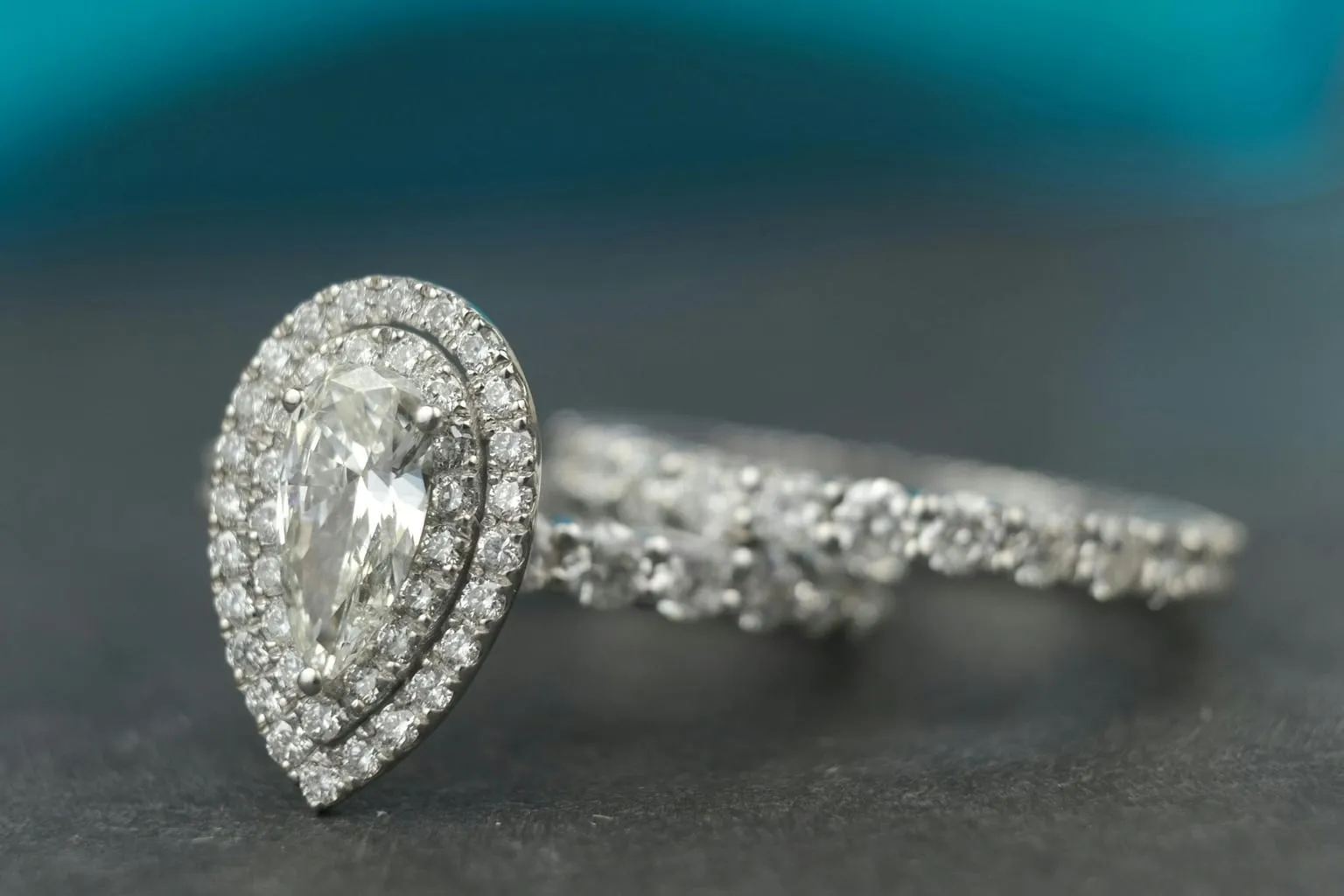
Pear shaped engagement rings put a teardrop diamond in the center: round at one end, pointed at the other. The point is what to shop around, because GIA calls it the most vulnerable part of the stone. Below are five pear rings in five settings, a plain solitaire, a claw-prong solitaire, a hidden halo, a full halo and a three-stone, each priced on 2 October 2026 with the same 1.02 carat lab-grown pear, from 1,220 dollars to 2,550 dollars as finished rings. All five come from Rare Carat, so read this as five ways to set a pear with one ring you can buy for each, not a ranking of every jeweler.
How we are paid. RingReel earns a commission from Rare Carat through the Awin network when you buy through a Rare Carat link on this page, at no cost to you. The picks come from the listings and terms below, not from who pays. Nothing here was bought or handled: it is researched, not tested.
What is on this page12 sections
Our Top Picks
- Our top pick
Best overall
Rare Carat Windy Solitaire Engagement Ring With 1.02 Carat Pear Lab Diamond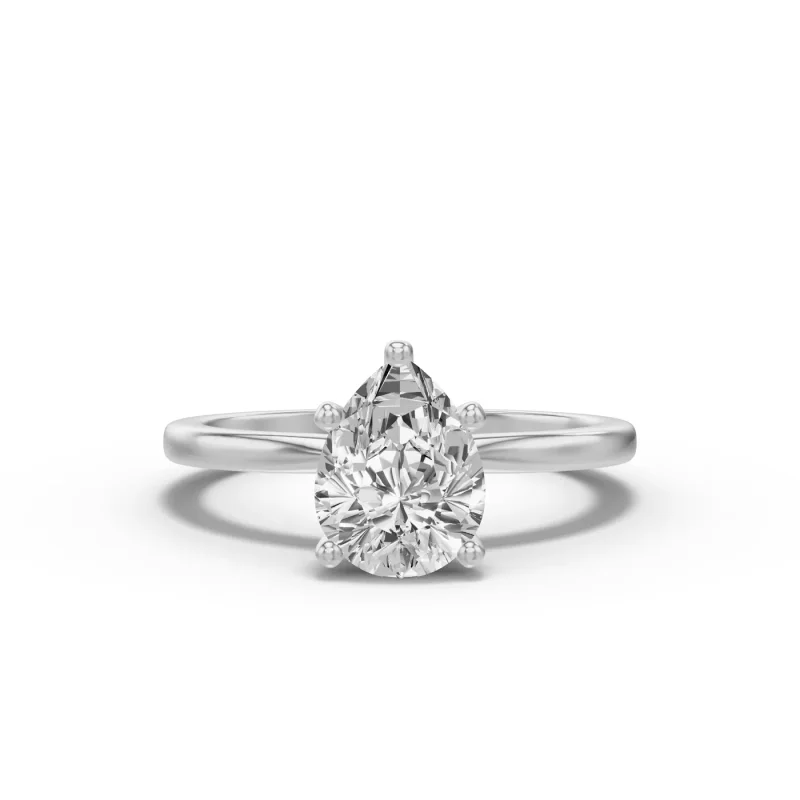
A buyer who wants a plain pear solitaire, finished and set, at the lowest price of the five.
- 14K white gold; 1.02 ct pear lab-grown diamond
- $1,220
Best for a V-shaped band
Rare Carat Bellora Solitaire Engagement Ring With 1.02 Carat Pear Lab Diamond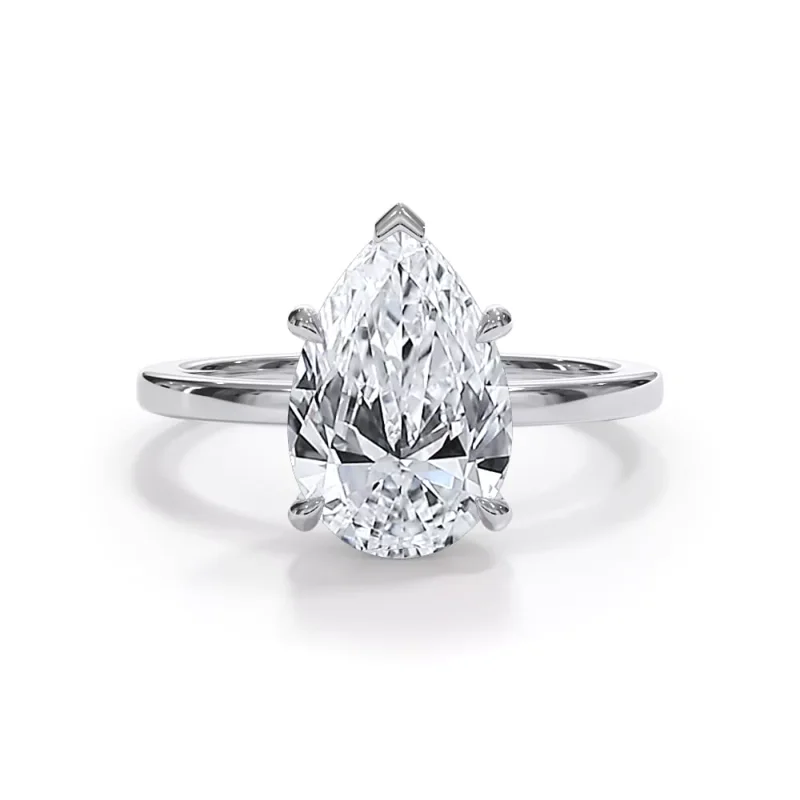
A buyer who wants a pear solitaire with a V-shaped wedding band made for it.
- 14K white gold; 1.02 ct pear lab-grown diamond
- $1,510
Best hidden halo
Rare Carat Marie Classic Hidden Halo Lab Pavé Engagement Ring With 1.02 Carat Pear Lab Diamond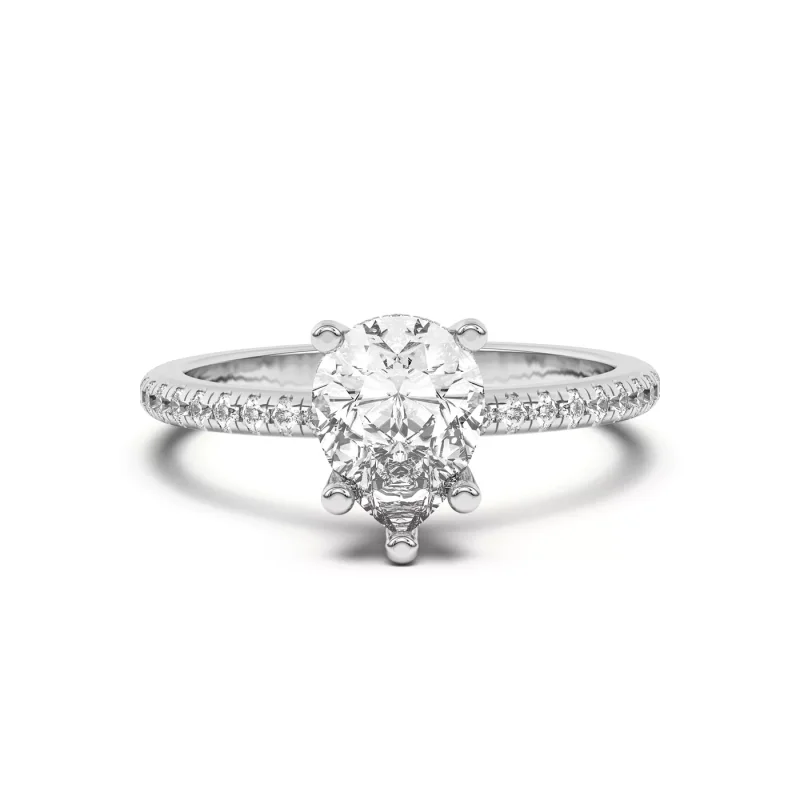
A buyer who wants extra sparkle without a visible halo changing the pear's outline.
- 14K white gold; 1.02 ct pear lab-grown diamond with lab pavé diamonds
- $1,230
Best halo
Rare Carat Sue Timeless Halo Engagement Ring With 1.02 Carat Pear Lab Diamond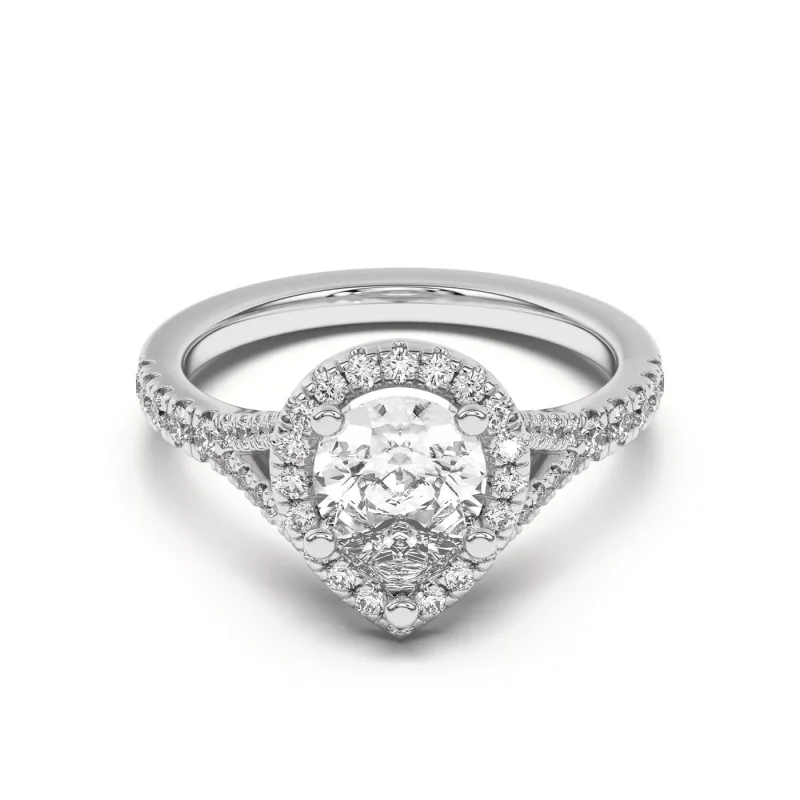
A buyer who wants the pear to read as large as possible from across a room.
- 14K white gold; 1.02 ct pear lab-grown diamond with a pavé halo and pavé shank
- $2,550
Best three-stone
Rare Carat Madison Three-Stone Lab Pear Engagement Ring With 1.02 Carat Pear Lab Diamond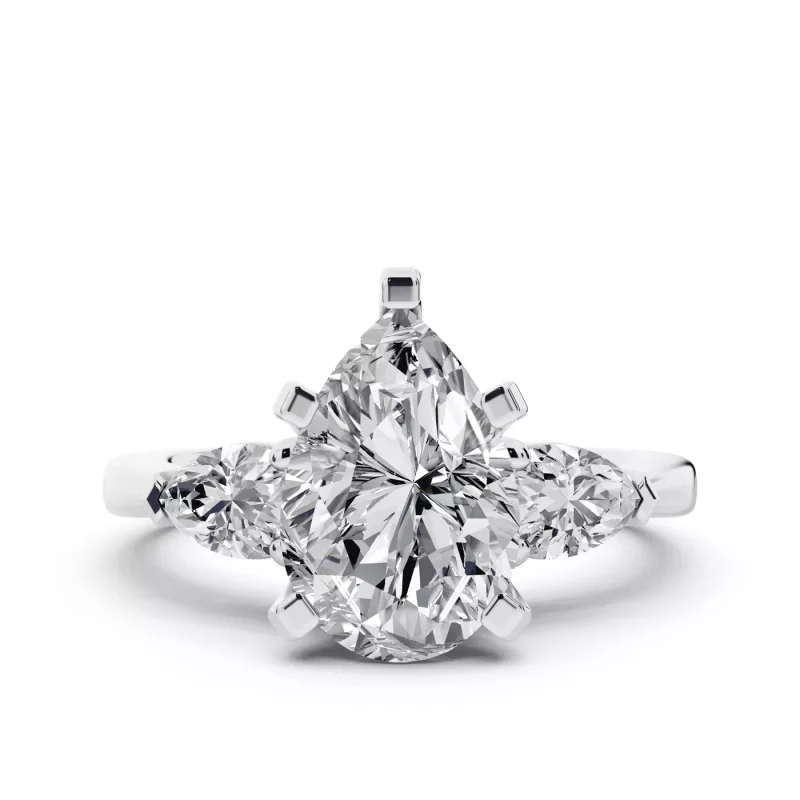
A buyer who wants the pear repeated in the side stones rather than a solitaire.
- 14K white gold; 1.02 ct pear lab-grown diamond with two pear lab diamond side stones
- $1,835
What is on this page12 sections
Key Takeaways
- As finished rings in 14K white gold with a 1.02 carat pear lab diamond, H color and VS1 clarity, the five picks ran from 1,220 to 2,550 dollars on 2 October 2026.
- At Rare Carat the setting price does not change with the shape. With a 1 carat round lab diamond instead, every one of the five cost exactly 40 dollars less, because the round stone it paired was 395 dollars against 435 for the pear.
- With natural diamonds the order flips: the same Windy setting cost 3,790 dollars with a 1.01 carat natural pear and 4,290 dollars with a 1.03 carat natural round, both D color and VS1.
- GIA says a pear’s point is protected by a V-prong on the tip or a bezel around the whole stone. None of the five listings says which it uses; one names claw prongs, and the photos show a prong at the tip.
- For about the same weight, the pear measured 9.43 mm long, against 6.46 mm across for the round and 7.87 mm long for an oval.
Pear Shaped Engagement Rings Compared
Every price below is what the listing showed on 2 October 2026 in 14K white gold, as a complete ring with the center stone set. Each setting is also sold alone, and the setting share of each price is in its review.
| Ring | Price range | Style | Stones | How the point is held, per the listing | Complete ring or setting | Returns and resizing, per Rare Carat |
|---|---|---|---|---|---|---|
| $1,220 | Solitaire: one pear on a slim tapering band | A 1.02 carat pear lab-grown diamond, H color, VS1 clarity, 9.43 x 5.58 mm, length-to-width ratio 1.69 | Not stated in the text; the listing photo shows a single prong at the tip | Complete ring as priced; the setting is also sold alone | 30 days from shipment for a full refund; one free resize in the first year, after which it cannot be returned | |
Rare Carat Bellora Solitaire Engagement Ring With 1.02 Carat Pear Lab DiamondBest for a V-shaped band | $1,510 | Solitaire with claw prongs and a gallery basket | A 1.02 carat pear lab-grown diamond, H color, VS1 clarity, 9.43 x 5.58 mm, length-to-width ratio 1.69 | Claw prongs named, but not which one holds the tip or its shape | Complete ring as priced; the setting is also sold alone | 30 days from shipment for a full refund; one free resize in the first year, after which it cannot be returned |
| $1,230 | Hidden halo under the stone, pavé on the band | A 1.02 carat pear lab-grown diamond, H color, VS1 clarity, plus lab pavé and hidden-halo diamonds listed at 0.25 carat in total as priced | Not stated | Complete ring as priced; the setting is also sold alone | 30 days from shipment for a full refund; one free resize in the first year, after which it cannot be returned | |
| $2,550 | Halo: a ring of pavé around the pear, on a split cathedral shank | A 1.02 carat pear lab-grown diamond, H color, VS1 clarity, plus a pavé halo and pavé shank whose total weight is not stated | Not stated; the halo surrounds the tip | Complete ring as priced; the setting is also sold alone | 30 days from shipment for a full refund; one free resize in the first year, after which it cannot be returned | |
| $1,835 | Three-stone: a pear center between two smaller pears | A 1.02 carat pear lab-grown diamond, H color, VS1 clarity, plus two pear side diamonds of 0.50 carat in total as priced | Not stated | Complete ring as priced; the setting is also sold alone | 30 days from shipment for a full refund; one free resize in the first year, after which it cannot be returned |
Price ranges from the makers' sites, checked 2 October 2026. Prices change; the maker's site has the current one.
The Best Pear Shaped Engagement Rings, Reviewed
Best overall
Rare Carat Windy Solitaire Engagement Ring With 1.02 Carat Pear Lab Diamond
by Rare Carat
Best for: A buyer who wants a plain pear solitaire, finished and set, at the lowest price of the five.
Rare Carat describes "a softly rounded band" that "gently tapers toward the center stone", 1.40mm wide as priced with a 2.5mm option, and the same setting cost 1,180 dollars with a 1 carat round on the same day.
What we like
- The lowest-priced complete ring of the five, with the stone's grades and measurements on the page
- A slim band keeps the eye on the pear's outline
- The earliest delivery date of the five picks when we looked: Friday, 9 October
Keep in mind
- The text never says how the point is held; only the photo shows a prong at the tip
- The matching band offered is a shared-prong eternity band, which Rare Carat says cannot be resized after 30 days
- A 1.40mm band can look thin under a 9.43mm stone
- Price range
- $1,220 complete: $785 for the setting and $435 for the 1.02 ct pear lab diamond, 14K white gold (checked 2026-10-02)
- Material
- 14K white gold; 1.02 ct pear lab-grown diamond
- Widths
- 1.40mm or 2.5mm
- Sizes
- 3.0 to 10.0
- Guarantee
- Returns within 30 days of shipment; one free resize in year one, per Rare Carat
- Made in
- Handcrafted in the USA, per Rare Carat
Best for a V-shaped band
Rare Carat Bellora Solitaire Engagement Ring With 1.02 Carat Pear Lab Diamond
by Rare Carat
Best for: A buyer who wants a pear solitaire with a V-shaped wedding band made for it.
The only one of the five listings that names its prongs: "Slender claw prongs hold the center stone tightly without taking up its outline", and the band it is sold with is a chevron.
What we like
- The matching band is the Bellora Chevron Pavé Band at 1,190 dollars, a V shape that frames the pear's point
- The listing names claw prongs, more than any other pick here says about how the stone is held
- A 2mm band option for a sturdier look under the stone
Keep in mind
- About 290 dollars more than the Windy for another plain solitaire
- The chevron band costs more than the setting it matches
- The latest quoted delivery of the five, Friday, 16 October, shared with two others
- Price range
- $1,510 complete: $1,075 for the setting and $435 for the 1.02 ct pear lab diamond, 14K white gold (checked 2026-10-02)
- Material
- 14K white gold; 1.02 ct pear lab-grown diamond
- Widths
- 1.6mm or 2mm
- Sizes
- 3.0 to 10.0
- Guarantee
- Returns within 30 days of shipment; one free resize in year one, per Rare Carat
- Made in
- Handcrafted in the USA, per Rare Carat
Best hidden halo
Rare Carat Marie Classic Hidden Halo Lab Pavé Engagement Ring With 1.02 Carat Pear Lab Diamond
by Rare Carat
Best for: A buyer who wants extra sparkle without a visible halo changing the pear's outline.
Rare Carat says "a delicate hidden halo adds subtle brilliance beneath the center stone", so the pear keeps a clean outline from above, and the side diamonds can be raised to 0.40 or 0.50 carat.
What we like
- Only 10 dollars more than the plainest solitaire here, with pavé and a hidden halo added
- The halo sits under the stone, so the teardrop outline reads clean from above
- The side diamond weight can be chosen on the page
Keep in mind
- The listing does not say how the point is held
- The page gives only the total weight of the small diamonds, not their count or grades
- The suggested band is a shared-prong eternity band, which Rare Carat will not resize after 30 days
- Price range
- $1,230 complete: $795 for the setting and $435 for the 1.02 ct pear lab diamond, 14K white gold (checked 2026-10-02)
- Material
- 14K white gold; 1.02 ct pear lab-grown diamond with lab pavé diamonds
- Widths
- 1.5mm
- Sizes
- 3.0 to 10.0
- Guarantee
- Returns within 30 days of shipment; one free resize in year one, per Rare Carat
- Made in
- Handcrafted in the USA, per Rare Carat
Best halo
Rare Carat Sue Timeless Halo Engagement Ring With 1.02 Carat Pear Lab Diamond
by Rare Carat
Best for: A buyer who wants the pear to read as large as possible from across a room.
Pavé diamonds run up "the subtle split-shank, ascending in a cathedral design towards the halo", and Rare Carat says the halo makes the center stone "look noticeably larger".
What we like
- In the listing photo the halo follows the teardrop outline, point included
- A matching Sue Curved Pavé Band is sold for it at 635 dollars
- Rare Carat says the split in the band "gives the ring more dimension and a sleeker shoulder"
Keep in mind
- The most expensive pick by far: the setting alone is 2,115 dollars
- The listing gives no weight or count for the halo and shank diamonds
- A halo is not one of the two protections GIA names for the point, V-prong or bezel
- Price range
- $2,550 complete: $2,115 for the setting and $435 for the 1.02 ct pear lab diamond, 14K white gold (checked 2026-10-02)
- Material
- 14K white gold; 1.02 ct pear lab-grown diamond with a pavé halo and pavé shank
- Widths
- 1.6mm
- Sizes
- 3.0 to 10.0
- Guarantee
- Returns within 30 days of shipment; one free resize in year one, per Rare Carat
- Made in
- Handcrafted in the USA, per Rare Carat
Best three-stone
Rare Carat Madison Three-Stone Lab Pear Engagement Ring With 1.02 Carat Pear Lab Diamond
by Rare Carat
Best for: A buyer who wants the pear repeated in the side stones rather than a solitaire.
"Two pear-shaped diamonds are selected to match in cut and color", and the side stones can be set from 0.10 to 1 carat in total, which moves the setting price.
What we like
- The only pick here built around pears from end to end
- A Madison Lab Curved Pavé Band is sold to sit against it, at 895 dollars
- Side stone weight is a choice on the page, from 0.10 to 1 carat in total
Keep in mind
- Three points to protect instead of one, and the listing describes none of them
- The setting alone is 1,400 dollars, the second highest of the five
- Side stones change the outline a wedding band has to meet, which is why a curved band is offered with it
- Price range
- $1,835 complete: $1,400 for the setting and $435 for the 1.02 ct pear lab diamond, 14K white gold (checked 2026-10-02)
- Material
- 14K white gold; 1.02 ct pear lab-grown diamond with two pear lab diamond side stones
- Widths
- 1.9mm to 3.9mm
- Sizes
- 3.0 to 10.0
- Guarantee
- Returns within 30 days of shipment; one free resize in year one, per Rare Carat
- Made in
- Handcrafted in the USA, per Rare Carat
How We Chose
- Five settings, one ring each. The page is built around the ways a pear is usually set, with a single example of each that we could open, price and link to on the day.
- One jeweler, and we say so. Every pick is from Rare Carat, the only jeweler on this page whose affiliate program has accepted RingReel so far. Other stores sell pear rings too; they are not ranked below Rare Carat, they are simply not listed yet.
- The same stone in every ring. Each listing opened with the same 1.02 carat pear lab diamond, so the price gaps between the five are the settings and nothing else.
- The point, read on every page. We searched each listing for what it says about the prong or rim at the tip, because that is the question GIA puts first for this shape.
- Terms from Rare Carat’s own policy pages, read the same day: returns within 30 days of shipment and one free resize in the first year.
The Point Is the Weak Spot
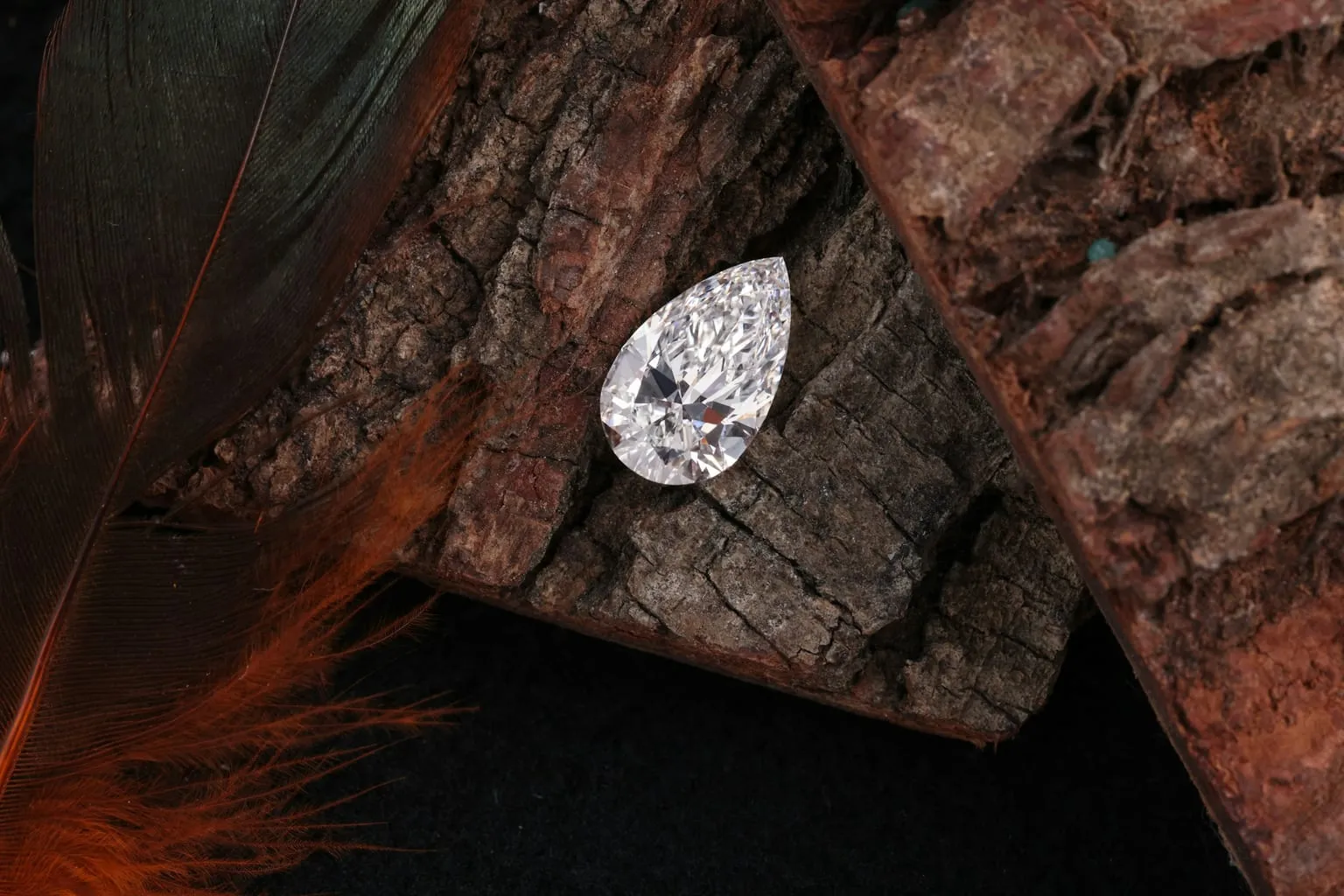
GIA describes the pear as blending “the best of the round and marquise diamond shapes”. The rounded end is easy to live with; the pointed end is the part a door frame finds first.
What GIA Says Protects It
GIA’s guide to choosing a pear is direct: “The most vulnerable part of a pear shaped diamond is the point. This area can be protected by placing a V-prong on the point or choosing a bezel setting around the entire stone.” Its settings guide adds that V-shaped prongs “are designed to protect pointed corners and are commonly used for shapes such as heart, princess, pear and marquise cuts.” The same pear guide also asks you to check the stone itself, noting whether it has inclusions “especially near its point”. If you want the whole outline wrapped in metal, our bezel setting guide covers the trade-off.
What the Five Listings Say
We read each product page for any word about the tip. This is what we found on 2 October 2026:
| Ring | What the text says about the point | What the main photo shows |
|---|---|---|
| Windy Solitaire | Nothing | A single prong at the tip |
| Bellora Solitaire | “Slender claw prongs”, no detail on the tip | A single prong at the tip |
| Marie Hidden Halo | Nothing | A single prong at the tip |
| Sue Halo | Nothing | A halo of small diamonds around the whole outline |
| Madison Three-Stone | Nothing | A single prong at the tip of the center pear |
No listing uses the words V-prong or bezel, and none of these settings is a bezel. A prong at the tip is visible in four of the five photos, but a photo at that size does not show whether it is V-shaped. That is not proof the prong is weak; it means the listing leaves the question to you.
Ask Before You Order
Every setting page offers a chat with a gemologist, and lists “Can I change the prongs?” among its suggested questions. Ask two things before paying: whether the prong at the tip is a V-prong, and whether it can be changed to one if not. Get the answer in writing. Our guide to engagement ring settings explains the other prong styles you may be offered.
Pear vs Round: What the Same Setting Costs
The pear is often sold as the cheaper shape. At Rare Carat on 2 October 2026 that depended entirely on whether the diamond was lab-grown or natural.
| Setting, 14K white gold | With the 1.02 ct pear lab diamond | With a 1 ct round lab diamond | Difference |
|---|---|---|---|
| Windy Solitaire | 1,220 dollars | 1,180 dollars | Pear 40 dollars more |
| Marie Hidden Halo | 1,230 dollars | 1,190 dollars | Pear 40 dollars more |
| Bellora Solitaire | 1,510 dollars | 1,470 dollars | Pear 40 dollars more |
| Madison Three-Stone | 1,835 dollars | 1,795 dollars | Pear 40 dollars more |
| Sue Halo | 2,550 dollars | 2,510 dollars | Pear 40 dollars more |
Lab-Grown: The Pear Costs a Little More
Every setting kept its price when we swapped the shape. The whole gap was the stone: 435 dollars for the 1.02 carat pear, 395 dollars for the 1 carat round, both H color and VS1 clarity. Per carat, the pear came out about 8% higher. If you are choosing between lab-grown and natural diamonds, that is the first thing to know: on lab stones, the pear is no bargain.
Natural: The Pear Costs Less
On natural stones the Windy setting told a different story. A 1.01 carat natural pear, D color and VS1, was 3,005 dollars as the stone; a 1.03 carat natural round with the same grades was 3,505 dollars. Per carat, the pear was about 13% cheaper. Two stones are not a market, so treat this as one day’s comparison at one store, not a rule.
What the Money Buys on the Finger
The pear is longer than a round of the same weight. The 1.02 carat lab pear measured 9.43 by 5.58 mm; the 1 carat round was 6.46 mm across. GIA’s shapes guide says elongated shapes like oval, marquise or pear “can give the illusion of greater size compared to a round diamond of the same carat weight”, and an earlier GIA article says their “north-south axis” can “accentuate the length of the finger”. Our guide to engagement ring shapes compares the pear with every other cut.
Choosing the Pear Itself
The setting is half the ring. The other half is the stone, and GIA gives three checks for a pear.
Length-to-Width Ratio
GIA writes that many experts prefer a length-to-width ratio of about 1.50 to 1.75 to 1, while “others in the trade believe that a ratio isn’t enough to convey a diamond’s beauty.” The lab pear in all five picks listed 1.69, and the natural one 1.57; both sit inside that range. A higher number reads slimmer and longer on the hand.
The Bow-Tie
“Many pear shaped diamonds show a dark pattern that resembles a bow-tie,” GIA says, and “the darker or larger it is, the more it detracts from the face-up appearance.” It adds that the bow-tie gets darker as the difference between length and width grows. Rare Carat’s pages include a video of the stone; turn it before you buy, because a still photo can hide a bow-tie.
Symmetry and the Table
GIA’s graders look for “a balanced and even outline” on fancy shapes, and it names high shoulders, flat or bulged wings and undefined points as faults. Hold the two halves of the stone against each other in the video. If one side looks fuller, the stone is not symmetrical.
Pear Engagement Ring Settings, Side by Side
A pear engagement ring can be set in most of the settings sold for rounds; the five picks cover the common ones.
Solitaire
A solitaire shows the teardrop outline with nothing around it. The Windy and Bellora picks are both solitaires, and the difference between them is the band and the 290 dollars. If the pear is going on a long, slender hand, our page on engagement rings for long fingers covers why elongated stones are recommended there.
Halo and Hidden Halo
A full halo, like the Sue, traces the whole teardrop in small diamonds and widens the face of the ring. A hidden halo, like the Marie, sits under the stone and shows only from the side, so from above the ring still reads as a solitaire. Neither replaces a V-prong in GIA’s account of what protects the point.
Three-Stone
The Madison sets the pear between two smaller matched pears. That is a three-stone ring, not a toi et moi, which pairs two main stones side by side; our toi et moi guide covers that style, including the pear-and-oval pairing.
The Wedding Band for a Pear
A straight band can leave a wedge of space beside a pear. All five listings suggested a band to go with the ring: a chevron for the Bellora, curved pavé bands for the Sue and the Madison, and straight shared-prong eternity bands for the Windy and the Marie. Rare Carat’s resizing policy says eternity bands “aren’t eligible for resizing after 30 days”, so settle the size first with our printable ring sizer. For curved, V-shaped and open bands from several makers, see our guide to wedding bands for pear shaped engagement rings.
Rare Carat resizes a ring once for free in the first year, but its policy says an item sent in for resizing “can’t be returned”. The free resize and the 30-day return are one or the other. Returns run 30 days from the shipment date, unworn and with the diamond certificate, which carries a 250 dollar fee if lost. Our Rare Carat review goes through those terms.
Which Pear Shaped Engagement Ring Fits You?
| Your situation | Our pick | Why |
|---|---|---|
| You want a plain pear solitaire for the least money | Windy Solitaire | 1,220 dollars complete, the lowest of the five |
| You want a V-shaped band made for the ring | Bellora Solitaire | Sold with a chevron band, and the only listing that names its prongs |
| You want sparkle without changing the outline | Marie Hidden Halo | The halo sits under the stone; 1,230 dollars complete |
| You want the pear to look as large as possible | Sue Halo | A full halo around the teardrop, at 2,550 dollars |
| You want pears in the side stones too | Madison Three-Stone | Two matched pear side diamonds |
| You want the point fully enclosed in metal | A bezel setting | None of the five is one; our bezel setting guide explains the option |
If the budget is the starting point, our pages on affordable engagement rings and engagement rings under $1,000 price complete rings at those levels. For a stone other than a white diamond, see our unique engagement rings page.
Frequently Asked Questions
What Does a Pear Ring Signify?
A pear has no official meaning, but GIA describes it in poetic terms. Its guide says a pear shaped diamond “conveys both the delicacy of a single tear and the strength of the brightest star”, and calls it reminiscent of a teardrop. Any symbolism beyond that comes from the people wearing it, not from a standard.
Are Pear Cut Diamonds Cheaper?
Pear cut diamonds can be cheaper, but not always. On 2 October 2026 a natural 1.01 carat pear at Rare Carat cost about 13% less per carat than a natural round of the same grades. Among lab-grown stones it was the other way round: the pear cost slightly more per carat than the round.
Do Oval or Pear Diamonds Look Bigger?
For the same weight, the pear we measured was longer. In the Windy setting on 2 October 2026, a 1.02 carat lab pear measured 9.43 by 5.58 mm, and a 1.02 carat lab oval 7.87 by 5.40 mm. The pear covered more length and slightly more width, and its stone cost 25 dollars less.
Are Pear Engagement Rings Trendy?
Pear rings are popular without being the most common choice. The Knot’s 2026 Real Weddings Study, as reported by Rapaport, found pear stones in 8% of engagement rings, level with emerald, princess and marquise. Round led at 26% and oval at 25%, so a pear stands out more than either.
How Much Is a 2 Carat Pear-Shaped Diamond Worth?
It depends far more on lab-grown versus natural than on shape. On 2 October 2026, Rare Carat listed a 2.06 carat lab-grown pear, H color and VS1, at 1,130 dollars, and a 2.03 carat natural pear with the same grades at 10,965 dollars. Those are asking prices for two stones, not appraisals.
Sources
- Rare Carat, Windy Solitaire Engagement Ring With 1.02 Carat Pear Lab Diamond, 14K white gold, with the round, oval, natural and 2 carat versions of the same setting, accessed 02/10/2026.
- Rare Carat, Bellora Solitaire Engagement Ring With 1.02 Carat Pear Lab Diamond, 14K white gold, accessed 02/10/2026.
- Rare Carat, Marie Classic Hidden Halo Lab Pavé Engagement Ring With 1.02 Carat Pear Lab Diamond, 14K white gold, accessed 02/10/2026.
- Rare Carat, Sue Timeless Halo Engagement Ring With 1.02 Carat Pear Lab Diamond, 14K white gold, accessed 02/10/2026.
- Rare Carat, Madison Three-Stone Lab Pear Engagement Ring With 1.02 Carat Pear Lab Diamond, 14K white gold, accessed 02/10/2026.
- Rare Carat, Pear Cut Lab Grown Diamond Engagement Rings and Pear Cut Natural Diamond Engagement Rings, category pages, accessed 02/10/2026.
- Rare Carat, 30-Day Returns and Ring Resizing Policy, undated, accessed 02/10/2026.
- GIA 4Cs, Pear Shaped Diamond: Tips for Picking the Perfect One, 2018, accessed 02/10/2026.
- GIA 4Cs, Complete Guide to Engagement Ring Settings: Types vs. Styles, 2026, accessed 02/10/2026.
- GIA 4Cs, Guide to Diamond Engagement Ring Shapes, 2025, accessed 02/10/2026.
- GIA 4Cs, Engagement Ring Styles to Flatter Every Finger Type, 2017, accessed 02/10/2026.
- Rapaport News, Leah Meirovich, Lab-Grown “Taking Over” Engagement-Ring Spending: The Knot, 2026, accessed 02/10/2026.