

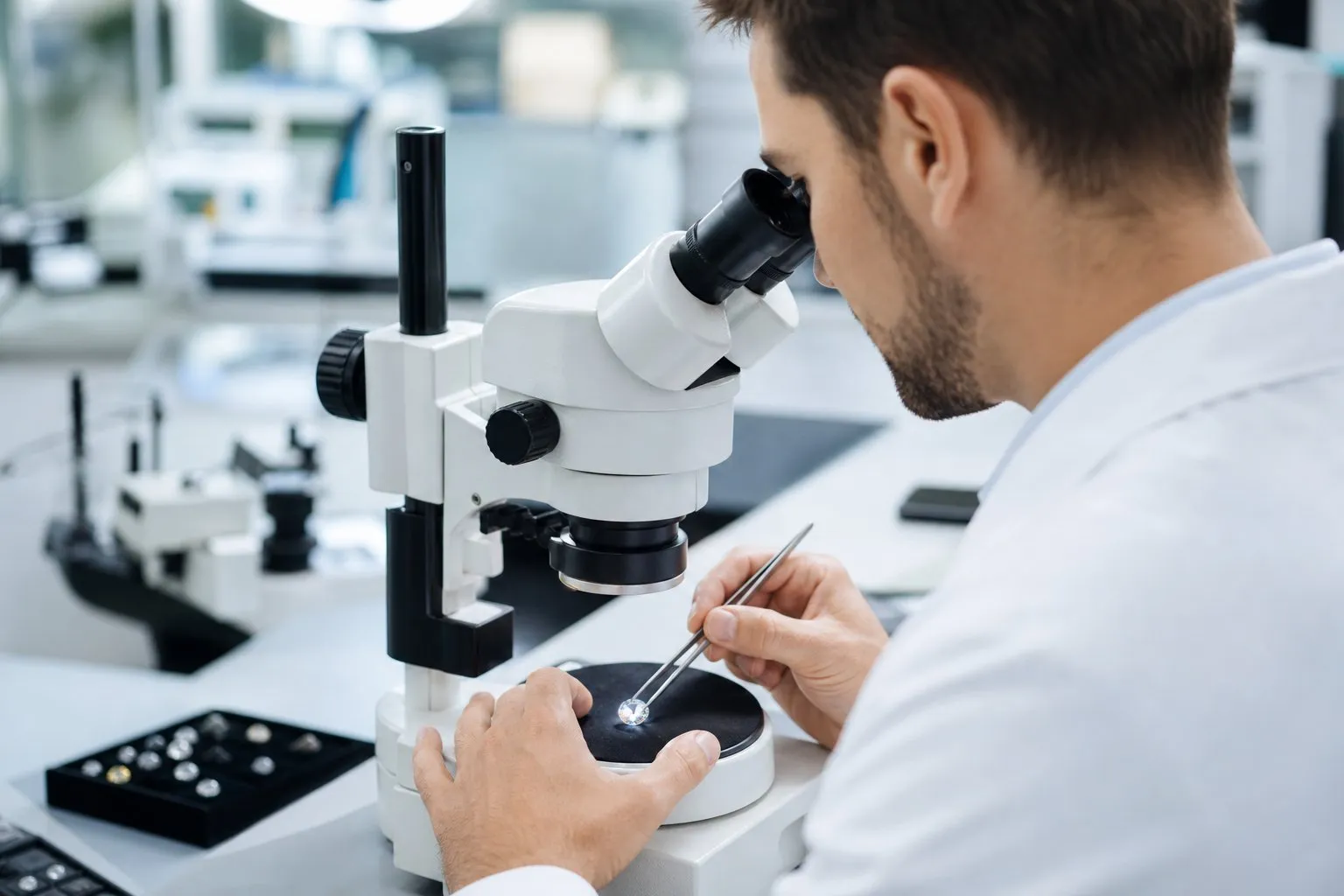
A lab grown diamond and a natural diamond are the same material. The Federal Trade Commission removed the word “natural” from its definition of diamond in the 2018 Federal Register notice, and GIA states that lab-grown diamonds have essentially the same chemical composition and crystal structure as mined stones. Comparing lab grown vs natural diamond, the material is identical; what differs is where the stone came from, how it gets graded, what it costs, and what it holds later.
That last part matters more than most couples expect. A stone that looks the same across a counter can follow a very different path once it leaves the store, and the grading system behind each one changed significantly in late 2025.
This guide walks through how each type is made, how labs separate them, what couples actually paid in recent survey data, and how to weigh the tradeoffs for your own ring.
What is on this page12 sections
Key Takeaways
- In 2018 the FTC removed the word “natural” from its definition of diamond, because lab-created stones with essentially the same optical, physical and chemical properties are also diamonds (Federal Register, 2018).
- FTC guidance still requires sellers to disclose that a lab-grown diamond is not mined, and treats words like “real,” “genuine” and “natural” as deceptive for products made artificially. What those rules require a budget listing to say, section by section, is in cheap engagement rings that are real.
- Since October 1, 2025, GIA describes lab-grown diamonds as “Premium” or “Standard” instead of using the color and clarity scales it built for natural diamonds.
- Colorless lab-grown diamonds are type II, while only about 1% of natural diamonds are, which is where a lab starts screening a stone (GIA, Gems & Gemology, 2024).
- Wholesale lab-grown diamond prices have fallen sharply and steadily since 2018 (Edahn Golan, Q2 2026 LGD Wholesale Price List).
Are Lab Grown Diamonds Real?
Yes. Lab grown diamonds are real diamonds: the FTC’s definition of a diamond, essentially pure carbon crystallized in the isometric system with a hardness of 10, says nothing about where the stone formed, and the FTC took the word “natural” out of that definition in 2018 for exactly that reason. A lab-grown stone is carbon crystallized in the same structure as a mined one, with the same hardness and optical behavior. What it is not is a simulant: moissanite and cubic zirconia look like diamonds but are different materials, which our guide to moissanite vs diamond explains.
The one word that trips people up is “real” itself. The same FTC guidance that calls a lab-grown stone a diamond treats “real,” “genuine” and “natural” as deceptive when a seller uses them for a stone made in a laboratory, so a lab-grown diamond is real as a material and still has to be sold as laboratory-grown. The rest of this section shows how the regulator and the grading lab draw that line.
What the FTC Says
The Federal Trade Commission defines a diamond as essentially pure carbon crystallized in the isometric system, with a hardness of 10, a specific gravity of about 3.52 and a refractive index of 2.42. Notice what is missing from that list: origin.
In 2018 the FTC removed the word “natural” from its diamond definition, explaining that lab-created stones with essentially the same properties are also diamonds2. The revised Jewelry Guides were approved in July 2018 by a 5-0 vote and covered both that definition and the use of “cultured.”
The Jewelry Guides are marketing guidance, not a product ban or a court ruling, and the definition describes the stone itself, not the setting or the metal around it.
What GIA Says
GIA states that lab-grown diamonds are real diamonds, with essentially the same chemical composition and crystal structure as mined ones, and that they look the same to the unaided eye. GIA compares the two to glacier ice and refrigerator ice: different origins, but “they’re both ice.”
GIA has graded these stones since 2007, when it began issuing synthetic diamond grading reports, and dropped the term “synthetic” from its reports on July 1, 2019. It still draws a firm line on origin: since October 1, 2025, D-to-Z lab-grown diamonds submitted to GIA are assessed as Premium or Standard rather than given natural-diamond color and clarity grades, and the girdle is inscribed “Laboratory-Grown.”
So “real” describes the material, not the origin. A lab created vs natural diamond comparison is a question of how the crystal formed, not whether it counts as a diamond. If origin matters to you for ethical reasons, our guide to ethical engagement rings covers what “conflict-free”, recycled metal and lab-grown each actually certify.
The Words a Seller Has to Use
Disclosure is where the difference between lab grown and natural diamonds becomes a legal matter. Under FTC guidance, a lab-grown stone must be clearly disclosed as not mined:
- “Real,” “genuine” and “natural” are unfair or deceptive when used for an artificially produced product.
- “Cultured” is allowed only with a clear disclosure, such as “laboratory-grown,” “laboratory-created” or “[manufacturer name]-created.”
- “Faux” is not an adequate disclosure of lab origin.
Read the tag and the report together. If a listing calls a stone a diamond but never says how it was made, ask directly whether it was mined or grown, and which lab issued the report.
How Each Diamond Is Made
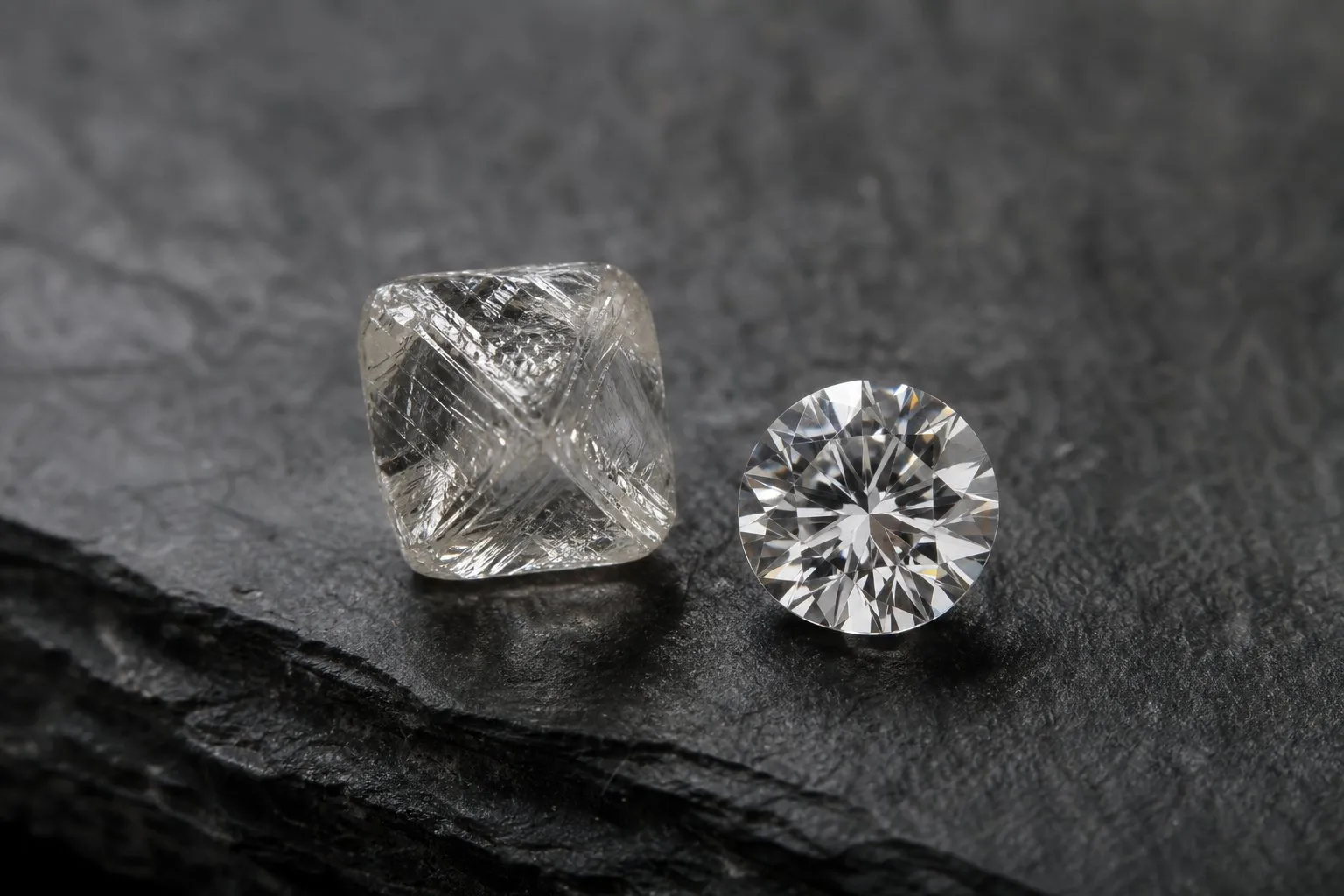
The difference between lab grown and natural diamonds starts with time and setting: one crystallizes deep in the earth over geological ages, the other in a machine over weeks. Two production methods dominate the lab side, and each leaves its own signature inside the finished stone.
Natural Diamonds: Billions of Years, About 100 Miles Down
Natural diamonds form roughly 100 miles below the surface, where carbon crystallizes under sustained heat and pressure, and are typically about 99.95% carbon (GIA, Diamond Description). Volcanic eruptions later carry that material toward the surface in kimberlite pipes, where it is mined.
A diamond you can wear is often three billion years or older, almost three quarters of the earth’s age, an age no synthetic diamond will ever match4.
HPHT: Heat and Pressure in a Press
High pressure, high temperature growth mimics mantle conditions inside a press. GIA describes a small diamond seed placed with a carbon source and a metal catalyst, then compressed and heated until carbon dissolves and crystallizes onto the seed.
Growth is fast by geological standards: GIA describes the process as taking a few days to a few weeks, depending on the size being grown. The metal catalyst is what often gives an hpht diamond away under a microscope, since metallic flux inclusions can remain trapped in the crystal.
CVD: Grown Layer by Layer From Gas
Chemical vapor deposition works at lower pressure. GIA describes a carbon-rich gas broken down in a chamber so carbon crystallizes onto a seed at 700°C to 1300°C, typically over four to six weeks.
Because the crystal builds up in flat layers, a cvd diamond can show layer-by-layer growth under deep-UV imaging. GIA notes that many CVD stones then receive HPHT treatment after growth to improve their color, which is one practical part of the cvd vs hpht distinction, and the reason a grading report should note the growth method.
Lab Grown vs Natural Diamond, Side by Side
The clearest way to see the difference between lab grown and natural diamonds is to put the sourced facts side by side.
| Natural diamond | Lab-grown diamond | Source | |
|---|---|---|---|
| Material | Essentially pure carbon crystallized in the isometric system | The same, when it has essentially the same optical, physical and chemical properties | FTC Jewelry Guides, 16 CFR 23.12 (2018 revision) |
| Hardness, specific gravity, refractive index | 10; about 3.52; 2.42 | Same definition | FTC Jewelry Guides, 16 CFR 23.12(a) |
| How it forms | High heat and pressure about 100 miles below the surface; often three billion years or older | HPHT press (a few days or weeks) or CVD from carbon gas (typically 4 to 6 weeks) | GIA |
| Nitrogen (diamond type) | About 1% are type II (no detectable nitrogen) | Colorless and near-colorless stones are all type II | GIA, Gems & Gemology (2024) |
| Words a seller may use | Diamond, mined diamond | Laboratory-grown, laboratory-created, [maker]-created, or “cultured” with that disclosure; not “real,” “genuine” or “natural” | FTC Jewelry Guides, 16 CFR 23.12(c)(3) and 23.27 |
| GIA grading | GIA color and clarity grades | “Premium” or “Standard” since October 1, 2025; below Standard gets no GIA assessment | GIA (2025) |
| Screening device result | “Pass” means natural | “Refer”, then laboratory testing (a “Refer” can also be natural) | GIA, Gems & Gemology (2024) |
| Average engagement ring, couples married in 2025 | $7,000 at 1.6 carats | $4,300 at 2 carats | The Knot 2026 study, via Rapaport |
The rows that differ are origin, grading, screening and price. The rows about the material itself, hardness, specific gravity and refractive index, are the same for both.
Can You Tell Them Apart?
Telling the two apart comes down to origin, not appearance, since both are carbon crystallized in the isometric system with the same hardness and optical properties. Separation happens in a laboratory setting, with instruments that read growth history rather than sparkle.
Not by Eye
GIA states that lab-grown and natural diamonds look the same to the unaided eye, so a loupe at the counter will not settle a lab grown vs real diamond question. If you are asking how to tell if a diamond is lab grown, or whether a jeweler can tell, the honest answer is that a trained gemologist without laboratory instruments usually cannot.
What a Gem Lab Looks For
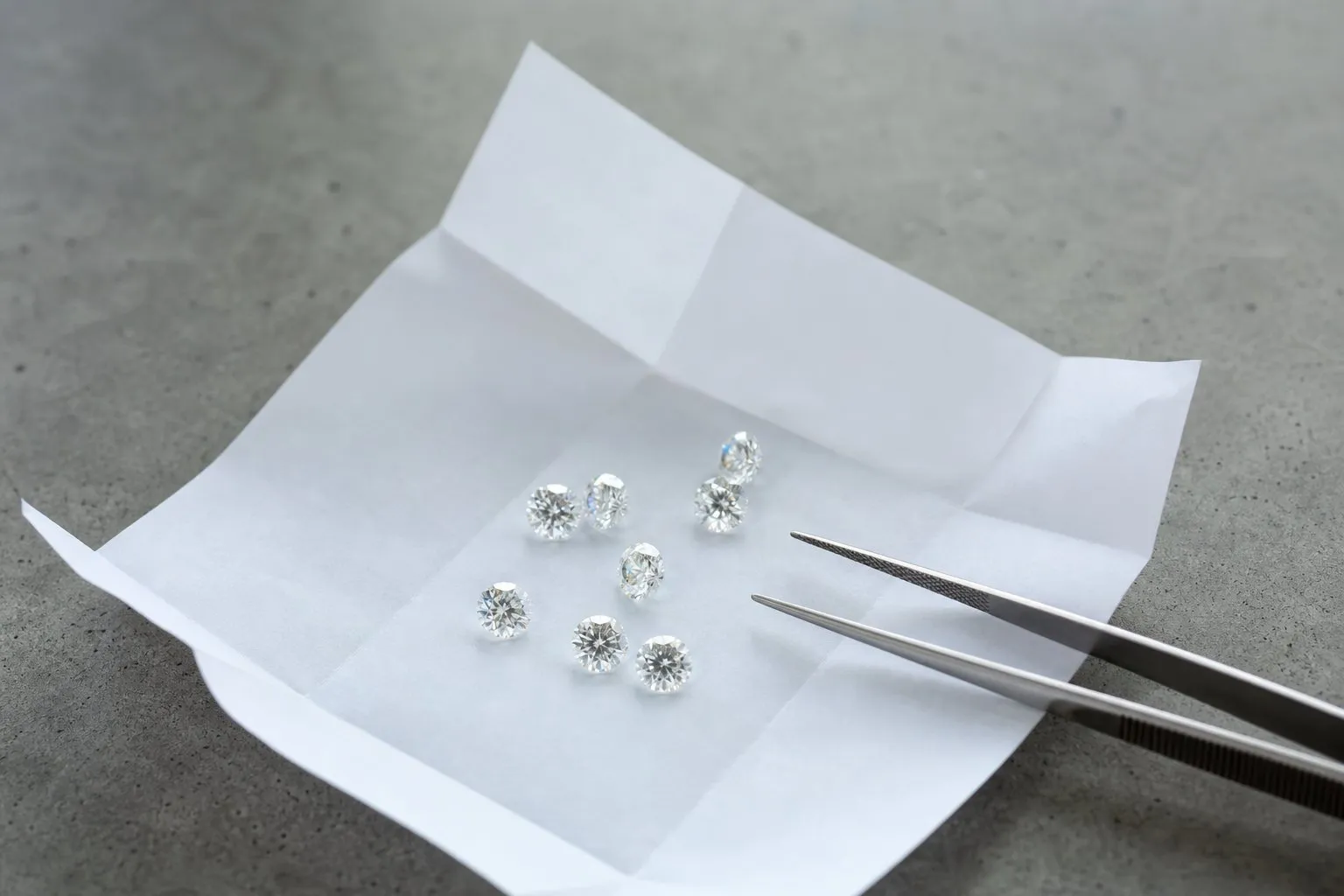
A lab works through a sequence rather than a single test. GIA describes examiners starting with inclusions, color zoning and graining, then moving to photoluminescence and deep-UV imaging.
Those images show growth patterns tied to how the crystal formed: CVD material reveals layer-by-layer growth, while HPHT stones can carry metallic flux inclusions instead, one practical part of telling cvd vs hpht apart. Colorless lab-grown diamonds are all type II, while natural type II stones are rare, which is where a lab starts4. The same research notes that colorless lab-grown and natural diamonds share many other properties, a real challenge for independent gemologists and appraisers working outside a full laboratory.
Screening Devices: Pass or Refer
Retail screening tools do not grade; they sort. According to GIA’s 2024 Gems & Gemology research, a Pass result means the stone is natural and needs no further testing, while a Refer result can be either natural or lab-grown and needs laboratory testing. No rapid screening tool identifies every lab-grown diamond, and some devices can pass a simulant as natural.
The GIA iD100 works this way: GIA describes it as separating natural diamonds from HPHT and CVD lab-grown diamonds and simulants, returning Pass or Refer, and testing mounted or loose stones from about 0.9mm, roughly 0.005 carat. A Refer result is not an accusation; it is a request for better equipment, most often a full lab report.
How Grading Differs Since 2025
Since October 1, 2025, GIA no longer applies its natural-diamond color and clarity scales to lab-grown stones: it assesses D-to-Z lab-grown diamonds as “Premium” or “Standard”, gives no assessment to stones below the Standard minimums, and inscribes “Laboratory-Grown” on the girdle4. A natural diamond keeps the familiar color and clarity grades, and what that change means for a lab stone still listed as VS1 or VS2 is in VS1 vs VS2. Whatever the lab, the report should name the stone as laboratory-grown and carry a number you can check on the lab’s own site. How GIA’s lab-grown report now compares with IGI’s, and why most online listings carry one or the other, is the subject of our guide to IGI vs GIA; which lab each store uses is compared in our guide to the best place to buy lab-grown diamonds.
Price: What Couples Paid for Each
The gap between the two categories is measurable, and it shows up in what couples actually spent last year.
Average Ring Spend by Stone Type
The Knot’s 2026 study, reported by Rapaport, found that couples married in 2025 spent about $4,300 on a 2 carat lab-grown center stone versus $7,000 on a 1.6 carat natural one, and you can see how that fits your own budget in what couples spend on an engagement ring.
Preference has shifted along with the price. The same study put lab-grown center stones at 61% of engagement rings, a 239% increase since 2020, and Rapaport notes that 2024 was the first year lab-grown passed 50% of purchases.
Why Lab-Grown Prices Keep Falling
Supply is the short answer. Growing capacity has expanded quickly, and wholesale prices have followed it down. Edahn Golan’s lab-grown wholesale price index fell 26% across 2025 and 13% year over year in the Q2 2026 list, and JCK reports Golan’s view that the steepest declines began to ease in 2024. These are wholesale figures, not retail tags and not resale offers.
Resale Value: The Difference That Lasts
The gap between what you pay and what you can recover later is where a lab grown diamond vs natural comparison stops being about looks. Lab-grown production can expand to meet demand and natural supply cannot, and Edahn Golan’s wholesale price index for lab-grown diamonds is down 96% since tracking began in July 2018 (Q2 2026 list), so a used lab stone competes with new ones made more cheaply. Whether that makes a lab-grown stone a poor buy, what stores offer at trade-in, and when the lower price still wins, is weighed in our guide to whether lab-grown diamonds are worth it.
Durability and Everyday Wear
Both stone types share the same crystal structure and the same hardness, so neither one scratches more easily in daily wear. What actually threatens a ring is chipping along an exposed edge, and that risk comes from the setting and your habits, not from origin.
The Same Hardness
The FTC defines a diamond as essentially pure carbon crystallized in the isometric system, with hardness 10, specific gravity about 3.52 and refractive index 2.42, and that definition applies equally to lab-grown stones. GIA notes diamond is so hard that only another diamond can scratch it.
These numbers describe the stone only. The metal holding it, whether platinum, palladium or gold, is far softer and will show scuffs long before the diamond does. Hardness is also not the same as toughness: a sharp knock at the wrong angle can still chip a girdle or a pointed corner on a marquise or pear cut, in either a lab-grown or natural stone.
Protecting Either Stone at Work
Since durability is a tie, the setting is what actually protects the stone. A low, enclosed style such as a bezel setting keeps the girdle covered and is less likely to catch on gloves or tools than a setting with raised prongs.
That matters most if your hands are busy all day. Our guide to rings nurses can wear on shift covers styles built for gloves and frequent handwashing, and if a nickel allergy is part of the decision, look for hypoallergenic metals in the band as well as the setting.
Which Should You Choose?
Both options are diamond under the FTC’s definition, so the choice comes down to budget, size, meaning and how you feel about resale. If the stone need not be a diamond at all, see sapphire engagement rings compared.
| Your situation | What points that way | Why |
|---|---|---|
| You want the biggest stone for your budget | Lab-grown | Couples married in 2025 got 2 carats for $4,300 on average vs 1.6 carats for $7,000 natural (The Knot, via Rapaport) |
| You may sell or trade the stone later | Natural, and keep the report | Lab-grown wholesale prices fell 96% from July 2018 to Q2 20261 |
| Geological age matters to you | Natural | A natural diamond is often three billion years or older2 |
| You want an independent grade | Either, with a lab report | GIA grades naturals on color and clarity, and lab-grown stones as Premium or Standard since October 2025 |
| You want to check a stone you already own | A gem lab, not a loupe | Screening devices give only Pass or Refer; a lab confirms origin3 |
| You work with your hands | Either, in a protective setting | Both are the same material, so the setting matters more than the origin |
3 sources cited in this table
Lab-grown buyers most often chose oval center stones in 2025, while natural buyers still favored round; our guide to engagement ring shapes compared walks through how each outline wears and photographs. Whichever you choose, buy with a report from a recognized lab, keep the paperwork, and ask the seller in writing whether the stone is mined or laboratory-grown.
Frequently Asked Questions
Buyers most often ask whether a lab-grown stone counts as a diamond, how a jeweler tells it apart from a mined one, and what happens to its value later. The answers below cover material identity, disclosure, detection, durability and GIA’s current grading.
Are Lab Grown Diamonds Real?
Yes, a lab grown diamond is a real diamond. The FTC defines a diamond by its material, essentially pure carbon crystallized in the isometric system with a hardness of 10, and removed the word “natural” from that definition in 2018. GIA says lab-grown and mined diamonds share essentially the same chemical composition and crystal structure. The seller must still disclose that the stone is laboratory-grown.
Are Lab Diamonds as Good as Real Diamonds?
Yes, lab diamonds match natural diamonds in the material properties that matter every day. GIA states both share essentially the same chemical composition and crystal structure and look identical to the unaided eye. The real differences are origin, grading language and price, not hardness or brilliance, and the FTC’s diamond definition covers both types equally.
Are Lab-Grown Diamonds Considered Fake?
No, a lab-grown diamond is not fake; a fake stone is a simulant such as cubic zirconia or moissanite. The FTC removed “natural” from its diamond definition in 2018 because lab-created stones share essentially the same properties as mined ones. Sellers must still disclose the lab origin, since FTC guidance treats “real” and “genuine” as deceptive for manufactured products.
Can a Jeweler Tell If a Diamond Is Lab-Grown?
Not reliably by eye alone; separating the two takes laboratory instruments. Screening devices return a Pass or Refer result, where Pass means natural and Refer requires further lab testing, according to GIA’s 2024 Gems & Gemology research. Labs then use photoluminescence and deep-UV imaging, and most graded lab-grown stones carry a laser-inscribed girdle confirming their origin.
What Is the Lifespan of a Lab Diamond?
A lab diamond wears the same way a mined one does, because it meets the same FTC diamond definition: hardness 10, specific gravity about 3.52 and refractive index 2.42. GIA notes that only another diamond can scratch a diamond. The realistic risk over the years is a chip at the girdle or a point from a hard knock, exactly as with a mined stone.
Did GIA Stop Grading Lab-Grown Diamonds?
No, GIA has not stopped assessing lab-grown diamonds. Since October 1, 2025, it grades D-to-Z lab-grown stones as Premium or Standard instead of using its natural-diamond color and clarity scales. Stones below Standard receive no GIA assessment, the girdle is inscribed “Laboratory-Grown,” and reports issued before the change remain valid.
Sources
- Federal Trade Commission, eCFR, 16 CFR Part 23, Guides for the Jewelry, Precious Metals, and Pewter Industries, 2018.
- Federal Trade Commission, Federal Register, Guides for the Jewelry, Precious Metals, and Pewter Industries, 2018.
- Federal Trade Commission, FTC Approves Final Revisions to Jewelry Guides, 2018.
- GIA, Laboratory-Grown Diamond Report (LGDR) by GIA, undated, accessed 10/09/2026.
- GIA, Gems & Gemology (Eaton-Magana, Hardman, Odake), Laboratory-Grown Diamonds: An Update on Identification and Products Evaluated at GIA, 2024.
- GIA, GIA iD100, undated, accessed 10/09/2026.
- GIA, GIA to Use New Descriptive Terminology for Laboratory-Grown Diamonds, 2025.
- GIA, GIA Launches Updated Laboratory-Grown Diamond Services October 1, 2025.
- GIA (Wayback Machine copy, 2025), Does GIA grade laboratory-grown diamonds?, undated, archived 2025, accessed 10/09/2026.
- GIA, Diamond Description, undated, accessed 10/09/2026.
- GIA, Gems & Gemology (Smit, Shirey), Diamonds from the Deep: How Old Are Diamonds? Are They Forever?, 2019.
- The Knot Worldwide, The Knot Worldwide Unveils 2026 Real Wedding Study, 2026.
- Rapaport News, Lab-Grown ‘Taking Over’ Engagement-Ring Spending: The Knot, 2026.
- Edahn Golan Diamond Research & Data, After a 96% Decline, What’s Next for Lab-Grown Diamond Prices?, 2026.
- JCK, Lab-Grown Diamond Prices Show Signs of Stabilizing, 2026.