

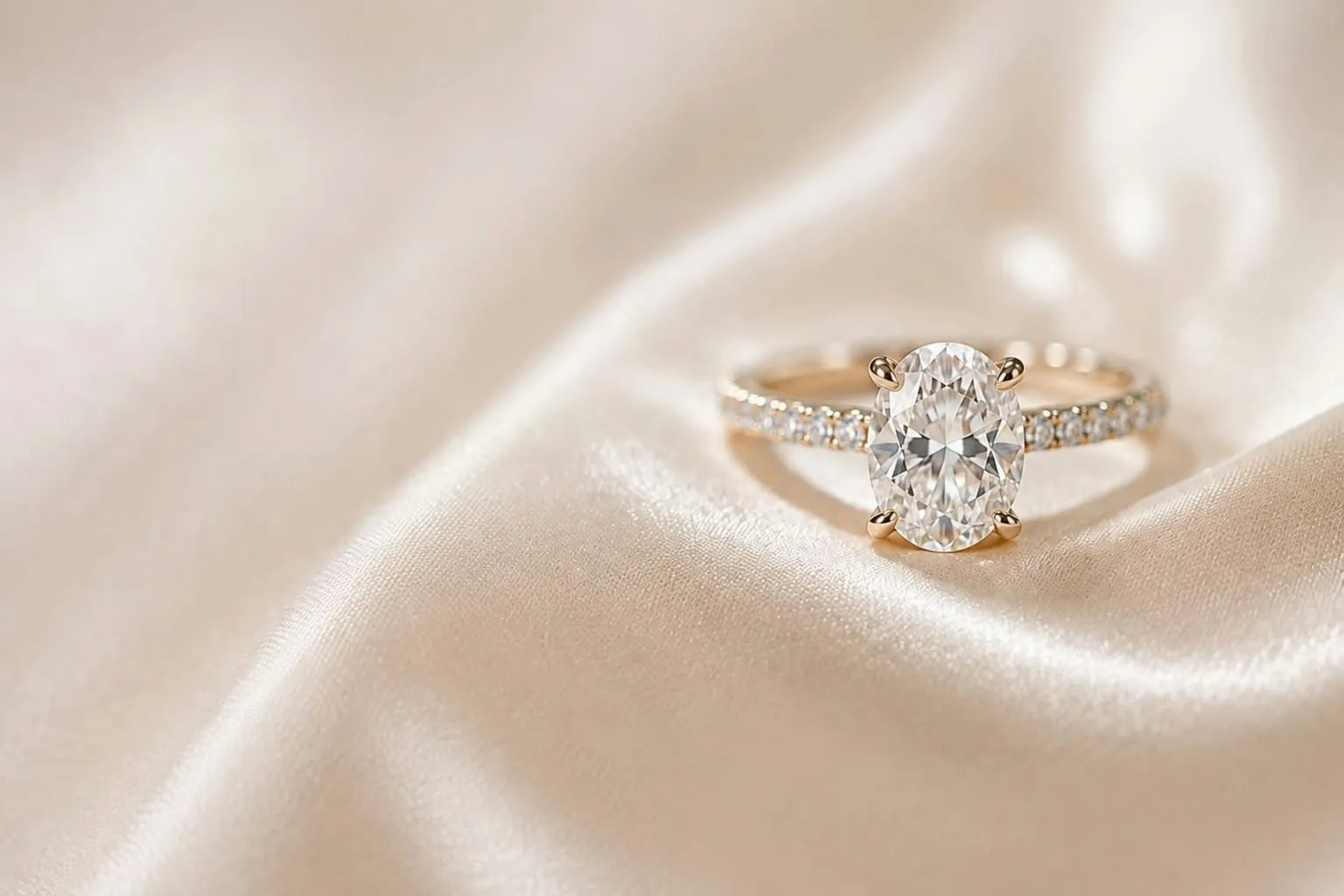
Oval engagement rings come in every setting a round stone does, and on 2 October 2026 Rare Carat sold the five below as finished rings with a 1.10 carat lab-grown oval, from 1,300 dollars for a cathedral solitaire to 2,200 dollars for a halo. The surprise came when we priced the same setting with a round stone: a lab-grown oval cost more than a lab round of about the same weight that day, while a natural oval cost less than a natural round. All five picks come from Rare Carat, so read this as five settings with one ring in each, priced on one day, not a ranking of every jeweler.
How we are paid. RingReel earns a commission from Rare Carat through the Awin network when you buy through a Rare Carat link on this page, at no cost to you. The picks come from the listings and terms below, not from who pays. Nothing here was bought or handled: it is researched, not tested.
What is on this page12 sections
Our Top Picks
- Our top pick
Best overall
Rare Carat Bella Solitaire Engagement Ring With 1.10 Carat Oval Lab Diamond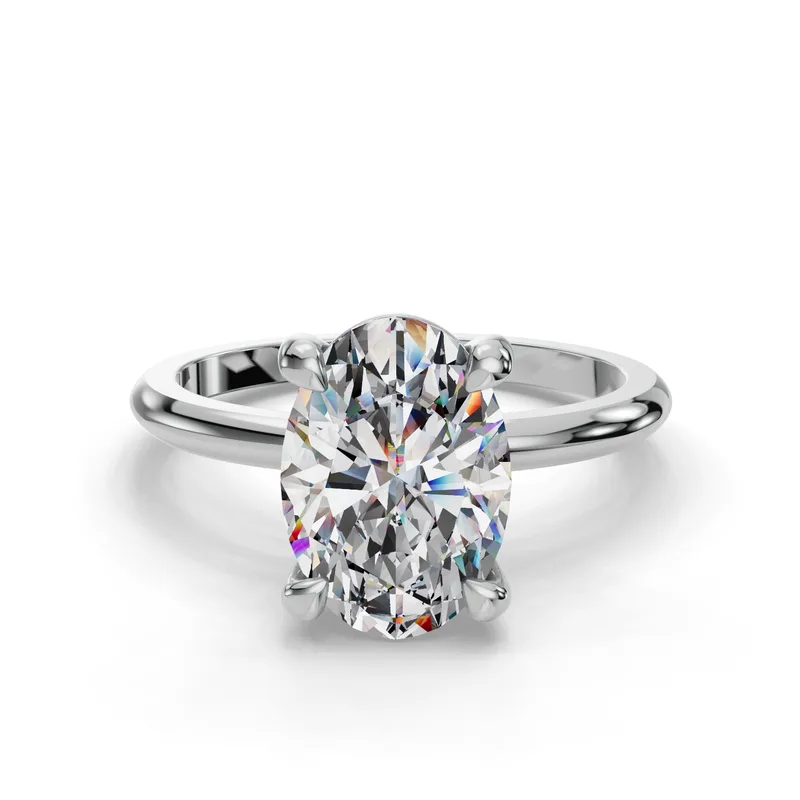
A buyer who wants the classic oval solitaire, finished and set, with nothing beside the stone to pull the eye away from it.
- 14K white gold; 1.10 ct oval lab-grown diamond
- $1,395
Lowest price
Rare Carat Tradition Cathedral Solitaire Engagement Ring (1.8mm) With 1.10 Carat Oval Lab Diamond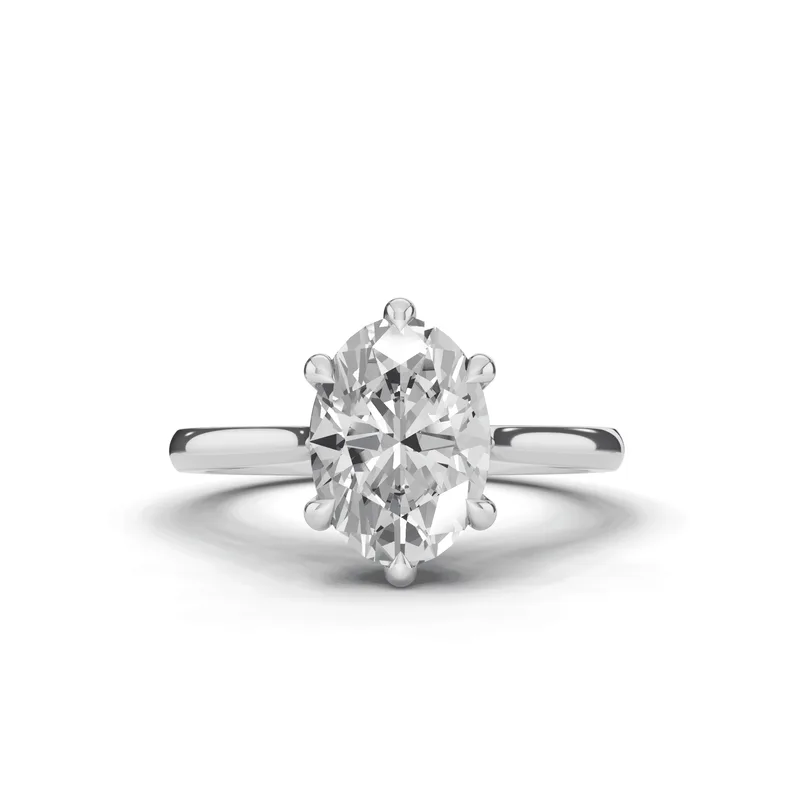
A buyer who wants a plain oval solitaire for the least money here, with a little more height and structure under the stone.
- 14K white gold; 1.10 ct oval lab-grown diamond
- $1,300
Best hidden halo
Rare Carat Lisa Hidden Halo Diamond Engagement Ring With 1.10 Carat Oval Lab Diamond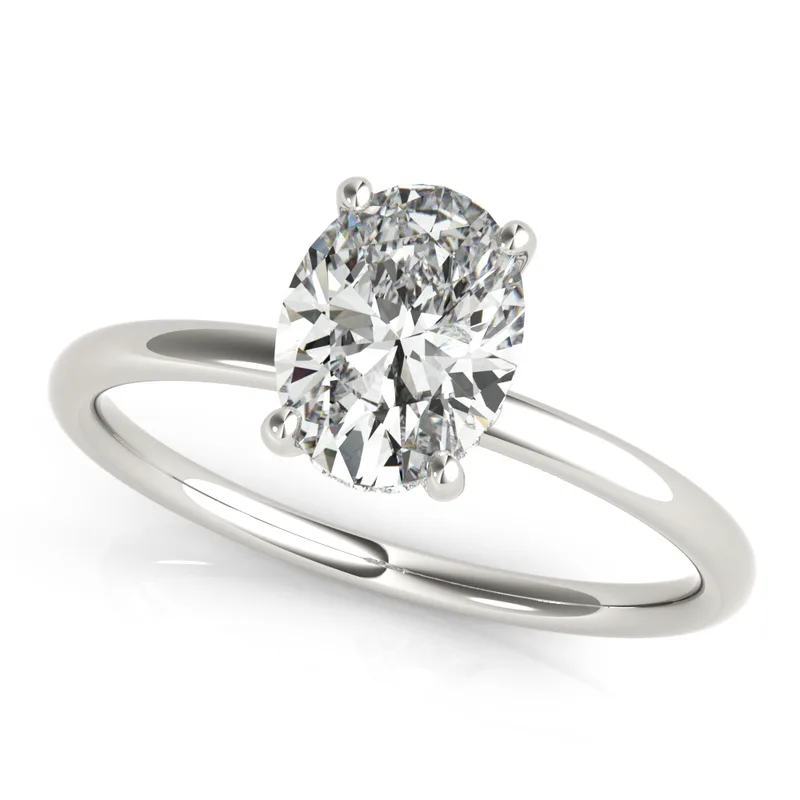
A buyer who wants an oval that reads as a clean solitaire from above, with sparkle that shows only in profile.
- 14K white gold; 1.10 ct oval lab-grown diamond with 16 small side diamonds
- $1,850
Best halo
Rare Carat Cici Halo Engagement Ring With 1.10 Carat Oval Lab Diamond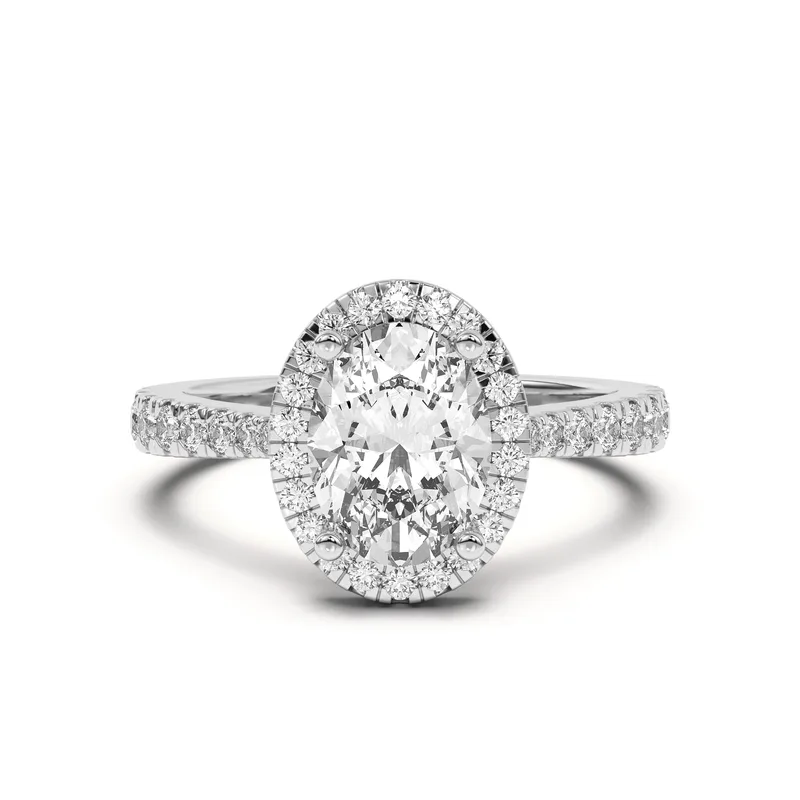
A buyer who wants the most visible sparkle and the biggest look from a stone of about one carat.
- 14K white gold; 1.10 ct oval lab-grown diamond with 38 small side diamonds
- $2,200
Best three-stone
Rare Carat Rosella Three Stone Lab Engagement Ring With 1.10 Carat Oval Lab Diamond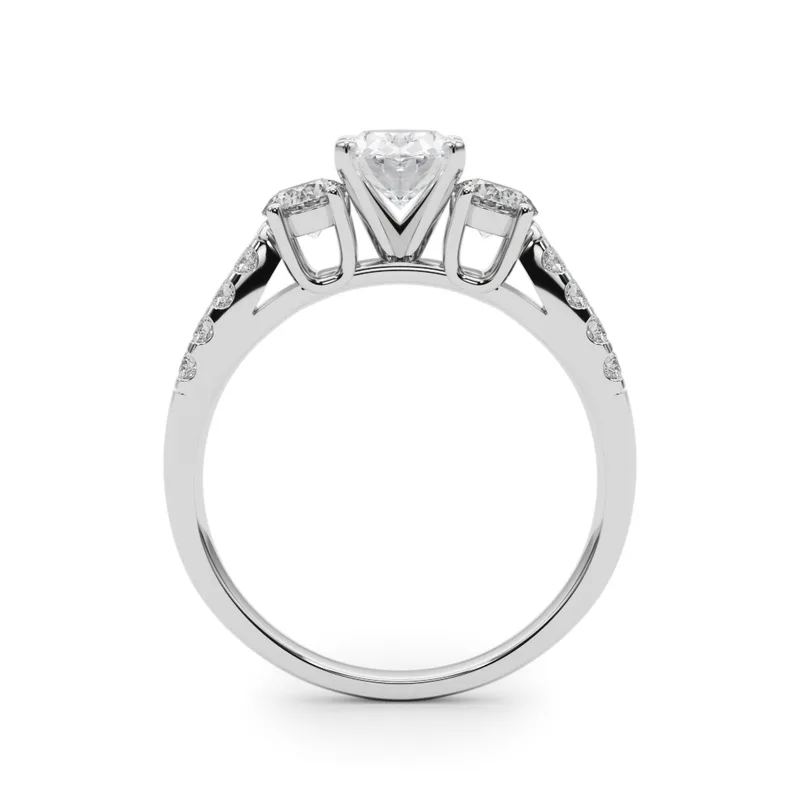
A buyer who wants more than one stone across the top of the finger without a full halo.
- 14K white gold; 1.10 ct oval lab-grown diamond with 18 round side diamonds
- $1,600
What is on this page12 sections
Key Takeaways
- As complete rings in 14K white gold, the five picks ran from 1,300 to 2,200 dollars on 2 October 2026, each set with the same 1.10 carat H VS1 lab-grown oval that Rare Carat paired by default.
- In the Bella setting, a 1.02 carat lab oval made a 1,370 dollar ring against 1,305 dollars with a 1.00 carat lab round; with natural stones the order flipped, 2,955 dollars for a 1.04 carat oval against 3,170 dollars for a 1.01 carat round.
- GIA’s 2026 settings guide says fewer prongs expose more of the stone and more prongs add security, and that a bezel protects the stone’s edges but lets in slightly less light; the table in the settings section matches each to a priority.
- GIA says ovals are typically more affordable than round brilliants of the same carat weight. On that day it held for the natural pair and not for either lab pair.
- No ring page showed the stone’s length-to-width ratio. The diamond’s own page did, 1.34 and 1.46 for the two lab ovals we opened, and neither page assessed the bow tie.
- In The Knot’s 2026 Real Weddings Study of US couples married in 2025, round took 26% of engagement rings and oval 25%, as reported by JCK.
Oval Engagement Rings Compared
The price column is what each listing showed on 2 October 2026 in 14K white gold with the 1.10 carat lab oval set. All five are complete rings, and each setting is also sold alone if you would rather choose another stone.
| Ring | Price range | Setting | Stones | Band width | Returns and resizing, per Rare Carat |
|---|---|---|---|---|---|
| $1,395 | Solitaire: one oval on four claw prongs and a raised basket | A 1.10 carat oval lab-grown diamond, H color, VS1 clarity, IGI report, length-to-width ratio 1.34 on the diamond's own page | 1.50mm as priced | 30 days from shipment for a full refund; one free resize in the first year, after which it cannot be returned | |
| $1,300 | Cathedral solitaire: arches lift the oval above a tapered band | A 1.10 carat oval lab-grown diamond, H color, VS1 clarity, IGI report, held by six prongs in the listing photo | 1.8mm as priced; narrower versions offered | 30 days from shipment for a full refund; one free resize in the first year, after which it cannot be returned | |
| $1,850 | Hidden halo: small diamonds under the oval, seen only from the side | A 1.10 carat oval lab-grown diamond, H color, VS1 clarity, plus 16 round side diamonds of 0.05 carat in total, graded G-H and SI1-SI2 | 1.6mm | 30 days from shipment for a full refund; one free resize in the first year, after which it cannot be returned | |
| $2,200 | Halo: a ring of pavé diamonds around the oval on a cathedral band | A 1.10 carat oval lab-grown diamond, H color, VS1 clarity, plus 38 side diamonds of 0.56 carat in total, graded G-H and SI1 | 2.0mm | 30 days from shipment for a full refund; one free resize in the first year, after which it cannot be returned | |
| $1,600 | Three-stone: an oval center between two round side stones, with pavé on the band | A 1.10 carat oval lab-grown diamond, H color, VS1 clarity, plus 18 round side diamonds of 0.50 carat in total, graded G-H and SI1-SI2 | 2.0mm to 2.2mm | 30 days from shipment for a full refund; one free resize in the first year, after which it cannot be returned |
Price ranges from the makers' sites, checked 2 October 2026. Prices change; the maker's site has the current one.
The Best Oval Engagement Rings, Reviewed
Best overall
Rare Carat Bella Solitaire Engagement Ring With 1.10 Carat Oval Lab Diamond
by Rare Carat
Best for: A buyer who wants the classic oval solitaire, finished and set, with nothing beside the stone to pull the eye away from it.
Rare Carat says the center stone "sits raised on a sculpted basket so it catches more light from every angle", on a polished band of about 1.5mm.
What we like
- A complete ring with the oval set, priced on the page as setting plus stone
- The widest size range of the five picks, from 3 to 12
- A matching Bella Pavé Contoured Band is offered beside it
Keep in mind
- The ring page does not show the stone's ratio; it sits on the diamond's own page behind the View link
- The URL asks for a 1.16 carat stone and the page served a 1.10 carat one, so the stone can change between visits
- A raised basket sits higher than a low-profile head, which is worth knowing if you work with your hands
- Price range
- $1,395 complete: $910 for the setting and $485 for the 1.10 ct oval lab diamond, 14K white gold (checked 2026-10-02)
- Material
- 14K white gold; 1.10 ct oval lab-grown diamond
- Widths
- 1.50mm as priced
- Sizes
- 3.0 to 12.0
- Guarantee
- Returns within 30 days of shipment; one free resize in year one, per Rare Carat
- Made in
- Handcrafted in the USA, per Rare Carat
Lowest price
Rare Carat Tradition Cathedral Solitaire Engagement Ring (1.8mm) With 1.10 Carat Oval Lab Diamond
by Rare Carat
Best for: A buyer who wants a plain oval solitaire for the least money here, with a little more height and structure under the stone.
Rare Carat describes "a classic cathedral arch" that "raises the center stone for more light" and a tapered 1.8mm band.
What we like
- The lowest complete price of the five picks on 2 October 2026
- Six prongs in the listing photo, two more points of contact than a four-prong head
- Cathedral arches can leave room under the head for a straight wedding band
Keep in mind
- The band Rare Carat suggests beside it is a heart-shaped eternity ring, an odd partner for an oval
- Rare Carat's policy says eternity bands cannot be resized after 30 days
- Six prongs cover more of the oval's outline than four
- Price range
- $1,300 complete: $815 for the setting and $485 for the 1.10 ct oval lab diamond, 14K white gold (checked 2026-10-02)
- Material
- 14K white gold; 1.10 ct oval lab-grown diamond
- Widths
- 1.8mm as priced; narrower versions offered
- Sizes
- 3.0 to 10.0
- Guarantee
- Returns within 30 days of shipment; one free resize in year one, per Rare Carat
- Made in
- Handcrafted in the USA, per Rare Carat
Best hidden halo
Rare Carat Lisa Hidden Halo Diamond Engagement Ring With 1.10 Carat Oval Lab Diamond
by Rare Carat
Best for: A buyer who wants an oval that reads as a clean solitaire from above, with sparkle that shows only in profile.
Rare Carat says "a circle of diamonds tucks just under the crown, visible from the side and invisible from above", and that the halo is sized to the center stone.
What we like
- From above it looks like a solitaire, so the oval's outline stays clean
- Rare Carat says the halo is sized to the center stone, so it scales if you choose a larger oval
- A matching Lisa Pavé Band is offered beside it
Keep in mind
- The 16 halo stones total 0.05 carat and are graded SI1-SI2, so they are there for glints, not size
- The listing does not state the head height
- A hidden halo is still metal under the stone, which a flat wedding band has to clear
- Price range
- $1,850 complete: $1,365 for the setting and $485 for the 1.10 ct oval lab diamond, 14K white gold (checked 2026-10-02)
- Material
- 14K white gold; 1.10 ct oval lab-grown diamond with 16 small side diamonds
- Widths
- 1.6mm
- Sizes
- 3.0 to 10.0
- Guarantee
- Returns within 30 days of shipment; one free resize in year one, per Rare Carat
- Made in
- Handcrafted in the USA, per Rare Carat
Best halo
Rare Carat Cici Halo Engagement Ring With 1.10 Carat Oval Lab Diamond
by Rare Carat
Best for: A buyer who wants the most visible sparkle and the biggest look from a stone of about one carat.
Rare Carat says "a circle of pavé diamonds wraps the center stone, making it look noticeably larger", on a reverse tapered cathedral band that widens as it rises.
What we like
- The halo frames the oval's outline, which GIA says makes the center diamond appear larger
- 0.56 carat of side diamonds, the most of the five picks
- A matching Cici Pavé Band is offered beside it
Keep in mind
- The most expensive pick, and most of the price is the setting rather than the center stone
- Pavé on the halo and band means many small stones to check over the years
- A halo sits wider than the shank, so a flat band usually leaves a gap
- Price range
- $2,200 complete: $1,715 for the setting and $485 for the 1.10 ct oval lab diamond, 14K white gold (checked 2026-10-02)
- Material
- 14K white gold; 1.10 ct oval lab-grown diamond with 38 small side diamonds
- Widths
- 2.0mm
- Sizes
- 3.0 to 10.0
- Guarantee
- Returns within 30 days of shipment; one free resize in year one, per Rare Carat
- Made in
- Handcrafted in the USA, per Rare Carat
Best three-stone
Rare Carat Rosella Three Stone Lab Engagement Ring With 1.10 Carat Oval Lab Diamond
by Rare Carat
Best for: A buyer who wants more than one stone across the top of the finger without a full halo.
The listing photo shows the oval between two round side stones in their own baskets, with small diamonds running down the shoulders; the band is listed at 2.0mm to 2.2mm.
What we like
- Three stones across the finger for 600 dollars less than the halo pick
- Round side stones contrast with the oval's outline instead of copying it
- A matching Rosella Lab Band is offered beside it, the cheapest band of the five
Keep in mind
- The listing gives 0.50 carat for all 18 side diamonds together, not the weight of the two larger ones
- Rare Carat's own description is generic and says nothing specific about this design
- Side stones run along the shank, which points to a curved or open wedding band
- Price range
- $1,600 complete: $1,115 for the setting and $485 for the 1.10 ct oval lab diamond, 14K white gold (checked 2026-10-02)
- Material
- 14K white gold; 1.10 ct oval lab-grown diamond with 18 round side diamonds
- Widths
- 2.0mm to 2.2mm
- Sizes
- 3.0 to 10.0
- Guarantee
- Returns within 30 days of shipment; one free resize in year one, per Rare Carat
- Made in
- Handcrafted in the USA, per Rare Carat
How We Chose
- Five settings, one ring each. A solitaire, a cathedral solitaire, a hidden halo, a halo and a three-stone, every one with an oval center stone, because the setting is the choice you make after choosing the shape.
- One jeweler, and we say so. Every pick is from Rare Carat, the only jeweler whose affiliate program has accepted RingReel so far. Other stores are not ranked below it; they are simply not listed yet.
- The same stone in all five. Each listing opened with one 1.10 carat oval, IGI report LG_811693797, so the price gap between the picks is the setting and nothing else.
- Sale prices, labeled. Rare Carat was running an anniversary sale on 2 October, and the prices here are the ones displayed during it. Each page also showed a higher “Comp. value”, which we leave out. Check the total on the page before you buy.
- Terms from Rare Carat’s own policy pages, read the same day: returns within 30 days of shipment and one free resize in the first year.
Oval vs Round: The Same Ring, Two Stones, One Day
GIA’s guide to engagement ring shapes says ovals are “typically more affordable than round brilliants of the same carat weight”. We put that to Rare Carat’s prices by opening the Bella setting with an oval and then with a round, H color and VS1 clarity each time, and letting the page choose the stone.
| Stone in the Bella setting, 14K white gold | Carat | Stone price | Complete ring |
|---|---|---|---|
| Lab-grown round, H, VS1 | 1.00 | 395 dollars | 1,305 dollars |
| Lab-grown oval, H, VS1 | 1.02 | 460 dollars | 1,370 dollars |
| Lab-grown round, H, VS1 | 1.13 | 440 dollars | 1,350 dollars |
| Lab-grown oval, H, VS1 | 1.10 | 485 dollars | 1,395 dollars |
| Natural round, H, VS1 | 1.01 | 2,260 dollars | 3,170 dollars |
| Natural oval, H, VS1 | 1.04 | 2,045 dollars | 2,955 dollars |
Lab-Grown: The Oval Cost More
Both lab pairs went the same way. The 1.02 carat oval cost 65 dollars more than the 1.00 carat round, and the 1.10 carat oval cost 45 dollars more than a round that weighed slightly more. Per carat, the two lab ovals came to about 440 and 450 dollars, the two lab rounds to about 390 and 395.
Natural: The Oval Cost Less
The natural pair followed GIA’s rule. The 1.04 carat oval cost 215 dollars less than the 1.01 carat round even though it weighed more, which works out to roughly 1,970 dollars a carat against 2,240.
What This Shows, and What It Does Not
Six stones on one day, picked by Rare Carat’s own page, show a direction, not a market rate. If you are buying lab-grown, do not assume the oval is the saving: price both shapes in your setting, and see our guide to lab-grown diamond prices by carat for how lab prices move with weight.
Lab Grown Oval Engagement Rings
Every pick here is a lab grown oval engagement ring as priced, and the lab stone is what keeps a carat inside these numbers: the natural 1.04 carat oval above cost more than four times the lab 1.02 carat oval.
The Stone All Five Pages Opened With
Rare Carat paired the same stone with all five settings: a 1.10 carat oval, H color, VS1 clarity, graded by IGI. Its own page lists measurements of 7.86 by 5.86 by 3.51 mm, a depth of 59.9% and a length-to-width ratio of 1.34. Any of the five pages lets you swap it for another stone. Our guide to IGI vs GIA explains what each lab’s report covers.
Lab or Natural
The shape and the setting do not change with the choice; the price does, and so does what the grading report has to tell you. Our guide to lab-grown vs natural diamonds covers the difference in full.
Length-to-Width Ratio and the Bow Tie
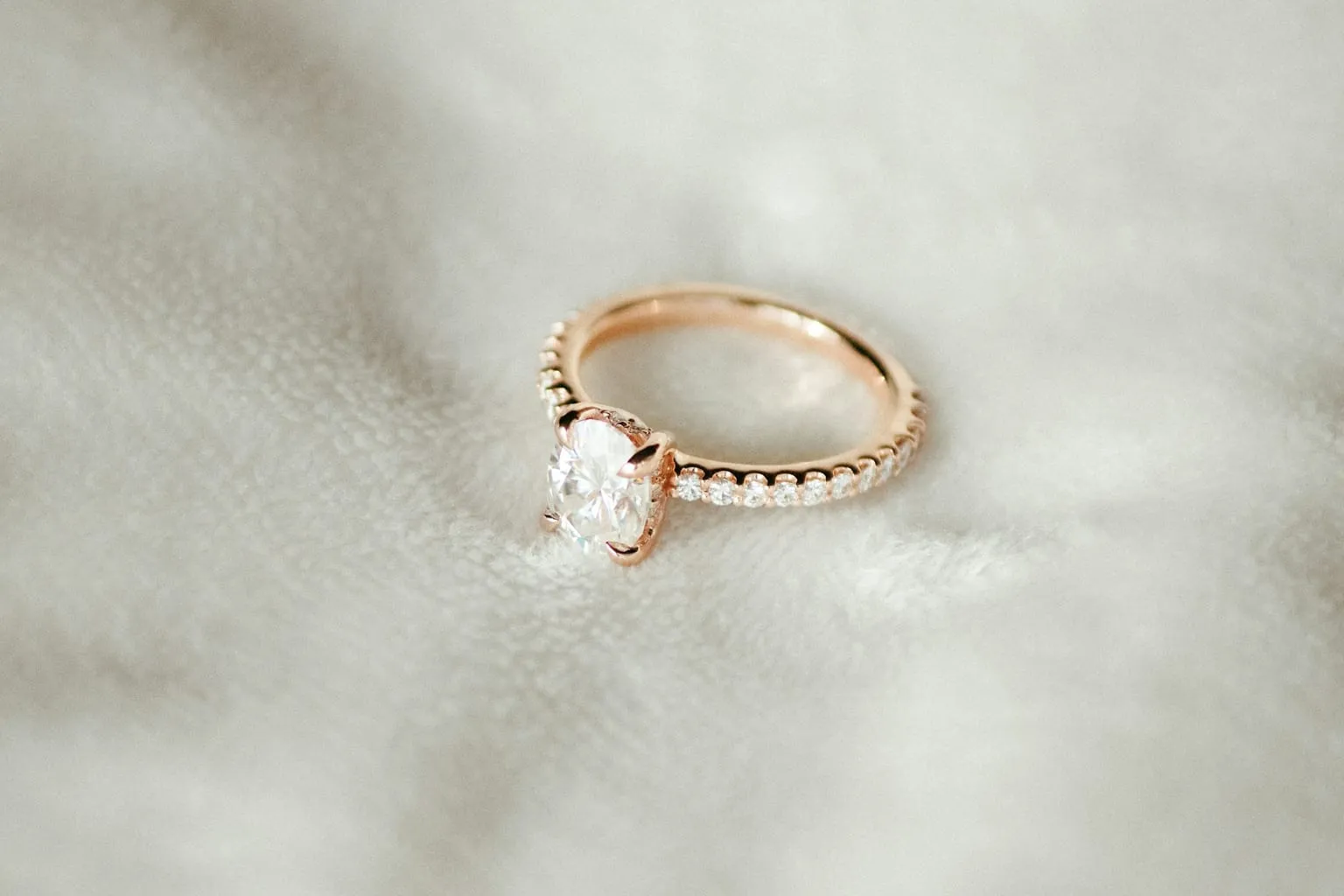
Two numbers decide how an oval looks on the hand, and neither appears on the ring pages at Rare Carat.
What GIA Says About Ratio
GIA’s oval cut guide, published in September 2025, says many people prefer a length-to-width ratio “between 1.30:1 and 1.50:1”. It describes 1.30:1 to 1.40:1 as “a gently elongated look that flatters most fingers”, and says 1.41:1 to 1.50:1 ovals “are often chosen for their slimming effect on the finger”. Above 1.50:1 they are “rarely seen, as it is impractical to cut them from diamond crystals”. GIA’s shapes guide adds that the round brilliant is the only shape that receives an official GIA cut grade, so a ratio is a preference, never a grade. Our guide to wedding bands for oval engagement rings explains how the ratio changes the band you pair with it.
Where the Listing Shows It
A Rare Carat ring page names the carat, color, clarity and “Rare Carat Ideal Cut”, and stops there. Ratio, measurements, table and depth sit on the diamond’s own page, behind the View link. When we asked the Bella page for a 1 carat oval, it served a 1.02 carat stone with a ratio of 1.46, near the long end of GIA’s preferred range; the 1.10 carat stone on all five picks sits at 1.34, near the short end. Same shape name, two different outlines.
The Bow Tie Nobody Grades
GIA explains that in an oval “some degree of bow tie is always present”, a dark band across the middle caused by your own head and shoulders blocking light. Rare Carat’s own guide to the effect says “once present, the bow-tie effect cannot be removed” and advises looking at the stone “all the way around in the 360 degree video”. Neither diamond page we opened graded or described a bow tie. “Does this diamond have a bow tie?” appears only as a question you can put to Rare Carat’s gemologists in chat, so ask it before you order.
Read the Checklist on the Diamond Page
Each diamond page carries Rare Carat’s own checklist for the shape: for an oval, a table of 53% to 64% and a depth of 57% to 65%, with polish and symmetry Very Good or better. The page adds that a stone which misses “by a little bit on one or two” of these is still fine. It is the quickest way to compare two ovals of the same weight before you choose.
Ring Settings for Oval Stones: Which Protects and Flatters
The right setting for an oval depends on what you ask of it: protection for the stone, a low profile for daily wear, a bigger look, or a set budget. GIA’s guide to engagement ring settings, published in August 2026, separates the setting types (prong, bezel and others) from the styles built on them (solitaire, cathedral, halo, three-stone). The sections below take the choices in that order, using the five Rare Carat picks as examples. For the full range of settings on any shape, see our guide to engagement ring settings.
4 Prongs or 6 Prongs
GIA writes that “fewer prongs expose more of the gemstone, while additional prongs provide extra security”, and that four prongs “may make the stone appear slightly squarer”. The Bella holds its oval in four claw prongs and cost 1,395 dollars on 2 October 2026; the Tradition Cathedral uses six prongs and cost 1,300 dollars. GIA’s wording is general and its examples are round stones, so read the squarer-look point as a general note, not an oval rule. If you work with your hands or knock rings often, the extra grip points of six prongs are the cautious choice.
Solitaire and Cathedral
A solitaire puts nothing beside the oval’s outline. GIA says solitaire rings feature “a single center stone as the focal point, highlighting the diamond’s beauty without distraction”. A cathedral adds arches of metal that rise from the shank to support the center setting, which GIA says emphasize the stone “while adding visual height and elegance”. The Tradition Cathedral lifts its head on arches, and Rare Carat says that “raises the center stone for more light”. The added height means a cathedral stands higher on the finger, so check our page on low-profile engagement rings if snagging is a worry. Our guide to the cathedral setting covers the trade-offs.
Halo and Hidden Halo
GIA’s oval guide says a halo of smaller diamonds around the oval “enhances brilliance and makes the diamond appear larger”, and its settings guide defines the halo as a prong or bezel set center stone surrounded by a ring of smaller accent stones. The Cici does that from above, with 38 side diamonds across the halo and band. A hidden halo, as on the Lisa, hides the ring of small stones under the oval, where it shows only from the side. A halo widens the head, which matters if you work with your hands.
Bezel
GIA says bezel settings “offer excellent protection for the edges of the stone while creating a clean, modern look”, and that they cover more of the stone’s edge and “allow slightly less light to enter the stone”. That is the trade: more protection and a clean outline, a little less light. None of our five Rare Carat picks is a bezel, so we cannot price one here. If you are torn, ask the jeweler for photos or video of the same oval in a prong head and in a bezel before you order. Our bezel setting guide covers the types, and our unique engagement rings page prices an east-west bezel from Rare Carat.
Three Stone and Side Stones
GIA describes the three-stone style as a center gemstone flanked by two smaller side stones. Its oval guide says half-moon or oval side stones mirror the oval shape while tapered baguettes offer contrast, and its settings guide says the side stones’ color grades should typically be within about two color grades of the center stone. The Rosella uses round side stones graded G-H beside an H center, inside that range.
East-West
An east west oval engagement ring turns the stone sideways across the finger, which GIA’s oval guide calls “a unique, fashion-forward look”. It changes how the stone sits on the hand rather than the setting type, so it can be combined with the options above. Our unique engagement rings page prices one from Rare Carat.
Which Setting for Which Priority
| Your priority | Setting to look at | Why, from the sources |
|---|---|---|
| Security | 6 prongs, or a bezel | GIA: additional prongs give extra security; a bezel protects the stone’s edges |
| A low profile on the hand | A plain solitaire head | A cathedral adds height and a halo widens the head |
| The biggest look | Halo or hidden halo | GIA: a halo makes the diamond appear larger |
| The most stone showing | 4 prongs | GIA: fewer prongs expose more of the gemstone |
| Budget | The simplest head | On 2 October 2026 the six-prong cathedral was the cheapest pick at 1,300 dollars and the halo the dearest at 2,200 dollars |
| More than one stone | Three-stone | GIA: a center stone flanked by two side stones |
Once the setting is chosen, the band is the next decision, and our guide to wedding bands for oval engagement rings covers it.
The Wedding Band to Go With It
Every listing offered a band made to sit beside it, shown on the page on 2 October 2026:
| Engagement ring | Matching band offered | Band price, 14K white gold | Ring and band together |
|---|---|---|---|
| Bella Solitaire, 1,395 dollars | Bella Pavé Contoured Band | 945 dollars | 2,340 dollars |
| Tradition Cathedral, 1,300 dollars | Sculpted Heart Lab Diamond Eternity Ring (1 ct. tw.) | 600 dollars | 1,900 dollars |
| Lisa Hidden Halo, 1,850 dollars | Lisa Pavé Band | 985 dollars | 2,835 dollars |
| Cici Halo, 2,200 dollars | Cici Pavé Band | 865 dollars | 3,065 dollars |
| Rosella Three Stone, 1,600 dollars | Rosella Lab Band | 565 dollars | 2,165 dollars |
The totals add the two listed prices, before any bundle saving the page applies at checkout. Whether a band sits flush depends on how high the head sits and what hangs below it more than on the oval itself, which is why the halo and three-stone picks are the hardest fits here.
Sizing Before You Order
Rare Carat’s policy takes any order back within 30 days of the shipment date for a full refund, and resizes once for free in the first year, but its resizing policy says that once a ring is sent in for resizing, “it can’t be returned”. Eternity bands, like the one suggested beside the Tradition Cathedral, “can’t be resized after 30 days”. Measure first with our printable ring sizer, and read our Rare Carat review for the rest of the terms.
Which Oval Engagement Ring Fits You?
| Your situation | Our pick | Why |
|---|---|---|
| You want the classic oval solitaire | Bella Solitaire | Four prongs, a raised basket, sizes 3 to 12 |
| You want the lowest price here | Tradition Cathedral | 1,300 dollars complete with six prongs |
| You want a solitaire look with hidden sparkle | Lisa Hidden Halo | The halo shows from the side only |
| You want the stone to look as big as possible | Cici Halo | A pavé halo framing the oval |
| You want more than one stone across the finger | Rosella Three Stone | Round side stones beside the oval |
| You want the oval turned sideways | An east-west setting | Our unique engagement rings page prices one |
If you are still choosing a shape, our guide to engagement ring shapes compares the oval with every other cut.
Frequently Asked Questions
What Are the Best Engagement Ring Settings for an Oval Cut Diamond?
It depends on your priority. Six prongs or a bezel protect the stone most, a halo makes it look larger, a solitaire shows it plainly, and a three-stone adds side stones. GIA does not name one best setting for ovals, so match the setting to how you will wear the ring every day.
Is a Bezel or Prong Setting Better for an Oval?
Neither wins outright. GIA says a bezel gives excellent protection for the stone’s edges but lets in slightly less light, while prongs expose more of the stone and extra prongs add security. Choose a bezel for protection and a smooth outline, prongs for the most visible stone.
Is an Oval Diamond Popular?
Yes, it is one of the two most chosen shapes. Ovals made up a quarter of engagement rings bought by US couples married in 2025, one point behind round, in figures from The Knot’s 2026 Real Weddings Study reported by JCK.
Is an Oval Diamond Cheaper Than a Round?
Often, but not always. GIA describes ovals as usually costing less than rounds of equal weight, and a natural oval at Rare Carat did on 2 October 2026. Two lab-grown ovals that day each cost more than lab rounds of similar weight. Price both shapes in the setting you want before deciding.
Do Oval or Round Diamonds Look Bigger?
An oval usually looks bigger for its weight. GIA says its elongated shape gives a larger surface area than a round of the same carat weight. The Rare Carat stones we compared fit that: the 1.10 carat oval measured 7.86 mm long, while the heavier 1.13 carat round measured 6.72 mm across.
Is an Oval Diamond Good for an Engagement Ring?
Yes, for most people. It is a brilliant cut, GIA says it can make fingers appear longer and more slender, and it suits solitaire, halo and three-stone settings alike. The trade-offs are a bow tie that every oval shows to some degree and no GIA cut grade to lean on when comparing stones.
How Much Does a Lab Grown Oval Diamond Typically Cost?
We found no published average, so here is one seller on one day. On 2 October 2026 Rare Carat priced an H color, VS1 clarity lab oval at 460 dollars for 1.02 carats and 485 dollars for 1.10 carats, during a sale. Color, clarity, cut and the end of the sale all move that figure.
Sources
- Rare Carat, Bella Solitaire Engagement Ring With 1.1 Carat Oval Lab Diamond, 14K white gold, accessed 02/10/2026.
- Rare Carat, Tradition Cathedral Solitaire Engagement Ring (1.8mm) With 1.1 Carat Oval Lab Diamond, 14K white gold, accessed 02/10/2026.
- Rare Carat, Lisa Hidden Halo Diamond Engagement Ring With 1.1 Carat Oval Lab Diamond, 14K white gold, accessed 02/10/2026.
- Rare Carat, Cici Halo Engagement Ring With 1.1 Carat Oval Lab Diamond, 14K white gold, accessed 02/10/2026.
- Rare Carat, Rosella Three Stone Lab Engagement Ring With 1.1 Carat Oval Lab Diamond, 14K white gold, accessed 02/10/2026.
- Rare Carat, Bella Solitaire with a 1.00 carat round lab diamond, a 1.02 carat oval lab diamond, a 1.13 carat round lab diamond, a 1.01 carat round natural diamond and a 1.04 carat oval natural diamond, accessed 02/10/2026.
- Rare Carat, diamond pages for the 1.10 carat lab oval, the 1.02 carat lab oval and the 1.04 carat natural oval, accessed 02/10/2026.
- Rare Carat, Oval Cut Lab Grown Diamond Engagement Rings, category page, accessed 02/10/2026.
- Rare Carat, 30-Day Returns and Ring Resizing Policy, undated, accessed 02/10/2026.
- Rare Carat, Bow Tie Effect In Ovals And How To Avoid Them, 2026, accessed 02/10/2026.
- GIA 4Cs, Oval Cut Diamond Buying Guide, 2025, accessed 02/10/2026.
- GIA 4Cs, Complete Guide to Engagement Ring Settings: Types vs. Styles, published 14 August 2026, accessed 22/10/2026.
- GIA 4Cs, Guide to Diamond Engagement Ring Shapes, 2025, accessed 02/10/2026.
- JCK, Victoria Gomelsky, Lab-Grown Diamonds Take Command of the Engagement Ring Market, published 25 February 2026, accessed 22/10/2026.