

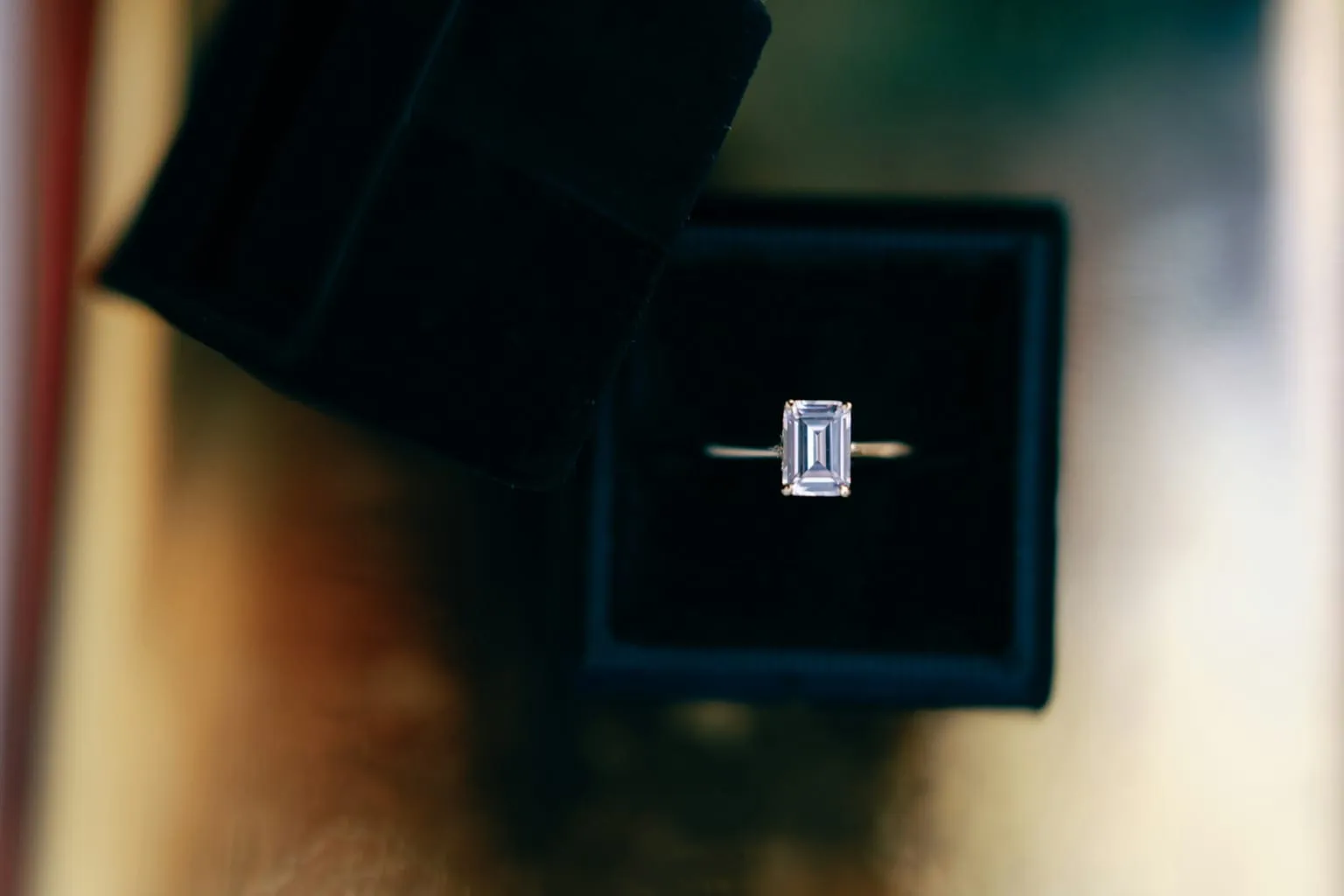
Emerald cut engagement rings set a rectangular, step-cut diamond in the center, and the setting around it decides most of the price. Below are five settings, a plain solitaire, a hidden halo, a three-stone, a vintage-inspired band and a full halo, each priced on 2 October 2026 as a finished ring with the same 1.21 carat lab-grown emerald cut diamond, from 1,365 to 2,085 dollars. All five come from Rare Carat, so read this as five ways to set an emerald cut with one ring you can buy in each, not a ranking of every jeweler. We also priced one setting with an emerald, a round and a radiant center on the same day, because the cut moves the price in opposite directions for lab and natural diamonds.
How we are paid. RingReel earns a commission from Rare Carat through the Awin network when you buy through a Rare Carat link on this page, at no cost to you. The picks come from the listings and terms below, not from who pays. Nothing here was bought or handled: it is researched, not tested.
What is on this page13 sections
Our Top Picks
- Our top pick
Best overall
Rare Carat Windy Solitaire Engagement Ring With 1.21 Carat Emerald Lab Diamond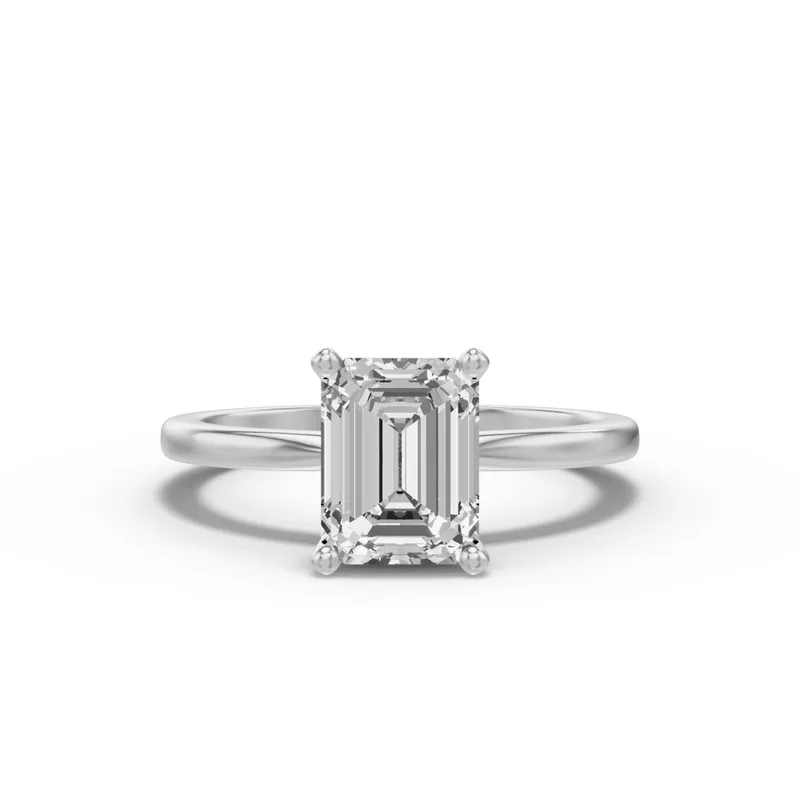
A buyer who wants the plainest frame for an emerald cut, finished and set, at the lowest price of the five.
- 14K white gold; 1.21 ct emerald cut lab-grown diamond
- $1,365
Best hidden halo
Rare Carat Marie Classic Hidden Halo Lab Pavé Engagement Ring With 1.21 Carat Emerald Lab Diamond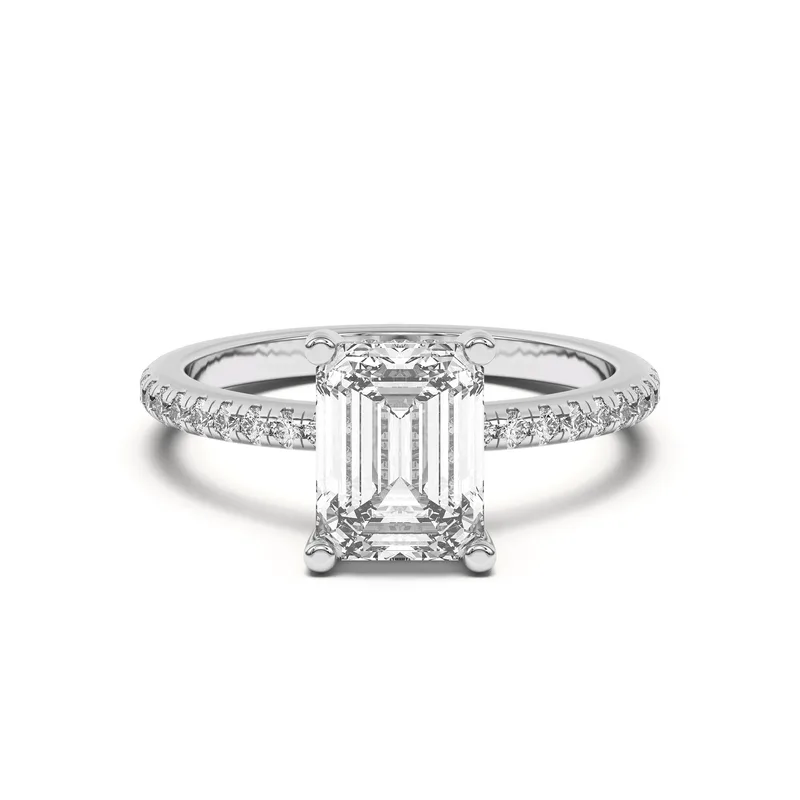
A buyer who wants extra sparkle around a step cut without a visible frame around the stone.
- 14K white gold; 1.21 ct emerald cut lab-grown diamond with pavé lab diamonds
- $1,375
Best three-stone
Rare Carat Marni Petite Three-Stone Engagement Ring With 1.21 Carat Emerald Lab Diamond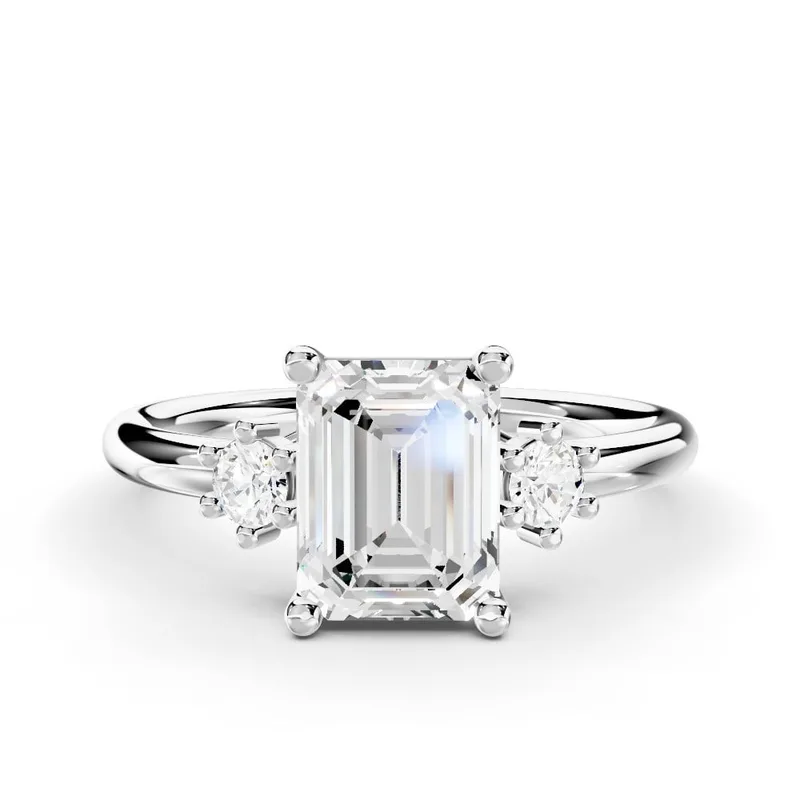
A buyer who wants a three-stone ring that keeps the emerald cut clearly in charge.
- 14K white gold; 1.21 ct emerald cut lab-grown diamond with two round side diamonds
- $1,595
Best vintage-inspired
Rare Carat Mila Vintage-Inspired Solitaire Engagement Ring With 1.21 Carat Emerald Lab Diamond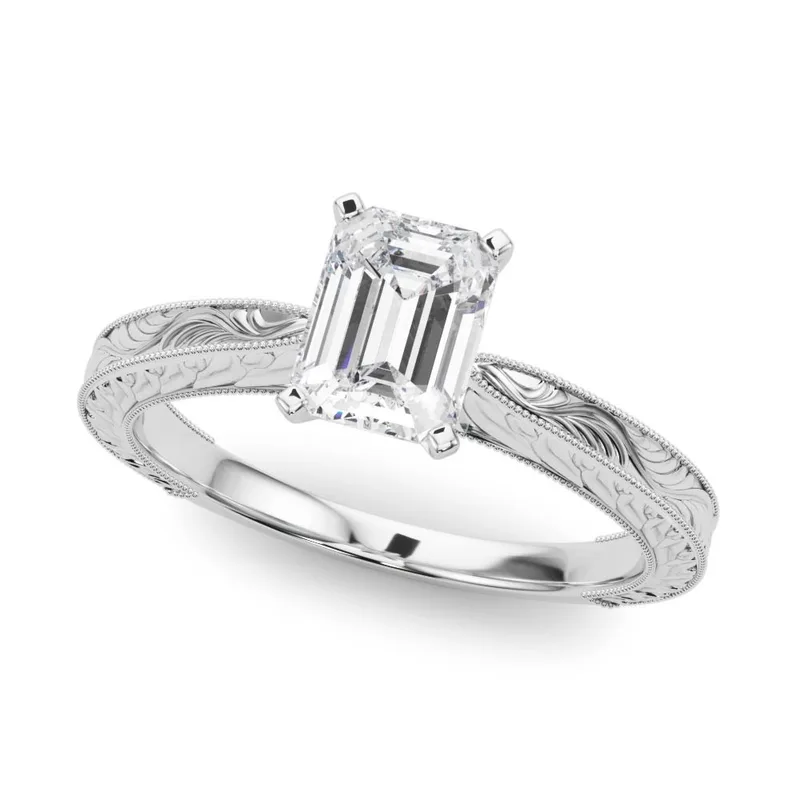
A buyer drawn to the Art Deco and vintage looks GIA ties to the emerald cut, without a halo.
- 14K white gold; 1.21 ct emerald cut lab-grown diamond
- $1,805
Best halo
Rare Carat Estelle Classic Pavé Cathedral Halo Engagement Ring With 1.21 Carat Emerald Lab Diamond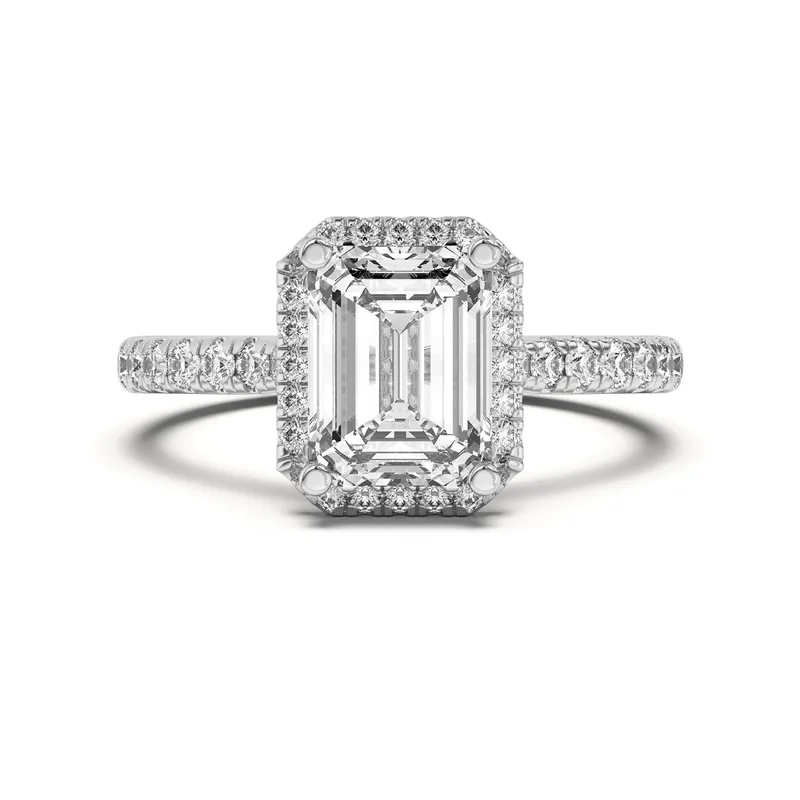
A buyer who wants the emerald cut to look bigger and brighter, with a frame that keeps its rectangular outline.
- 14K white gold; 1.21 ct emerald cut lab-grown diamond with pavé diamonds
- $2,085
What is on this page13 sections
Key Takeaways
- Each of the five picks opened with the same center stone on 2 October 2026: a 1.21 carat lab-grown emerald cut, H color, VS1 clarity, priced at 580 dollars, so the gap between the rings is the setting alone.
- In the same Bella solitaire setting, a 1 carat lab emerald cut cost 30 dollars more than a lab round of the same grades, while a natural emerald cut cost 810 dollars less than a natural round.
- GIA advises VS2 clarity and G color or better for an emerald cut. Rare Carat’s default lab stone clears the clarity bar but sits one color grade below it, and a G color lab emerald cost no more that day.
- A radiant cut shares the emerald cut’s outline but not its facets; in the same setting it cost 10 dollars more as a lab stone and 90 dollars more as a natural one.
- Every pick offers a matching band on its page, and two of the five are eternity bands with resizing limits.
Emerald Cut Engagement Rings Compared
The price column is what each listing showed on 2 October 2026 in 14K white gold, as a complete ring with the center stone set. The setting and the diamond are also listed separately on each page, and both parts are in the column.
| Ring | Price range | Style | Stones | Matching band offered | Returns and resizing, per Rare Carat |
|---|---|---|---|---|---|
| $1,365 | Four-prong solitaire on a tapering band | One 1.21 carat emerald cut lab-grown diamond, H color, VS1 clarity, 7.49 x 5.28 mm, length to width ratio 1.42 | Shared Prong Lab Eternity Band (.25ct. tw.), $625 | 30 days from shipment for a full refund; one free resize in the first year, after which it cannot be returned | |
| $1,375 | Hidden halo under the stone, pavé along the band | One 1.21 carat emerald cut lab-grown diamond, H color, VS1 clarity, plus 32 small lab diamonds of .25 carat in total, listed as F color and VS2 clarity | Shared Prong Lab Eternity Band (.33ct. tw.), $740 | 30 days from shipment for a full refund; one free resize in the first year, after which it cannot be returned | |
| $1,595 | Three-stone: an emerald cut center between two small round diamonds | One 1.21 carat emerald cut lab-grown diamond, H color, VS1 clarity, plus two side diamonds of .12 carat in total, listed as G-H color and VS1 clarity | Marni Wide Curved Band, $585 | 30 days from shipment for a full refund; one free resize in the first year, after which it cannot be returned | |
| $1,805 | Vintage-inspired solitaire with engraving and milgrain | One 1.21 carat emerald cut lab-grown diamond, H color, VS1 clarity; no side stones | Mila Vintage-Inspired Band, $825 | 30 days from shipment for a full refund; one free resize in the first year, after which it cannot be returned | |
| $2,085 | Rectangular halo on a pavé cathedral band | One 1.21 carat emerald cut lab-grown diamond, H color, VS1 clarity, plus 36 small diamonds of .38 carat in total, listed as G-H color and SI1 clarity | Estelle Pavé Band, $900 | 30 days from shipment for a full refund; one free resize in the first year, after which it cannot be returned |
Price ranges from the makers' sites, checked 2 October 2026. Prices change; the maker's site has the current one.
The Best Emerald Cut Engagement Rings, Reviewed
Best overall
Rare Carat Windy Solitaire Engagement Ring With 1.21 Carat Emerald Lab Diamond
by Rare Carat
Best for: A buyer who wants the plainest frame for an emerald cut, finished and set, at the lowest price of the five.
A softly rounded band that tapers toward the center stone, with nothing but four prongs between you and the step facets.
What we like
- The lowest price of the five picks as a complete ring with a 1.21 carat center
- The listing gives the center stone's measurements and ratio, not just its weight and grades
- No side stones, so all of the budget sits in the center diamond and the setting
Keep in mind
- H color is one grade below the G that GIA advises for an emerald cut
- At 1.40mm it is the slimmest band here, which can look thin under a long rectangular stone
- The matching band offered is an eternity band, which Rare Carat says cannot be resized after 30 days
- Price range
- $1,365 complete: $785 for the setting and $580 for the 1.21 ct emerald lab diamond, 14K white gold (checked 2026-10-02)
- Material
- 14K white gold; 1.21 ct emerald cut lab-grown diamond
- Widths
- 1.40mm
- Sizes
- 3 to 10
- Guarantee
- Returns within 30 days of shipment; one free resize in year one, per Rare Carat
- Made in
- Handcrafted in the USA, per Rare Carat
Best hidden halo
Rare Carat Marie Classic Hidden Halo Lab Pavé Engagement Ring With 1.21 Carat Emerald Lab Diamond
by Rare Carat
Best for: A buyer who wants extra sparkle around a step cut without a visible frame around the stone.
Rare Carat describes a halo hidden beneath the center stone and pavé along the band, so from above it still reads as a rectangle on a sparkling shank.
What we like
- Only 10 dollars more than the plain solitaire pick for a pavé band and a hidden halo
- The listing grades the small diamonds, F color and VS2 clarity, not just the center stone
- The page lets you raise the side stones to .40 or .50 carat in total
Keep in mind
- Brilliant Earth says brilliant-cut pavé beside an emerald cut creates contrast rather than continuity, and here the pavé is on the ring itself
- The matching band is an eternity band, so resizing is limited after 30 days
- Brilliant Earth says a hidden halo is visible only from the side and may raise the center stone slightly, which can affect how flush a band sits
- Price range
- $1,375 complete: $795 for the setting and $580 for the 1.21 ct emerald lab diamond, 14K white gold (checked 2026-10-02)
- Material
- 14K white gold; 1.21 ct emerald cut lab-grown diamond with pavé lab diamonds
- Widths
- 1.50mm
- Sizes
- 3 to 10
- Guarantee
- Returns within 30 days of shipment; one free resize in year one, per Rare Carat
- Made in
- Handcrafted in the USA, per Rare Carat
Best three-stone
Rare Carat Marni Petite Three-Stone Engagement Ring With 1.21 Carat Emerald Lab Diamond
by Rare Carat
Best for: A buyer who wants a three-stone ring that keeps the emerald cut clearly in charge.
Rare Carat describes diamond side stones in six-prong settings framing the center, "a classic symbol of past, present, and future love".
What we like
- The side stones are small, .12 carat in total, so the rectangle stays the focus
- Side stones graded VS1, the same clarity as the center
- The matching band is a curved band rather than an eternity band
Keep in mind
- Round side stones rather than baguettes, so the sparkle beside the center is brilliant, not step cut
- The page offers larger side stones, up to .50 carat, which raises the price
- The listing does not say where the ring is made
- Price range
- $1,595 complete: $1,015 for the setting and $580 for the 1.21 ct emerald lab diamond, 14K white gold (checked 2026-10-02)
- Material
- 14K white gold; 1.21 ct emerald cut lab-grown diamond with two round side diamonds
- Widths
- 1.40mm to 1.60mm
- Sizes
- 3 to 10
- Guarantee
- Returns within 30 days of shipment; one free resize in year one, per Rare Carat
- Made in
- Not stated
Best vintage-inspired
Rare Carat Mila Vintage-Inspired Solitaire Engagement Ring With 1.21 Carat Emerald Lab Diamond
by Rare Carat
Best for: A buyer drawn to the Art Deco and vintage looks GIA ties to the emerald cut, without a halo.
Rare Carat describes "intricate engravings and delicate milgrain trim" on the shank, with the center stone held in four prongs.
What we like
- The widest band of the five, about 2mm, which balances the length of the stone
- Engraving and milgrain give detail without adding small diamonds to clean
- A matching vintage-inspired band is sold for it
Keep in mind
- The most expensive setting here after the full halo pick
- The setting alone costs 440 dollars more than the Windy setting
- Delivery quoted for 12 October on a 2 October order, later than the plain solitaire
- Price range
- $1,805 complete: $1,225 for the setting and $580 for the 1.21 ct emerald lab diamond, 14K white gold (checked 2026-10-02)
- Material
- 14K white gold; 1.21 ct emerald cut lab-grown diamond
- Widths
- 1.92mm to 2.22mm
- Sizes
- 3 to 10
- Guarantee
- Returns within 30 days of shipment; one free resize in year one, per Rare Carat
- Made in
- Handcrafted in the USA, per Rare Carat
Best halo
Rare Carat Estelle Classic Pavé Cathedral Halo Engagement Ring With 1.21 Carat Emerald Lab Diamond
by Rare Carat
Best for: A buyer who wants the emerald cut to look bigger and brighter, with a frame that keeps its rectangular outline.
A frame of small diamonds follows the emerald cut's outline, and Rare Carat says the halo makes the center look "noticeably larger".
What we like
- The halo follows the rectangle, so the ring keeps the emerald cut's outline
- A cathedral band raises the center stone, which GIA says can make the ring appear more substantial
- A matching pavé band is sold for it
Keep in mind
- The most expensive pick, 720 dollars more than the plain solitaire
- The 36 halo and band diamonds are graded SI1, below the center stone
- Delivery quoted for 16 October on a 2 October order, the longest of the five
- Price range
- $2,085 complete: $1,505 for the setting and $580 for the 1.21 ct emerald lab diamond, 14K white gold (checked 2026-10-02)
- Material
- 14K white gold; 1.21 ct emerald cut lab-grown diamond with pavé diamonds
- Widths
- 1.80mm
- Sizes
- 3 to 10
- Guarantee
- Returns within 30 days of shipment; one free resize in year one, per Rare Carat
- Made in
- Handcrafted in the USA, per Rare Carat
How We Chose
- Five settings, one ring each, each opened, priced and linked on the day. East-west mounts are left to our unique engagement rings page.
- One jeweler, and we say so. Every pick is from Rare Carat, the only jeweler whose affiliate program has accepted RingReel so far. Other stores are not ranked below it, simply not listed yet.
- The same stone in every ring. All five listings carried the same 1.21 carat lab diamond with the same report number, so the prices compare settings, not diamonds.
- Every listing opened on 2 October 2026, priced as the page loaded in 14K white gold, with the stone’s measurements taken from the listing data.
- Terms from Rare Carat’s own policy pages: returns within 30 days of shipment and one free resize in the first year.
What an Emerald Cut Is
An emerald cut is a rectangle with its corners cut off and rows of long facets running parallel to the edges. GIA describes it as “a rectangular shape with beveled corners and concentric rows of facets” on both the top and the bottom of the stone.
Step Facets, Not Brilliant Sparkle
GIA groups the emerald and the Asscher as step cuts, with “concentric, trapezoidal facets that create a mesmerizing ‘hall of mirrors’ effect”, known “for their elegant gleam rather than brilliance”. Round, pear and princess cuts are brilliant cuts. That difference decides what clarity to buy and how the stone compares with a radiant. Our guide to engagement ring shapes compares the cut with every other shape.
Not the Green Gemstone
GIA says the emerald cut “refers to the style of cutting, not the gemstone itself”, a style first developed for emeralds to reduce pressure during cutting and prevent chipping. Every ring on this page has a colorless diamond in the center, not a green emerald.
Shape and Ratio on the Listing
The 1.21 carat stone in all five picks measured 7.49 by 5.28mm, a length-to-width ratio of 1.42. GIA publishes no ratio range for the shape; the jeweler Whiteflash writes that most people prefer “a balanced rectangle with a length/width ratio of about 1.4”, which this stone matches. Rare Carat labels the stone “Rare Carat Ideal Cut”, which is the seller’s own label: as the jeweler GOODSTONE notes, GIA does not issue a cut grade for this shape.
What an Emerald Cut Costs Next to a Round
To see what the cut itself costs, we kept one setting fixed, the Bella Solitaire in 14K white gold at 910 dollars, and changed only the center stone. Each row below is the single stone Rare Carat put in that configuration on 2 October 2026, not a market average.
| Center stone in the Bella Solitaire | Diamond price | Complete ring | Measurements |
|---|---|---|---|
| Lab round, 1.00 ct, H, VS1 | 395 dollars | 1,305 dollars | 6.46 x 6.41 mm |
| Lab emerald, 1.00 ct, H, VS1 | 425 dollars | 1,335 dollars | 7.00 x 4.65 mm |
| Lab round, 1.01 ct, G, VS1 | 380 dollars | 1,290 dollars | 6.44 x 6.40 mm |
| Lab emerald, 1.01 ct, G, VS1 | 420 dollars | 1,330 dollars | 7.11 x 4.72 mm |
| Natural round, 1.01 ct, G, VS2 | 2,665 dollars | 3,575 dollars | 6.40 x 6.37 mm |
| Natural emerald, 1.01 ct, G, VS2 | 1,855 dollars | 2,765 dollars | 6.93 x 4.83 mm |
Lab-Grown: the Emerald Cut Costs Slightly More
Among lab diamonds the emerald cut was the dearer stone, by 30 dollars at H color and 40 dollars at G, about 2 to 3 percent of a complete ring. The common advice that an emerald cut saves money against a round does not hold here.
Natural: the Emerald Cut Costs Far Less
Among natural diamonds the picture flips. At 1.01 carats, G color and VS2 clarity, which is exactly GIA’s suggested floor for the shape, the natural emerald cut was 810 dollars cheaper than the round, and the complete ring came to 2,765 dollars against 3,575. If you want a natural diamond, the emerald cut is where the savings are. Our guide to lab-grown vs natural diamonds covers what else separates the two.
Size on the Finger
At 1 carat the lab emerald cut was half a millimeter longer than the round and nearly two millimeters narrower. Whiteflash says emerald cuts “tend to look a little bigger” for their weight because they extend further down the finger. GIA adds that the elongated shape creates “the illusion of longer, more slender fingers”, which our page on engagement rings for long fingers puts to use.
Clarity and Color for an Emerald Cut
A step cut hides less than a brilliant cut, and that should shape which grades you pay for.
What GIA Advises
GIA’s shape guide says that because of its “large table and open facets, the emerald cut tends to show inclusions and color more easily than other shapes”, and advises VS2 clarity and G color or above, with higher grades for stones of 2 to 3 carats and up. Its 2016 article on the cut adds that the stone “produces less scintillation, or sparkle, than other diamond cuts”, which “makes the diamond’s color more prominent”. The listing data bears out the table point: the lab emerald cut’s table was 67 percent of its width against 55 percent for the lab round.
What Rare Carat Pairs It With
Rare Carat’s emerald cut page opens every setting with an H color, VS1 stone. VS1 is one grade above GIA’s clarity floor, so the clarity is covered; our guide to VS1 vs VS2 explains the step between them. H is one grade below GIA’s color advice. On the day we checked, moving to G cost nothing: the 1.01 carat G VS1 lab emerald cut was 5 dollars cheaper than the 1.00 carat H VS1. On a lab stone, G may cost nothing extra.
The Grading Report
The listings show a report number for the lab stone but the page text does not name the lab that issued it. Ask Rare Carat which lab graded the stone, and read our guide to IGI vs GIA before comparing two reports.
Emerald Cut vs Radiant Cut
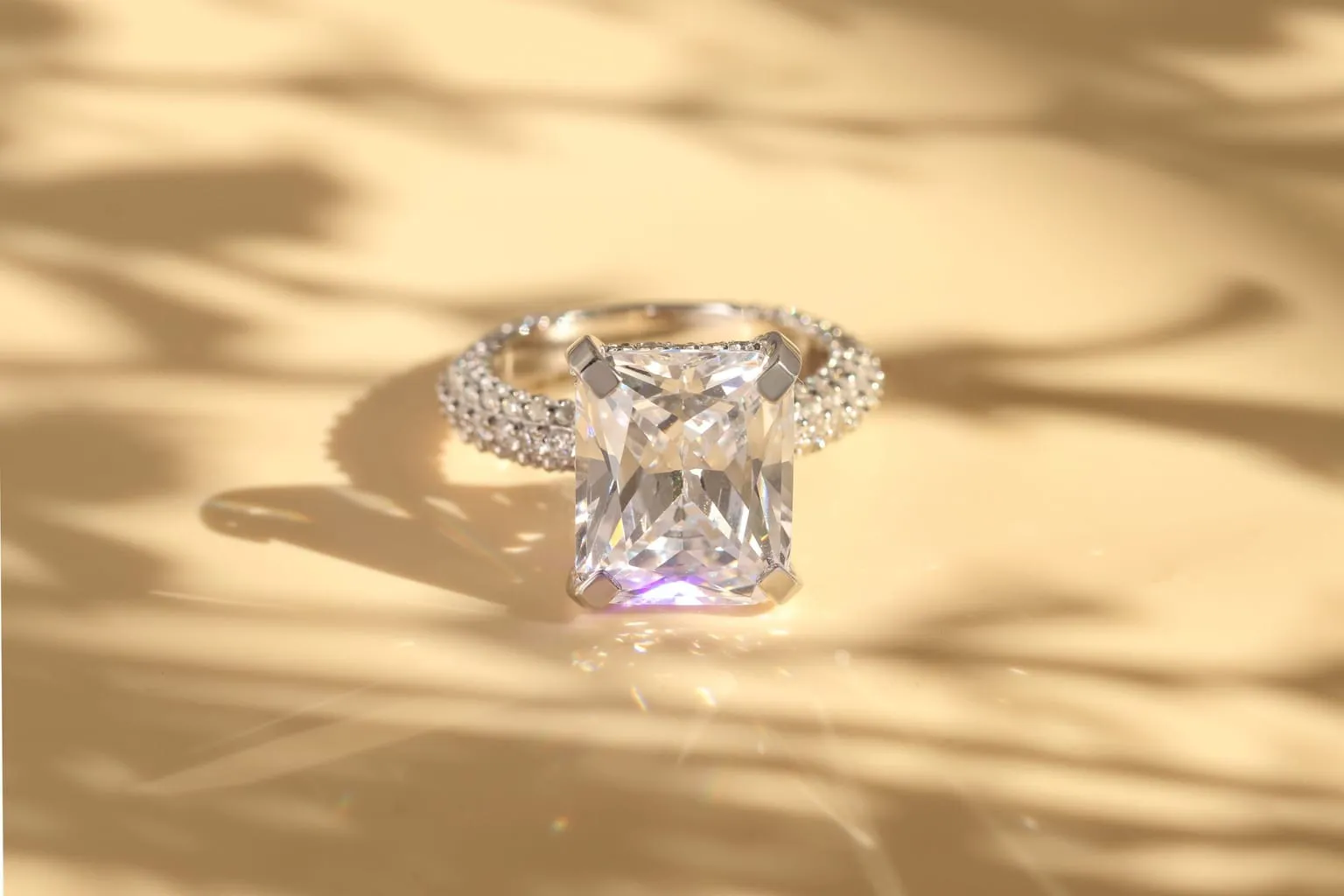
A radiant cut has the same rectangular outline and cropped corners as an emerald cut, with brilliant facets inside. GIA says it “combines the sleek, geometric lines of an emerald cut with the dazzling sparkle of a brilliant cut”.
| Emerald cut | Radiant cut | |
|---|---|---|
| Facet style | Step cut: long parallel facets | Brilliant cut: many small facets |
| Light | Broad flashes, “elegant gleam rather than brilliance” (GIA) | Sparkle; GIA says it helps “mask inclusions” |
| Clarity to buy | GIA advises VS2 or above | GIA says the facets help mask inclusions |
| Corners | Cropped; GIA lists emerald cut corners as higher risk for chips | Cropped; GIA’s shape guide says they help prevent chipping, its chipping article lists radiant corners as higher risk |
| Lab 1 ct, H, VS1, Bella Solitaire | 425 dollars for the stone | 435 dollars for a 1.02 ct stone |
| Natural 1.01 ct, G, VS2, Bella Solitaire | 1,855 dollars for the stone | 1,945 dollars for the stone |
Which Forgives More
If you want sparkle in a rectangular outline, the radiant gives it; if you want the mirrored look of long facets, only a step cut does. A radiant also hides inclusions and color better, so it tolerates lower grades. An emerald cut shows them, which is why GIA’s advice for it starts at VS2 and G. On a lab stone that difference costs little; on a large natural stone it can decide the budget.
What the Corners Mean
Both shapes crop their corners, but GIA’s article on chipping, by Al Gilbertson, names emerald cut and radiant corners among those “at higher risk” that “need adequate girdle thickness”. The 1.21 carat stone in the picks lists a medium girdle. Neither shape is chip-proof, whatever a listing implies.
Settings That Suit an Emerald Cut
GIA writes that the emerald cut’s angular shape “is at home in virtually any design, from vintage-inspired Art Deco style mountings to contemporary rings with minimal adornment”. The five picks span that range.
Solitaire and Vintage
A plain four-prong solitaire, like the Windy, shows the step facets with nothing around them. The Mila keeps a single stone but adds engraving and milgrain to the band, the vintage route GIA links to the shape. For more settings in that style, see our page of vintage engagement rings. Our guide to engagement ring settings explains each mount.
Halo and Hidden Halo
A full halo follows the rectangle with small diamonds, as on the Estelle, and Rare Carat says it makes the center look larger. A hidden halo, as on the Marie, sits under the stone and shows from the side. The Estelle also rises on a cathedral band; our cathedral setting guide covers what that changes.
Three Stones
The Marni flanks the center with two small round diamonds, which keep the rectangle dominant.
The Wedding Band for an Emerald Cut
Every pick has a matching band on its page, shown beside the ring on 2 October 2026:
| Engagement ring | Matching band offered | Band price, 14K white gold |
|---|---|---|
| Windy Solitaire | Shared Prong Lab Eternity Band (.25ct. tw.) | 625 dollars |
| Marie Hidden Halo | Shared Prong Lab Eternity Band (.33ct. tw.) | 740 dollars |
| Marni Three-Stone | Marni Wide Curved Band | 585 dollars |
| Mila Vintage-Inspired | Mila Vintage-Inspired Band | 825 dollars |
| Estelle Halo | Estelle Pavé Band | 900 dollars |
Two of those are eternity bands, and Rare Carat’s resizing policy says eternity bands “can’t be resized after 30 days”; our guide to what an eternity ring is explains why. Brilliant Earth writes that bands with step-cut diamonds, channel settings or bezel-set stones complement an emerald cut, while a brilliant-cut pavé band can work but creates “contrast rather than continuity”. For every option, see our guide to wedding bands for emerald cut engagement rings.
Rare Carat resizes a ring once for free in the first year, but its policy says that once a ring is sent in for resizing, “it can’t be returned”. Settle the size first with our printable ring sizer; our Rare Carat review covers the rest.
Which Emerald Cut Engagement Ring Fits You?
| Your situation | Our pick | Why |
|---|---|---|
| You want the cleanest look at the lowest price | Windy Solitaire | 1,365 dollars complete, nothing but four prongs around the stone |
| You want more sparkle without a visible frame | Marie Hidden Halo | Pavé and a hidden halo for 10 dollars more than the Windy |
| You want three stones with the rectangle in charge | Marni Three-Stone | Two small round side diamonds,.12 carat in total |
| You like Art Deco and vintage detail | Mila Vintage-Inspired | Engraving and milgrain on the widest band here |
| You want the stone to look as large as possible | Estelle Halo | A rectangular halo on a pavé cathedral band |
| You want a natural diamond | Any of the five with a natural stone | The natural emerald cut cost far less than a natural round |
On a tighter budget, see our affordable engagement rings.
Frequently Asked Questions
Are Emerald Cut Diamonds More Expensive?
It depends on whether the diamond is lab-grown or natural. At Rare Carat on 2 October 2026, a natural 1.01 carat emerald cut, G color and VS2 clarity, cost 30% less than a natural round of the same grades. Among lab diamonds the emerald cut cost slightly more, between 30 and 40 dollars at 1 carat.
What Is the Average Cost of an Emerald Cut Engagement Ring?
We found no survey that publishes an average for this shape alone. As a reference point, the five complete rings on this page, each with a 1.21 carat lab-grown emerald cut in 14K white gold, ranged from 1,365 to 2,085 dollars on 2 October 2026. With a natural 1.01 carat emerald cut, G color and VS2 clarity, a plain Rare Carat solitaire cost 2,765 dollars.
Is Radiant More Expensive Than Emerald?
Slightly, in the configurations we priced. In one Rare Carat solitaire on 2 October 2026, a 1.02 carat lab radiant cost 10 dollars more than a 1 carat lab emerald cut, and a natural 1.01 carat radiant cost 90 dollars more than a natural emerald cut of the same color and clarity. Single stones vary, so compare the listings you are considering.
What Are the Disadvantages of Radiant Cut Diamonds?
The main one is that a radiant gives up the step cut’s long, mirrored facets for brilliant sparkle, so it loses the look many emerald cut buyers want. GIA’s chipping article also lists radiant corners among those at higher risk, needing adequate girdle thickness, even though its shape guide says the cropped corners help prevent chips.
What Is the Classiest Engagement Ring Cut?
No authority ranks cuts by class, so this is taste. The emerald cut is the shape most often described that way: GIA calls it “perfect for those drawn to understated luxury” and links it to minimalist, Art Deco and vintage-inspired settings. A plain solitaire or a slim vintage band keeps that restrained look.
Sources
- Rare Carat, Windy Solitaire Engagement Ring With 1.21 Carat Emerald Lab Diamond, 14K white gold, accessed 02/10/2026.
- Rare Carat, Marie Classic Hidden Halo Lab Pavé Engagement Ring With 1.21 Carat Emerald Lab Diamond, 14K white gold, accessed 02/10/2026.
- Rare Carat, Marni Petite Three-Stone Engagement Ring With 1.21 Carat Emerald Lab Diamond, 14K white gold, accessed 02/10/2026.
- Rare Carat, Mila Vintage-Inspired Solitaire Engagement Ring With 1.21 Carat Emerald Lab Diamond, 14K white gold, accessed 02/10/2026.
- Rare Carat, Estelle Classic Pavé Cathedral Halo Engagement Ring With 1.21 Carat Emerald Lab Diamond, 14K white gold, accessed 02/10/2026.
- Rare Carat, Bella Solitaire Engagement Ring, priced with lab and natural emerald, round and radiant centers, 14K white gold, accessed 02/10/2026.
- Rare Carat, Emerald Cut Lab Grown Diamond Engagement Rings, category page, accessed 02/10/2026.
- Rare Carat, 30-Day Returns and Ring Resizing Policy, undated, accessed 27/09/2026.
- GIA 4Cs, Guide to Diamond Shapes for Engagement Rings, 2025, accessed 02/10/2026.
- GIA 4Cs, The Emerald Cut Engagement Ring, 2016, accessed 02/10/2026.
- GIA, Al Gilbertson, How to Protect Your Diamond from Chipping, 2016, accessed 02/10/2026.
- GIA 4Cs, Complete Guide to Engagement Ring Settings, 2026, accessed 02/10/2026.
- Whiteflash, A Complete Guide to Emerald Cut Diamonds, 2026, accessed 02/10/2026.
- GOODSTONE, Emerald Cut Diamond Ratios Explained, 2026, accessed 02/10/2026.
- Brilliant Earth, How to Stack an Emerald Cut Engagement Ring with a Wedding Band, 2026, accessed 02/10/2026.
- Brilliant Earth, Halo vs. Hidden Halo, 2026, accessed 02/10/2026.