

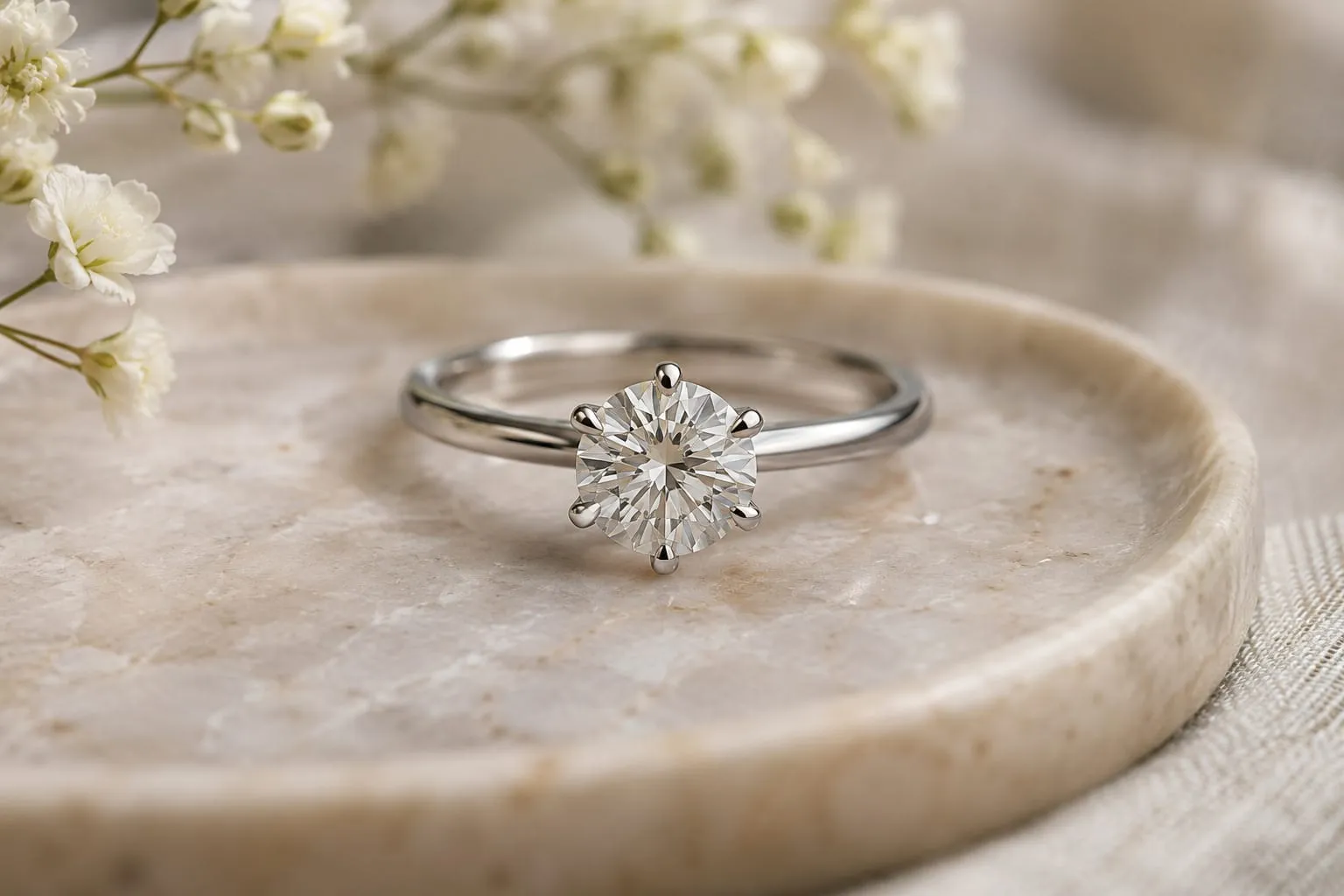
Round engagement rings are the default for a reason: GIA calls the round brilliant the most popular diamond shape and the one with the most brightness, and it is the only shape GIA gives a cut grade. The five picks below are complete rings, each priced with the same 1.01 carat round lab-grown diamond (H color, VS1 clarity) so the settings can be compared on equal terms. On 6 November 2026 they ran from $1,270 to $1,660 in 14K gold, from a classic six-prong solitaire to a three-stone, and our overall pick is the Olivia Knife Edge 6 Prong Solitaire, the lowest complete price of the five.
How we are paid. RingReel earns a commission from Rare Carat through the Awin network when you buy through a Rare Carat link on this page, at no cost to you. The picks come from the listings and terms below, not from the commission. Nothing here was bought or handled: it is researched, not tested.
What is on this page11 sections
Our Top Picks
- Our top pick
Best overall
Illustration of the setting type, not a photo of this ring.
Rare Carat Olivia Knife Edge 6 Prong Solitaire Engagement RingA buyer who wants the classic round solitaire look at the lowest complete price on this page.
- 14K white gold as priced; yellow and rose gold, 18K and platinum on the page
- $1,270
Best for daily wear
Illustration of the setting type, not a photo of this ring.
Rare Carat Mackenzie Solitaire Engagement RingSomeone who uses her hands all day and wants a solitaire built with more metal around the stone.
- 14K white gold as priced; yellow and rose gold, 18K and platinum on the page
- $1,330
Best hidden halo
Illustration of the setting type, not a photo of this ring.
Rare Carat Kate Hidden Halo Diamond Engagement RingA buyer who wants a plain solitaire from above with a hidden flash of diamonds from the side.
- 14K yellow gold as priced; white and rose gold, 18K and platinum on the page
- $1,395
Best three-stone
Illustration of the setting type, not a photo of this ring.
Rare Carat Stacy Petite Three-Stone Hidden Halo Engagement RingA buyer who wants round side stones beside the round center, without the side stones taking over.
- 14K white gold as priced; yellow and rose gold, 18K and platinum on the page
- $1,630
Best pavé twist
Illustration of the setting type, not a photo of this ring.
Rare Carat Torvia Solitaire Engagement RingA buyer who wants a round center on a band with movement and sparkle, without a halo.
- 14K white gold as priced; yellow and rose gold, 18K and platinum on the page
- $1,660
What is on this page11 sections
Key Takeaways
- GIA’s 2025 shape guide calls the round brilliant the most popular diamond shape, says it has the most brightness of all diamond cuts, and notes it is the only shape with an official GIA cut grade.
- A standard round brilliant has 57 or 58 facets, according to the same GIA guide, which is why its cut can be graded on a fixed scale from Excellent to Poor.
- GIA’s Gems and Gemology reported in 2024 that 70% of D-to-Z natural diamonds it sees are round, while lab-grown diamonds are spread more evenly across shapes.
- All five picks here use the same diamond, so the price differences come from the setting alone, from $895 to $1,285 for the setting.
- Platinum adds $180 to $515 over 14K gold on these five rings, with the three-stone at the top of that range.
Round Engagement Rings Compared
Every price below is for a complete ring in 14K gold with a 1.01 carat round lab diamond graded H color and VS1 clarity, as listed on Rare Carat on 6 November 2026. Holding the stone constant means the table compares settings, not diamonds. If you swap in a bigger or natural stone, the setting price stays the same and only the diamond line changes.
| Ring | Price range | Setting | Stones | Returns, per the jeweler |
|---|---|---|---|---|
| $1,270 | Six-prong solitaire on a knife-edge band | 1.01 ct round lab-grown center, H, VS1, Rare Carat Ideal cut; no side stones | Free returns until January 15, 2027 for holiday orders; one free resize in the first year, per Rare Carat | |
Rare Carat Mackenzie Solitaire Engagement RingBest for daily wear | $1,330 | Solitaire with a decorative head and thick prongs | 1.01 ct round lab-grown center, H, VS1, Rare Carat Ideal cut; no side stones | Free returns until January 15, 2027 for holiday orders; one free resize in the first year, per Rare Carat |
Rare Carat Kate Hidden Halo Diamond Engagement RingBest hidden halo | $1,395 | Round center over a hidden halo, with pavé under the bridge | 1.01 ct round lab-grown center, H, VS1; 22 accent diamonds, 0.08 ct total, F-G, SI1 | Free returns until January 15, 2027 for holiday orders; one free resize in the first year, per Rare Carat |
Rare Carat Stacy Petite Three-Stone Hidden Halo Engagement RingBest three-stone | $1,630 | Three-stone with a split shank and hidden halo | 1.01 ct round lab-grown center, H, VS1; 10 round side diamonds, 0.15 ct total, G-H, VS1 | Free returns until January 15, 2027 for holiday orders; one free resize in the first year, per Rare Carat |
Rare Carat Torvia Solitaire Engagement RingBest pavé twist | $1,660 | Twisting pavé setting with claw prongs | 1.01 ct round lab-grown center, H, VS1; pavé band, stone count not listed | Free returns until January 15, 2027 for holiday orders; one free resize in the first year, per Rare Carat |
Price ranges from the makers' sites, checked 6 November 2026. Prices change; the maker's site has the current one.
Rare Carat’s pages were showing a Black Friday sale with a crossed-out comparison value beside each price. We quote only the price shown, not the comparison value or the saving, and Rare Carat says its prices are protected until December 1.
The Best Round Engagement Rings, Reviewed
Best overall
Rare Carat Olivia Knife Edge 6 Prong Solitaire Engagement Ring
by Rare Carat
Best for: A buyer who wants the classic round solitaire look at the lowest complete price on this page.
Six low-profile prongs set the round center close to the finger on a band that tapers to a central ridge, 1.90mm to 2.00mm wide.
Illustration of the setting type, not a photo of this ring.
What we like
- The lowest complete price of the five, with a 1 ct round included
- Six prongs, one of the two counts GIA says most round brilliants use
- Sizes 3 to 12, wider than the three-stone and halo picks
Keep in mind
- No grading lab is named on the complete-ring page
- A knife-edge band shows its ridge, which not everyone wants
- Prongs need occasional checks, per GIA
- Price range
- $1,270 complete: $895 for the setting and $375 for a 1.01 ct lab diamond, 14K white gold (checked 2026-11-06)
- Material
- 14K white gold as priced; yellow and rose gold, 18K and platinum on the page
- Widths
- 1.90mm to 2.00mm
- Sizes
- 3 to 12
- Guarantee
- Lifetime guarantee and one free resize in year one, per Rare Carat; holiday returns to January 15, 2027
Best for daily wear
Rare Carat Mackenzie Solitaire Engagement Ring
by Rare Carat
Best for: Someone who uses her hands all day and wants a solitaire built with more metal around the stone.
Rare Carat: "Classic solitaire style engagement ring with decorative head and thick prongs along the center stone", 2.00mm to 2.10mm wide.
Illustration of the setting type, not a photo of this ring.
What we like
- Thick prongs named on the listing, for a sturdier grip on the round
- A 2mm band, slightly heavier than the Olivia
- Only $60 more than the Olivia as a complete ring
Keep in mind
- The listing does not give the prong count
- Thicker prongs cover a little more of the stone
- No grading lab named on the complete-ring page
- Price range
- $1,330 complete: $955 for the setting and $375 for a 1.01 ct lab diamond, 14K white gold (checked 2026-11-06)
- Material
- 14K white gold as priced; yellow and rose gold, 18K and platinum on the page
- Widths
- 2.00mm to 2.10mm
- Sizes
- 3 to 12
- Guarantee
- Lifetime guarantee and one free resize in year one, per Rare Carat; holiday returns to January 15, 2027
Best hidden halo
Rare Carat Kate Hidden Halo Diamond Engagement Ring
by Rare Carat
Best for: A buyer who wants a plain solitaire from above with a hidden flash of diamonds from the side.
Rare Carat: "This ring has a classic look and features pavé set diamonds under the bridge"; handcrafted in the USA, 1.60mm band.
Illustration of the setting type, not a photo of this ring.
What we like
- Looks like a solitaire face-on, so it pairs with a plain band
- A matching band is listed
- Made in the USA, per the listing
Keep in mind
- Sizes stop at 10
- The accent stones are tiny, 0.08 ct across 22 of them
- More small stones to check over time
- Price range
- $1,395 complete: $1,020 for the setting and $375 for a 1.01 ct lab diamond, 14K yellow or white gold (checked 2026-11-06)
- Material
- 14K yellow gold as priced; white and rose gold, 18K and platinum on the page
- Widths
- 1.60mm
- Sizes
- 3 to 10
- Guarantee
- Lifetime guarantee and one free resize in year one, per Rare Carat; holiday returns to January 15, 2027
- Made in
- Handcrafted in the USA, per Rare Carat
Best three-stone
Rare Carat Stacy Petite Three-Stone Hidden Halo Engagement Ring
by Rare Carat
Best for: A buyer who wants round side stones beside the round center, without the side stones taking over.
Rare Carat: "Petite round diamonds gracefully frame the center stone in this classic three-stone design"; handcrafted in the USA, 1.50mm to 1.70mm band.
Illustration of the setting type, not a photo of this ring.
What we like
- Side stones listed at VS1, the same clarity as the center
- Split shank and hidden halo add detail from the side
- Made in the USA, per the listing
Keep in mind
- Platinum costs $515 more than 14K gold on this setting, the biggest gap here
- A split shank is harder to pair with a straight band
- Sizes stop at 10
- Price range
- $1,630 complete: $1,255 for the setting and $375 for a 1.01 ct lab diamond, 14K white gold (checked 2026-11-06)
- Material
- 14K white gold as priced; yellow and rose gold, 18K and platinum on the page
- Widths
- 1.50mm to 1.70mm
- Sizes
- 3 to 10
- Guarantee
- Lifetime guarantee and one free resize in year one, per Rare Carat; holiday returns to January 15, 2027
- Made in
- Handcrafted in the USA, per Rare Carat
Best pavé twist
Rare Carat Torvia Solitaire Engagement Ring
by Rare Carat
Best for: A buyer who wants a round center on a band with movement and sparkle, without a halo.
Rare Carat: "A twisting setting secures the center diamond in refined claw prongs", 1.80mm band.
Illustration of the setting type, not a photo of this ring.
What we like
- A twist with pavé is a different look from every other pick
- Platinum is $180 more than 14K white gold, the smallest gap here
- Claw prongs keep the round center open to light
Keep in mind
- The most expensive pick in 14K gold
- The listing does not count the pavé stones
- Pavé bands are harder to resize, per GIA
- Price range
- $1,660 complete: $1,285 for the setting and $375 for a 1.01 ct lab diamond, 14K white gold (checked 2026-11-06)
- Material
- 14K white gold as priced; yellow and rose gold, 18K and platinum on the page
- Widths
- 1.80mm
- Sizes
- 3 to 10
- Guarantee
- Lifetime guarantee and one free resize in year one, per Rare Carat; holiday returns to January 15, 2027
How We Chose
- One stone for every ring. Each pick was priced with the same 1.01 carat round lab-grown diamond, H color, VS1 clarity, Rare Carat Ideal cut. That way the comparison is about settings, which is the part of the ring you live with.
- A spread of settings, not five solitaires. Round diamonds work in almost every setting, so the list covers a six-prong solitaire, a heavier four-prong solitaire, a hidden halo, a three-stone and a pavé twist. If you already know you want a plain solitaire, our page of solitaire engagement rings goes deeper on that one style.
- No repeats. None of these five settings appears on our other engagement ring pages, so each page shows you different rings.
- Jewelers from our approved list. All five are from Rare Carat, which is also the jeweler that pays us. Other stores sell round engagement rings; they are not ranked lower, they are simply not on this page.
- Nothing bought or handled. Every detail comes from the product page as read on 6 November 2026, from Rare Carat’s U.S. site in U.S. dollars.
Why Round Is the Default Shape
Shape is the first decision on an engagement ring and round is where most people start. Three facts from GIA explain why, and one of them matters more than the rest when you buy.
The Most Brightness of Any Cut
GIA’s 2025 guide to diamond shapes says the round brilliant “is renowned for having the most brightness out of all the diamond cuts.” Brightness is the white light a diamond returns to your eye. A round brilliant’s facets are arranged in a pattern designed around that, which is part of why the shape has held its place while others have come and gone.
The Only Shape With a GIA Cut Grade
This is the practical one. GIA gives cut grades only to round brilliant diamonds, on a scale from Excellent to Poor, because the round brilliant is the only cut with standardized facets. A standard round brilliant has exactly 57 or 58 facets, the same guide says. For an oval or a pear, there is no GIA cut grade to lean on, and you judge the stone by its proportions and by eye. For a round, the grade does that work for you, as long as the report comes from a lab that grades cut.
Most Natural Diamonds Are Round
GIA’s Gems and Gemology journal reported in summer 2024 that 70% of D-to-Z natural diamonds are round, citing earlier GIA research, while laboratory-grown diamonds are distributed more evenly across shapes. In practice, that means you will have the most choice of natural stones in round, and the shape is easy to match and replace years later.
Round Engagement Ring Settings
A round center works in every setting style there is. GIA’s 2026 guide to ring settings describes each style below, and the five picks map onto them one by one.
Solitaire: Four Prongs or Six
GIA says most round brilliant diamond rings use four or six prongs. Six prongs, as on the Olivia, give the stone a softer, rounder outline from above and spread the grip across more points. Four prongs, as on most classic solitaires, show a little more of the diamond. The Mackenzie is described by Rare Carat as having thick prongs, which adds metal around the stone at the cost of covering a touch more of it. GIA also notes that prongs should be checked occasionally and that their raised edges can catch on fabric, which is true of every pick here.
Halo and Hidden Halo
A halo, in GIA’s words, is a prong or bezel set center stone surrounded by a ring of smaller accent stones, and GIA notes a halo can make the center look the size of the whole halo. A hidden halo puts that ring of stones under the center, where you see it from the side but not from above. The Kate keeps a solitaire look face-on and adds pavé under the bridge. For full halos where the extra stones show from the top, see our list of halo engagement rings.
Three-Stone
GIA describes a three-stone ring as a center gemstone flanked by two smaller side stones, and advises that in an all-diamond three-stone ring the side stones should typically be within about two color grades of the center. The Stacy lists its ten side diamonds as G-H color beside an H center, so it sits inside that guidance. Its side stones are listed at VS1 clarity, the same as the center.
Pavé and Twist Bands
Pavé sets small stones close together with tiny beads or prongs of metal. GIA says pavé may need occasional maintenance to keep the stones secure, and that pavé-set bands can be harder to resize because adjusting the ring can disturb the small stones. The Torvia twists a pavé band around the center, which is the most decorative look here and the one with the most small stones to look after.
Choosing the Round Diamond Itself
The setting is what you see every day, but the diamond is where most of the money goes once you move past one carat. Three things are worth deciding before you pick a ring.
Read the Cut Grade, and Know Whose Grade It Is
Because GIA grades cut on round brilliants, ask for the cut grade on the report and check which lab issued it. The picks here list a “Rare Carat Ideal” cut, which is Rare Carat’s own label rather than a GIA grade, and the complete-ring pages we read do not name a grading lab for the stone. Before you order, ask Rare Carat for the stone’s report so you can see the lab, the cut grade and the measurements yourself.
Carat Weight and Diameter
Carat is weight, not size, but for a round diamond the two track closely. Brilliant Earth’s 2026 conversion chart puts a 1 carat round at about 6.3mm across, a 1.5 carat at about 7.3mm and a 2 carat at about 8mm, and warns that the conversions are approximate because two stones of the same weight can carry it differently.
| Round carat weight | Approximate diameter (Brilliant Earth, 2026) | What changes in the setting |
|---|---|---|
| 1.00 ct | 6.3mm | The weight priced on every ring on this page |
| 1.50 ct | 7.3mm | Same settings fit; prongs grip a wider girdle |
| 2.00 ct | 8.0mm | Check that the head is offered for the bigger stone before you order |
All five settings are listed for any diamond shape, so a larger round is a change of stone, not of setting. Our guide to average engagement ring carat size puts the 1 carat on this page in context.
Lab-Grown or Natural
Every pick here was priced with a lab-grown round because it keeps the comparison honest across five settings. You can set a natural round in any of them instead. GIA’s 2024 report notes that lab-grown diamonds have begun to replace parts of the natural market as their prices fell, so the price gap between the two is now the biggest variable in the total. Our comparison of lab-grown vs natural diamonds covers what you give up and what you keep.
Which Metal Suits a Round Engagement Ring?
All five settings are offered in 14K and 18K gold and in platinum. The table shows the complete price with the same 1.01 carat lab diamond in 14K white gold and in platinum, read on 6 November 2026.
| Ring | 14K gold, complete | Platinum, complete | Platinum premium |
|---|---|---|---|
| Olivia Knife Edge 6 Prong | 1,270 dollars | 1,485 dollars | 215 dollars |
| Mackenzie Solitaire | 1,330 dollars | 1,555 dollars | 225 dollars |
| Kate Hidden Halo | 1,395 dollars | 1,670 dollars | 275 dollars |
| Stacy Three-Stone | 1,630 dollars | 2,145 dollars | 515 dollars |
| Torvia Twist | 1,660 dollars | 1,840 dollars | 180 dollars |
On four of the five, 18K gold costs more than platinum: the Olivia, Mackenzie, Kate and Torvia are all cheaper in platinum than in 18K white gold. Only the Stacy reverses that. GIA’s 2013 article on platinum says the metal does not tarnish and keeps its natural white color, while white gold relies on plating, so if you were going to pay for 18K white gold, platinum is the better value on most of these rings. For the trade-offs in daily wear, see platinum vs white gold.
Which Round Engagement Ring Fits You?
| If you want | Pick | Why |
|---|---|---|
| The classic look for the lowest price | Olivia Knife Edge 6 Prong | Six prongs, knife-edge band, the lowest complete price |
| A solitaire for hands that work | Mackenzie Solitaire | Thick prongs and a slightly heavier 2mm band |
| A solitaire face-on with a secret | Kate Hidden Halo | Pavé under the bridge, seen only from the side |
| Side stones that match the center | Stacy Three-Stone | Ten round side diamonds at VS1, inside GIA’s color guidance |
| A band with movement | Torvia Twist | Pavé twist with claw prongs, smallest platinum premium |
If none of these suits, the engagement ring finder narrows rings by setting, metal and budget in a few questions.
Frequently Asked Questions
What Is the Prettiest Cut for a Diamond?
Beauty is a matter of taste, but if you mean sparkle, GIA’s 2025 shape guide says the round brilliant has the most brightness of any diamond cut. That is the closest thing to an objective answer. Ovals, pears and emeralds each have their own look, and plenty of people prefer them for exactly that reason.
Is Ideal a Good Diamond Cut?
It depends on who is using the word. GIA’s own scale for round diamonds runs from Excellent to Poor, so Ideal is not a GIA grade. Retailers, including Rare Carat on this page, use Ideal as their own label. Ask for the grading report and look for the lab’s cut grade before treating Ideal as proof of quality.
Are Round Engagement Rings With a Halo Still Popular?
The halo is one of the setting styles GIA’s 2026 guide describes in detail, and it remains easy to find at every major jeweler. If you like the effect but want a cleaner look from above, a hidden halo such as the Kate places the accent stones under the center, where they show only from the side.
How Big Is a 2 Carat Round Diamond?
About 8mm across, according to Brilliant Earth’s 2026 conversion chart, against roughly 6.3mm for a 1 carat round. The chart warns that conversions are approximate, because two diamonds of the same weight can carry it differently. Measure the stone itself on its report rather than trusting a chart.
Do Round Diamonds Look Good in Yellow Gold?
Yes, and it is a matter of taste rather than rule. A white diamond in yellow gold shows more contrast, while white gold or platinum keeps the whole ring cool and white. Every pick on this page is offered in yellow gold, and the Kate’s listing opens in 14K yellow gold at the same price as white.
Sources
- Rare Carat, Olivia Knife Edge 6 Prong Solitaire Engagement Ring with a 1.01 ct round lab diamond, complete ring, accessed 06/11/2026.
- Rare Carat, Mackenzie Solitaire Engagement Ring with a 1.01 ct round lab diamond, complete ring, accessed 06/11/2026.
- Rare Carat, Kate Hidden Halo Diamond Engagement Ring with a 1.01 ct round lab diamond, complete ring, accessed 06/11/2026.
- Rare Carat, Stacy Petite Three-Stone Hidden Halo Engagement Ring with a 1.01 ct round lab diamond, complete ring, accessed 06/11/2026.
- Rare Carat, Torvia Solitaire Engagement Ring with a 1.01 ct round lab diamond, complete ring, accessed 06/11/2026.
- GIA 4Cs, Guide to Diamond Shapes for Engagement Rings, 2025.
- GIA 4Cs, Diamond Cut, undated, accessed 11/09/2026.
- GIA 4Cs, Complete Guide to Engagement Ring Settings: Types vs. Styles, 2026.
- GIA, Gems and Gemology, Eaton-Magana, Hardman and Odake, Laboratory-Grown Diamonds: An Update on Identification and Products Evaluated at GIA, 2024.
- GIA 4Cs, Platinum: A Metal Fit for Kings, 2013.
- Brilliant Earth, MM to Carat Weight Conversion Chart, 2026.