

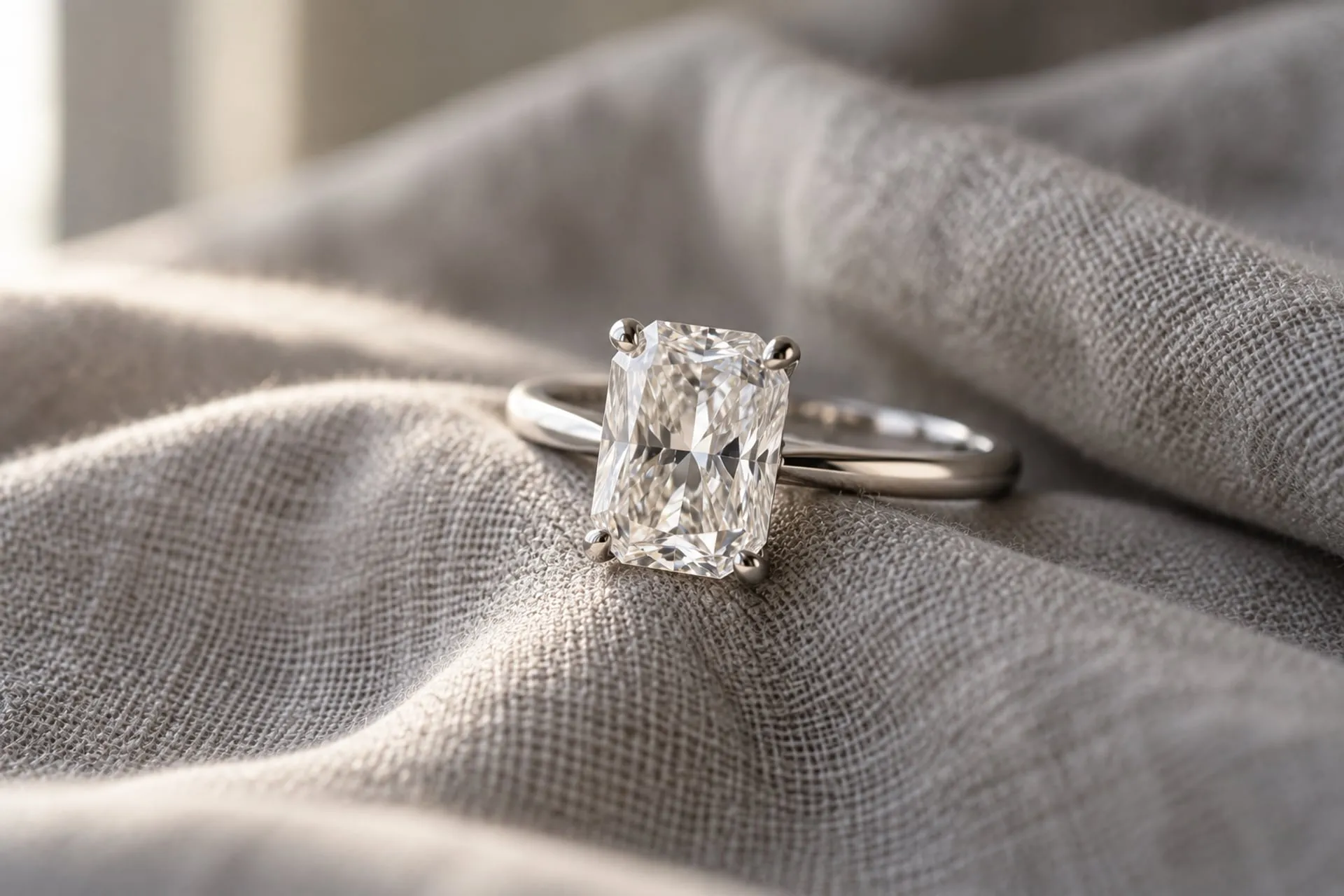
Radiant cut engagement rings pair a rectangular outline with a faceted, sparkling top, and on 30 October 2026 Rare Carat sold the five below as finished rings with a 1.19 carat lab-grown radiant, from 1,230 dollars for a classic solitaire to 2,210 dollars for a halo. Each is a different way to set the same stone: a plain solitaire, a cathedral, a hidden halo, a three-stone and a full halo. All five come from Rare Carat, so read this as five settings with one ring in each, priced on one day, not a ranking of every jeweler.
How we are paid. RingReel earns a commission from Rare Carat through the Awin network when you buy through a Rare Carat link on this page, at no cost to you. The picks come from the listings and terms below, not from who pays. Nothing here was bought or handled: it is researched, not tested.
What is on this page11 sections
Our Top Picks
- Our top pick
Best overall
Illustration of the setting type, not a photo of this ring.
Rare Carat Ally Classic Solitaire Engagement Ring (1.4mm) With 1.19 Carat Radiant Lab DiamondA buyer who wants the radiant to carry the ring, at the lowest total of these five.
- 14K white gold; 1.19 ct radiant lab-grown diamond
- $1,230
Best cathedral
Illustration of the setting type, not a photo of this ring.
Rare Carat Tradition Cathedral Solitaire Engagement Ring (1.8mm) With 1.19 Carat Radiant Lab DiamondA buyer who wants the stone lifted on arches, for a small step up from the plain solitaire.
- 14K white gold; 1.19 ct radiant lab-grown diamond
- $1,315
Best hidden halo
Illustration of the setting type, not a photo of this ring.
Rare Carat Marie Classic Hidden Halo Lab Pavé Engagement Ring With 1.19 Carat Radiant Lab DiamondA buyer who wants extra sparkle on the band without a visible halo around the stone.
- 14K white gold; 1.19 ct radiant lab-grown diamond
- $1,295
Best three-stone
Illustration of the setting type, not a photo of this ring.
Rare Carat Rosella Three Stone Lab Engagement Ring With 1.19 Carat Radiant Lab DiamondA buyer who wants more diamond across the finger than a single stone gives.
- 14K white gold; 1.19 ct radiant lab-grown diamond
- $1,615
Best halo
Illustration of the setting type, not a photo of this ring.
Rare Carat Cici Halo Engagement Ring With 1.19 Carat Radiant Lab DiamondA buyer who wants the 1.19 carat stone to look as big as it can.
- 14K white gold; 1.19 ct radiant lab-grown diamond
- $2,210
What is on this page11 sections
Key Takeaways
- As complete rings in 14K white gold, the five picks ran from 1,230 to 2,210 dollars on 30 October 2026, each set with the same 1.19 carat H VS1 lab-grown radiant priced at 505 dollars, so the whole gap between them is the setting.
- Rare Carat showed 48 radiant rings in its lab-grown radiant category that day, every one with the same 1.19 carat stone, from 1,105 dollars to 2,600 dollars.
- GIA says the radiant cut has 70 facets, that the pattern helps mask inclusions and warm colors, and that its cropped corners help prevent chipping.
- GIA also says radiants tend to cost less per carat than round brilliants while offering similar sparkle. We did not price a round that day, so we cannot confirm it for these listings.
- No ring page stated a prong count, a length-to-width ratio or a lab report for the stone. Ask before you order.
- A sale was running (Black Friday on the Ally page), so every figure here is a sale price. Check the total on the page.
Radiant Cut Engagement Rings Compared
The price column is what each listing showed on 30 October 2026 in 14K white gold with the 1.19 carat lab radiant set. Every setting is also sold alone if you would rather choose another stone.
| Ring | Price range | Setting | Stones | Band width | Returns and resizing, per Rare Carat |
|---|---|---|---|---|---|
| $1,230 | Classic solitaire on a slim band | A 1.19 carat radiant lab-grown diamond, H color, VS1 clarity, Rare Carat Ideal Cut | 1.40mm | Free returns within 30 days of shipment; one free resize in the first year | |
| $1,315 | Cathedral solitaire on a tapered band | A 1.19 carat radiant lab-grown diamond, H color, VS1 clarity, Rare Carat Ideal Cut | 1.15mm to 1.80mm, tapered | Free returns within 30 days of shipment; one free resize in the first year | |
| $1,295 | Hidden halo with a pavé band | A 1.19 carat radiant lab-grown diamond, H color, VS1 clarity, plus 32 pavé diamonds, 0.26 ct total, F color, VS2 clarity | 1.50mm | Free returns within 30 days of shipment; one free resize in the first year | |
| $1,615 | Three-stone style with side lab diamonds | A 1.19 carat radiant lab-grown diamond, H color, VS1 clarity, plus 18 round side lab diamonds, 0.5 ct total, F color, VS1 clarity | 2.00mm to 2.20mm | Free returns within 30 days of shipment; one free resize in the first year | |
| $2,210 | Full halo with pavé | A 1.19 carat radiant lab-grown diamond, H color, VS1 clarity, plus 38 pavé diamonds, 0.56 ct total, G-H color, SI1 clarity | 2.00mm | Free returns within 30 days of shipment; one free resize in the first year |
Price ranges from the makers' sites, checked 30 October 2026. Prices change; the maker's site has the current one.
The Best Radiant Cut Engagement Rings, Reviewed
Best overall
Rare Carat Ally Classic Solitaire Engagement Ring (1.4mm) With 1.19 Carat Radiant Lab Diamond
by Rare Carat
Best for: A buyer who wants the radiant to carry the ring, at the lowest total of these five.
Rare Carat says there is "no sparkle competing for attention"; the page does not state the prong count.
Illustration of the setting type, not a photo of this ring.
What we like
- The lowest total of the five
- A complete ring with the radiant set, priced as setting plus stone
- Nothing beside the stone to pull the eye away
Keep in mind
- The page does not state the prong count
- The ring page shows no lab report or length-to-width ratio
- A slim 1.4mm band leaves less metal to work with later
- Price range
- $1,230 complete: $725 for the setting and $505 for the 1.19 ct radiant lab diamond, 14K white gold (checked 2026-10-31)
- Material
- 14K white gold; 1.19 ct radiant lab-grown diamond
- Widths
- 1.40mm
- Sizes
- 3 to 10
- Guarantee
- Returns within 30 days of shipment; one free resize in year one, per Rare Carat
Best cathedral
Rare Carat Tradition Cathedral Solitaire Engagement Ring (1.8mm) With 1.19 Carat Radiant Lab Diamond
by Rare Carat
Best for: A buyer who wants the stone lifted on arches, for a small step up from the plain solitaire.
Rare Carat says the arch "raises the center stone for more light".
Illustration of the setting type, not a photo of this ring.
What we like
- Only 85 dollars above the Ally on the day we read it
- A tapered band that draws the eye to the stone
- The arch raises the stone, per Rare Carat
Keep in mind
- A raised head stands higher on the finger
- The page does not state the prong count
- The ring page shows no lab report or length-to-width ratio
- Price range
- $1,315 complete: $810 for the setting and $505 for the 1.19 ct radiant lab diamond, 14K white gold (checked 2026-10-31)
- Material
- 14K white gold; 1.19 ct radiant lab-grown diamond
- Widths
- 1.15mm to 1.80mm, tapered
- Sizes
- 3 to 10
- Guarantee
- Returns within 30 days of shipment; one free resize in year one, per Rare Carat
Best hidden halo
Rare Carat Marie Classic Hidden Halo Lab Pavé Engagement Ring With 1.19 Carat Radiant Lab Diamond
by Rare Carat
Best for: A buyer who wants extra sparkle on the band without a visible halo around the stone.
A hidden halo sits under the center stone, so from above the ring reads as a solitaire with a pavé band.
Illustration of the setting type, not a photo of this ring.
What we like
- Costs less than the Tradition Cathedral on the day we read it
- 32 pavé diamonds, with their color and clarity published
- A solitaire look from above
Keep in mind
- Pavé on a band limits later resizing more than plain metal
- The page does not state the prong count
- The ring page shows no lab report or length-to-width ratio
- Price range
- $1,295 complete: $790 for the setting and $505 for the 1.19 ct radiant lab diamond, 14K white gold (checked 2026-10-31)
- Material
- 14K white gold; 1.19 ct radiant lab-grown diamond
- Widths
- 1.50mm
- Sizes
- 3 to 10
- Guarantee
- Returns within 30 days of shipment; one free resize in year one, per Rare Carat
Best three-stone
Rare Carat Rosella Three Stone Lab Engagement Ring With 1.19 Carat Radiant Lab Diamond
by Rare Carat
Best for: A buyer who wants more diamond across the finger than a single stone gives.
The side diamonds are held by U-shaped prongs, per Rare Carat.
Illustration of the setting type, not a photo of this ring.
What we like
- 0.5 ct of side diamonds beside the center stone
- F color, VS1 side stones, with the grades published
- A matching Rosella band is offered beside it
Keep in mind
- Costs 385 dollars more than the Ally for the same center stone
- The wider head takes up more room beside a wedding band
- The ring page shows no lab report or length-to-width ratio
- Price range
- $1,615 complete: $1,110 for the setting and $505 for the 1.19 ct radiant lab diamond, 14K white gold (checked 2026-10-31)
- Material
- 14K white gold; 1.19 ct radiant lab-grown diamond
- Widths
- 2.00mm to 2.20mm
- Sizes
- 3 to 10
- Guarantee
- Returns within 30 days of shipment; one free resize in year one, per Rare Carat
Best halo
Rare Carat Cici Halo Engagement Ring With 1.19 Carat Radiant Lab Diamond
by Rare Carat
Best for: A buyer who wants the 1.19 carat stone to look as big as it can.
Rare Carat says the circle of pavé makes the center "look noticeably larger".
Illustration of the setting type, not a photo of this ring.
What we like
- The halo makes the center look larger, per Rare Carat
- 38 pavé diamonds, 0.56 ct total, the most stone weight of the five
- A matching Cici Pavé Band is offered beside it
Keep in mind
- The dearest of the five, 980 dollars above the Ally
- A halo widens the head, which matters if you work with your hands
- G-H color and SI1 pavé is the lowest side stone grade of the five
- Price range
- $2,210 complete: $1,705 for the setting and $505 for the 1.19 ct radiant lab diamond, 14K white gold (checked 2026-10-31)
- Material
- 14K white gold; 1.19 ct radiant lab-grown diamond
- Widths
- 2.00mm
- Sizes
- 3 to 10
- Guarantee
- Returns within 30 days of shipment; one free resize in year one, per Rare Carat
How We Chose
- Five settings, one ring each. A solitaire, a cathedral solitaire, a hidden halo with pavé, a three-stone and a halo, because the setting is the choice you make after choosing the shape.
- One jeweler, and we say so. Every pick is from Rare Carat, the only jeweler whose affiliate program has accepted RingReel so far. Other stores are not ranked below it; they are simply not listed yet.
- The same stone in all five. Each page opened with a 1.19 carat radiant, H color, VS1 clarity, Rare Carat Ideal Cut, at 505 dollars, so the price gap is the setting and nothing else.
- Sale prices, labeled. Each page also showed a higher “Comp. value”, which we leave out.
- Terms from Rare Carat’s own pages, read the same day: free 30-day returns and one free resize in the first year.
What Makes a Radiant Cut Different
GIA’s guide to engagement ring shapes describes the radiant as “one of the most brilliant of the rectangular shapes”, thanks to 70 facets that help mask inclusions and warm colors. Its corners are cropped, and GIA says those cropped corners help prevent chipping. In practice that puts the radiant between two neighbors we cover separately: the sleek step cut of the emerald cut and the sharper corners of the princess cut.
Square or Rectangular
GIA gives no ratio range for radiants. It says only that square versions look compact, while rectangular ones have a lengthening effect on the finger. None of the five ring pages stated the stone’s ratio or measurements, so ask Rare Carat for them before you pick between a square and a rectangular look. Our page on engagement rings for long fingers and the other finger guides show how outline affects the hand.
Radiant vs Emerald
The two share a rectangular outline but not a facet pattern. An emerald cut uses long step facets and looks glassy; a radiant uses brilliant-style facets and looks lively. If you are weighing the two, our guide to engagement ring shapes compares them with every other cut.
Lab Grown Radiant Engagement Rings
Every pick here is a lab grown radiant engagement ring as priced, and the lab stone is why a 1.19 carat center fits inside these numbers: the stone alone was 505 dollars on that day.
The Stone All Five Pages Opened With
Rare Carat paired the same stone with every setting: a 1.19 carat radiant lab diamond, H color, VS1 clarity, Rare Carat Ideal Cut. The pages we opened showed no lab report and no ratio. Our guide to IGI vs GIA explains what each lab’s report would tell you, so ask which lab graded the stone you are shown.
Lab or Natural
The shape and the setting do not change with the choice; the price does, and so does what the grading report has to tell you. Our guide to lab-grown vs natural diamonds covers the difference in full. For lower totals, see our affordable engagement rings page.
Ring Settings for Radiant Stones: Which Protects and Flatters
GIA’s guide to engagement ring settings, published in August 2026, separates the setting types (prong, bezel and others) from the styles built on them. The sections below take the choices in that order, using the five picks as examples. For the full range, see our guide to engagement ring settings.
Solitaire
The Ally Classic Solitaire is a 1.4mm band that Rare Carat says holds the stone on a rounded base, with “no sparkle competing for attention”. It was the lowest price of the five at 1,230 dollars. Rare Carat did not state the prong count.
Cathedral
The Tradition Cathedral Solitaire has a band that tapers from 1.8mm to 1.15mm, and Rare Carat says its arch “raises the center stone for more light”. It cost 1,315 dollars, 85 dollars above the Ally. A raised head stands higher on the finger, so check our low-profile engagement rings page if snagging is a worry, and read our guide to the cathedral setting.
Hidden Halo with Pavé
The Marie Classic Hidden Halo cost 1,295 dollars: 32 pavé diamonds totaling 0.26 carat in F color and VS2 clarity run along the band, and a hidden halo sits under the center stone. It is a sparkling look that reads as a solitaire from above.
Three-Stone
The Rosella Three Stone cost 1,615 dollars and adds 18 round side lab diamonds, 0.5 carat total, F color, VS1, held by U-shaped prongs, on a band of 2.00mm to 2.20mm.
Halo
The Cici Halo was the dearest at 2,210 dollars: 38 pavé diamonds, 0.56 carat total, G-H color and SI1 clarity, on a 2.00mm band. Rare Carat says the circle of pavé makes the center “look noticeably larger”. GIA says a halo of smaller diamonds surrounds the center stone, and a halo widens the head, which matters if you work with your hands.
What About Bezel and Prongs
GIA’s radiant section does not give setting advice beyond saying a radiant works “as a solitaire or surrounded by a halo”. For shapes with corners, GIA says princess cuts can be set in bezel settings for maximum protection and need prongs that protect the corners. Those lines are about princess cuts, so treat them as a general hint for any cornered stone, not a radiant rule. None of our five is a bezel, so we cannot price one here. See our bezel setting guide and our bezel set engagement rings page.
Which Setting for Which Priority
| Your priority | Setting to look at | Why, from the listings |
|---|---|---|
| The lowest total | Ally Classic Solitaire | 1,230 dollars, the cheapest of the five on 30 October 2026 |
| A raised stone | Tradition Cathedral | Arch raises the center stone, per Rare Carat |
| Hidden sparkle | Marie Hidden Halo | Pavé on the band and a halo under the stone |
| More than one stone | Rosella Three Stone | 18 side lab diamonds, 0.5 carat total |
| The biggest look | Cici Halo | Rare Carat says the halo makes the center look larger |
| Corner protection | Ask about the head | No page stated the prong count |
The Wedding Band to Go With It
Every listing offered a band made to sit beside it, shown on the page on 30 October 2026:
| Engagement ring | Matching band offered | Band price, 14K white gold | Ring and band together |
|---|---|---|---|
| Ally Classic Solitaire, 1,230 dollars | Shared Prong Lab Eternity Band (.25ct tw.) | 615 dollars | 1,845 dollars |
| Tradition Cathedral, 1,315 dollars | Sculpted Heart Lab Diamond Eternity Ring (1 ct. tw.) | 595 dollars | 1,910 dollars |
| Marie Hidden Halo, 1,295 dollars | Shared Prong Lab Eternity Band (.33 ct tw.) | 735 dollars | 2,030 dollars |
| Rosella Three Stone, 1,615 dollars | Rosella Lab Band | 560 dollars | 2,175 dollars |
| Cici Halo, 2,210 dollars | Cici Pavé Band | 860 dollars | 3,070 dollars |
The totals add the two listed prices, before any bundle saving the page applies at checkout. Our guide to what an eternity ring is explains why those bands cannot be resized later.
Sizing Before You Order
Rare Carat offers free 30-day returns and one free resize in the first year, and the sizes shown for all five rings ran from 3 to 10. Measure first with our printable ring sizer, and read our Rare Carat review for the rest of the terms.
Which Radiant Cut Engagement Ring Fits You?
| Your situation | Our pick | Why |
|---|---|---|
| You want the lowest price here | Ally Classic Solitaire | 1,230 dollars complete |
| You want the stone lifted | Tradition Cathedral | Cathedral arch, 1.8mm tapered band |
| You want a solitaire look with extra sparkle | Marie Hidden Halo | 32 pavé diamonds on the band |
| You want more than one stone across the finger | Rosella Three Stone | 18 side lab diamonds |
| You want the stone to look as big as possible | Cici Halo | 38 pavé diamonds around the stone |
Frequently Asked Questions
What Is the Best Setting for a Radiant Cut Engagement Ring?
GIA names no single best setting. It says a radiant suits a solitaire or a halo, so choose by priority: a solitaire shows the stone plainly, a halo makes it look larger, and a three-stone adds side diamonds. Ask about corner protection whichever you pick.
Are Radiant Cut Diamonds Cheaper Than Round?
Often, per carat. GIA says radiants tend to cost less per carat than round brilliants while offering similar sparkle. We did not price a round stone on the same day, so check both shapes in your setting before you decide.
Is a Radiant Cut Good for an Engagement Ring?
Yes, for most buyers. GIA calls it one of the most brilliant rectangular shapes, with 70 facets that help mask inclusions and warm colors, and cropped corners that help prevent chipping. Pick the setting after the stone.
How Much Do Radiant Cut Engagement Rings Cost?
We found no published average, so here is one seller on one day. On 30 October 2026 Rare Carat’s 48 radiant rings with a 1.19 carat lab stone ran from 1,105 to 2,600 dollars, and our five picks from 1,230 to 2,210 dollars.
Radiant or Emerald Cut: Which Is Better?
Neither wins outright. Both are rectangular, but a radiant uses brilliant-style facets for more sparkle, while an emerald uses step facets for a glassy look. Compare both stones in person or on video before choosing.
Do Radiant Cut Diamonds Chip Easily?
GIA says the radiant’s cropped corners help prevent chipping, which is one reason it is chosen over sharper-cornered shapes. No cut is chip-proof, so ask the jeweler how the head protects the corners before you order.
Sources
- Rare Carat, Radiant Cut Lab Grown Diamond Engagement Rings, category page, accessed 30/10/2026.
- Rare Carat, Ally Classic Solitaire Engagement Ring (1.4mm) With 1.19 Carat Radiant Lab Diamond, 14K white gold, accessed 30/10/2026.
- Rare Carat, Tradition Cathedral Solitaire Engagement Ring (1.8mm) With 1.19 Carat Radiant Lab Diamond, 14K white gold, accessed 30/10/2026.
- Rare Carat, Marie Classic Hidden Halo Lab Pavé Engagement Ring With 1.19 Carat Radiant Lab Diamond, 14K white gold, accessed 30/10/2026.
- Rare Carat, Rosella Three Stone Lab Engagement Ring With 1.19 Carat Radiant Lab Diamond, 14K white gold, accessed 30/10/2026.
- Rare Carat, Cici Halo Engagement Ring With 1.19 Carat Radiant Lab Diamond, 14K white gold, accessed 30/10/2026.
- GIA 4Cs, Guide to Diamond Engagement Ring Shapes, accessed 30/10/2026.
- GIA 4Cs, Complete Guide to Engagement Ring Settings: Types vs. Styles, published 14 August 2026, read earlier in the month.