

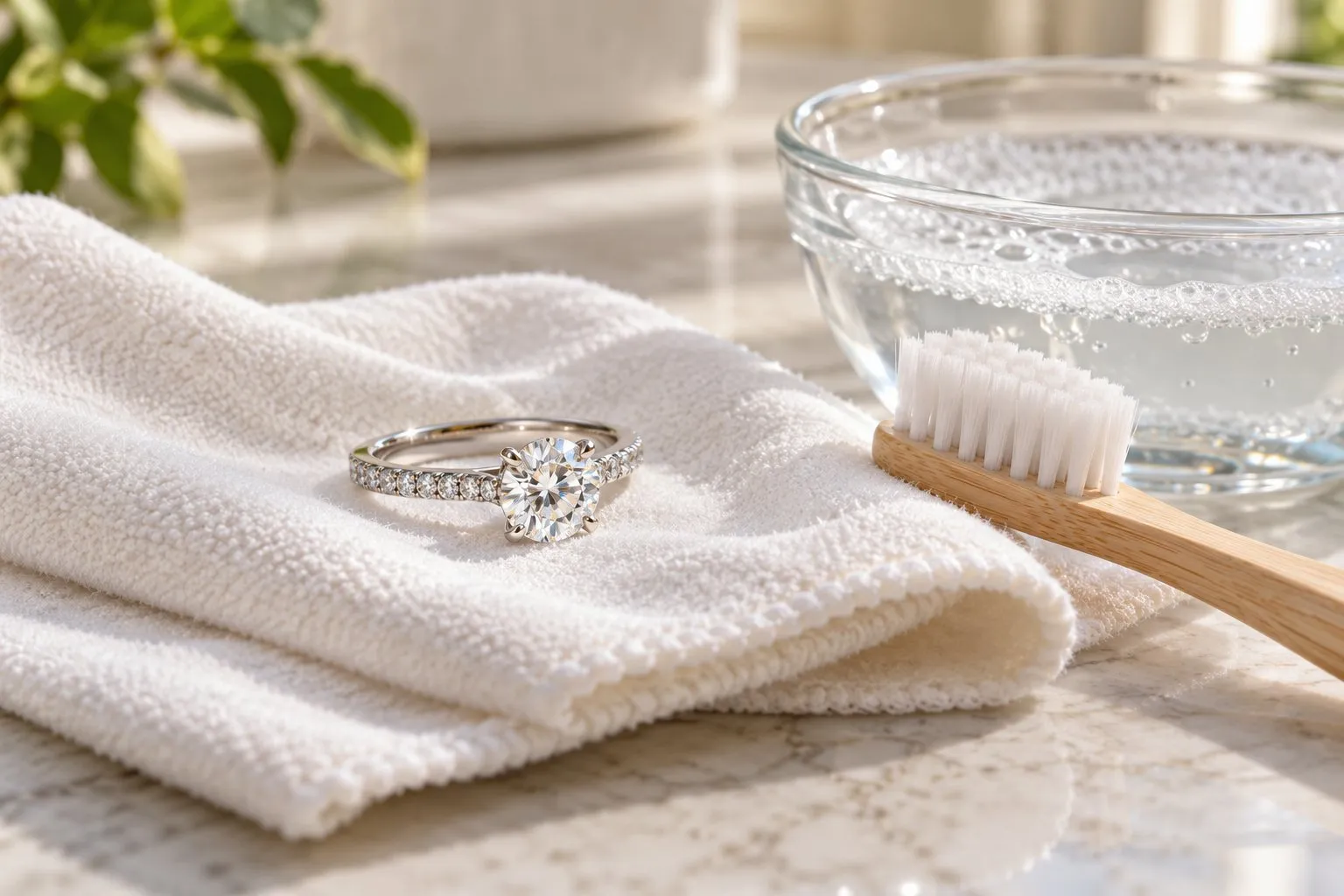
Here is how to clean a white gold diamond ring: soak it for 15 to 20 minutes in warm water with a few drops of mild dish soap, brush the stone and the underside of the setting with a soft toothbrush, rinse, and dry with a lint-free cloth. That is the whole routine, and it is deliberately gentle: the diamond is the toughest part of the ring, but the white finish on the band is a thin plating that cleaning can scuff and that no cleaner can put back.
That second half is what separates this ring from a plain diamond or a plain gold one. If your band looks yellow after a good clean, the soap did not fail. The plating wore thin, and the fix is a jeweler, not a stronger cleaner.
What is on this page9 sections
Key Takeaways
- Mild dish soap, warm water and a soft brush is the method GIA and white gold retailers publish, and it is the one that treats the plating gently.
- GIA says rhodium plating wears away gradually and the ring needs replating occasionally; no source we opened gives an exact number of months.
- A band that looks warm or yellow after cleaning has usually lost plating. A hazy stone with a white band usually has a film on it.
- Baking soda and toothpaste are abrasives, and one jeweler says they ruin the rhodium. GIA says abrasives can erode setting metals.
- Prongs should be checked every six months, according to GIA, and a stone that moves is a reason to stop cleaning.
What Is Safe for the Diamond and What Is Safe for the Rhodium
A cleaner can be fine for the stone and wrong for the finish, and most online lists only check the first. The table below separates the two. Where no source we opened gives a verdict, it says so rather than guessing.
| Product | Safe for the diamond? | Safe for the rhodium? |
|---|---|---|
| Mild dish soap in warm water | YesGIA (2017) names warm water, mild soap and a soft toothbrush | Yeswith a soft brush. Diamond Source NYC (2025) soaks white gold 15 to 20 minutes in mild soapy water |
| Ammonia-based window cleaner | YesGIA (2012) soaks diamonds overnight in one | Not publishedNelson Coleman Jewelers says the ammonia in Windex can damage precious metals over time |
| Hydrogen peroxide | NoNelson Coleman says it does not work on diamonds | Not published |
| Baking soda | Not published | NoDiamond Source NYC says abrasive baking soda ruins the rhodium |
| Toothpaste | NoGIA (2012) says abrasives such as toothpaste can erode setting metals | NoDiamond Source NYC lists harsh toothpastes among what scratches the plating |
| Chlorine bleach | NoGIA (2012) says chlorine can erode metals used in settings | Not published |
| Ultrasonic cleaner | Yes for untreated diamonds, per GIA (2017), but not for loose stones or girdles touching, per GIA (2015) | Not published |
| Steam cleaner | NoGIA (2017) advises against steam cleaners for an engagement ring | Not published |
How to Clean a White Gold Diamond Ring at Home
The full method for diamonds, including GIA’s overnight ammonia soak and the stones that should never go in a machine, is in our guide to how to clean a diamond ring, and the alloy-by-alloy version is in how to clean a gold ring. This section only adds what changes because the band is rhodium plated.
What You Need
A small bowl, warm water (not hot), a few drops of mild dish soap, a soft-bristled toothbrush kept for jewelry, and a lint-free or microfiber cloth. GIA’s 2017 ring-protection guide lists the same short kit: warm water, mild soap and a soft toothbrush, or a lint-free cloth.
Skip the scrubbers. Diamond Source NYC says scotch-brite pads, rough scrubbers and stiff brushes will permanently scratch the delicate metal and ruin the rhodium, and it says the same of baking soda and harsh toothpastes.
The Steps
- Mix a few drops of mild dish soap into warm water.
- Soak the ring for 15 to 20 minutes, the range Diamond Source NYC gives for white gold.
- Brush the diamond, the prongs and the underside of the setting. GIA (2012) says the underside of the diamond “tends to collect a lot of oil and dirt.”
- Rinse under warm running water with the drain closed or a bowl underneath. GIA (2012) says not to clean jewelry in or near the sink if it can be avoided, and if you must, to cover the drain.
- Check the stone before you dry it. GIA (2012) says diamonds can work loose from their settings if the settings are not secure.
Drying
Pat the ring completely dry with a lint-free towel, as Diamond Source NYC advises. A paper towel can leave fibers in the setting, and we found no source that endorses one on white gold. Let any water trapped under the stone drain before the ring goes back on.
What the Rhodium Plating Changes
Most white gold is plated, and the plating is what makes a white gold diamond ring different to care for. GIA (2018) says white gold is usually plated with rhodium for a whiter look, a better shine and protection against scratching. For how plating compares across metals, see white gold vs yellow gold.
Why White Gold Turns Yellow
White gold is gold mixed with white metals, and the mix alone is not truly white. GIA (2015) says the rhodium plating will wear away gradually over time and the ring will need replating occasionally. GIA (2025) says white gold appears faintly yellow unless it is plated.
Assay Assured (2025), which republishes work from the Birmingham Assay Office, says the plating wears off over time and reveals the true color of the alloy underneath. It adds that for jewelry worn often, such as rings, plating may not be a long-term durable solution, and that the thickness and quality of the plating affect how long it lasts. Neither GIA nor Assay Assured gives a number of months. Treat any exact schedule you read as unsourced.
This is why cleaning cannot reverse the color. Soap removes the film on top of the plating. It does not add plating.
Shampoo, Chlorine and Hand Cream
GIA (2025) says regular exposure to water and chemicals in some soaps and shampoos can dull the rhodium finish, and that it is best to remove white gold before showering. That is the cheapest way to slow the dulling, and it costs nothing.
Chlorine is the second habit to drop. GIA (2012) says chlorine, as in household bleach, should never be used on diamond jewelry, and GIA (2018) says to avoid chlorine and harsh chemicals because they can damage the alloying metals. Taking the ring off before a pool or a bleach clean-up follows directly from that.
No source we opened names hand cream. Our reading, not a source’s, is that creams and lotions add to the oily film GIA describes on the back of the stone, so a ring that comes off before you apply them stays cleaner between soaks.
Cloudy Diamond or Dirty Diamond?
A hazy diamond is far more often dirty than damaged, and the quickest test is to clean it and look again. The Diamond Pro (2023) says an engagement ring can look cloudy from grime, soap residue and oils, and that cleaning helps if the haze is on the surface. It also says there is no way to fix the internal structure of a stone.
A Film on the Surface
Oil, soap residue and skin products collect on a diamond, and GIA (2012) says the back of the stone tends to collect a lot of oil and dirt. If the stone is bright again after the soak and brush above, the haze was on the surface. A jeweler’s cleaning will do the same job more thoroughly, and GIA (2012) recommends a periodic professional cleaning as well as the home routine.
Cloud Inclusions and Other Causes
If the haze survives a proper clean, the cause may be inside the stone. The Diamond Pro describes clouds as many tightly grouped pinpoints, too small to tell apart, that together have a hazy look. It also names strong blue fluorescence as a cause of a milky look. GIA lists cloud among the names of inclusions on its clarity scale.
Check the grading report for the clarity grade and any note about clouds, and compare the stone in daylight, since The Diamond Pro says cloudiness is not visible on a screen or under store lights. If you are still choosing a stone, our guide to VS1 vs VS2 explains how clarity grades read in practice, and the broader cleaning routine is in the guide to cleaning an engagement ring.
When to Take It to a Jeweler
Some problems are not cleaning problems. A jeweler is the right call when the plating has gone, when a prong is loose, or when you are unsure what the ring can take.
Re-Rhodium Plating
Re-plating is the answer to a ring that stays yellow after a clean. GIA (2018) tells buyers to ask the jeweler whether they will replate the ring when needed, which is worth asking before you buy. Price varies by shop. Nelson Coleman Jewelers says its polishing service for white gold, which includes rhodium plating after the polish, starts at $50 on its care guide, an undated page we read on October 22, 2026; that is a starting price for the service, not a quote for a ring with a large setting. Ask for the final price for your own ring before you hand it over.
Nelson Coleman also notes that when it rhodium plates a ring it does a heavy dip, so that you only need an annual polish. That is one shop’s practice, not an industry rule.
Loose or Worn Prongs
GIA (2017) says it is a good idea to have the prongs in your engagement ring checked every six months for potential damage. GIA (2012) adds that diamonds can loosen if the setting is not secure. If the stone moves when you press it gently, or you can see a gap between the stone and the setting, stop cleaning and book a repair. Do not put a loose stone in an ultrasonic machine: GIA (2015) says vibration can shake gems loose or cause damage when stones are set with their girdles touching.
If you have a platinum band beside the white gold ring and wonder whether it would age differently, platinum vs white gold covers the plating question from the metal side.
Which Problem Do You Have?
| What you see | Likely cause | What to do |
|---|---|---|
| Stone looks dull or hazy, band still looks white | Oil and soap film on the stone1 | Soap, warm water and a soft brush, back of the stone included |
| Band looks warm or yellow even after cleaning | Rhodium plating worn away2 | Ask a jeweler about replating |
| Stone stays hazy after a proper clean | Possible cloud inclusions or strong fluorescence3 | Check the grading report and view the stone in daylight |
| Stone moves or there is a gap at a prong | Loose prong4 | Stop cleaning and see a jeweler before wearing it |
| Band is dull after showering often | Soaps and shampoos dulling the rhodium5 | Take the ring off before the shower |
| Fine scratches across the band | Wear on the finish; no source we opened gives a home fix | Ask a jeweler whether polishing and replating suit the ring |
5 sources cited in this table
Frequently Asked Questions
What’s the best home remedy to clean a diamond ring?
Warm water, a few drops of mild dish soap and a soft toothbrush. GIA names warm water, mild soap and a soft toothbrush for diamond rings. On white gold, add care: use a soft brush only and avoid baking soda and toothpaste, which a jeweler says scratch the rhodium.
How do I get my white gold ring white again?
Cleaning removes the film on the plating, but it cannot restore plating that has worn away. GIA says rhodium wears off gradually and the ring needs replating occasionally. If the band stays yellow after a clean, ask a jeweler about re-plating rather than reaching for a stronger cleaner.
Does Dawn soap clean diamonds?
Mild dish soap in warm water cleans diamonds, according to GIA, which names mild soap but not a brand. None of the pages we opened names Dawn specifically. Any plain, mild dish soap fits the description. Rinse well, because soap residue can leave the stone looking hazy.
Can I use hydrogen peroxide to clean my diamond ring?
Not on the sources we found. Nelson Coleman Jewelers says hydrogen peroxide works as an antiseptic and mouthwash, but not on diamonds. No source we opened tests it on rhodium plating either, so mild soap and water is the safer choice for a white gold setting.
Why would a diamond turn cloudy?
Most often a film of oil, soap residue and grime on the surface, which cleaning removes. The Diamond Pro says that if haze remains, the cause may be cloud inclusions inside the stone or strong blue fluorescence. Check the grading report for clarity notes, and look at the stone in daylight.
Sources
- GIA 4Cs, How to Clean Your Diamond Jewelry, May 23, 2012, read October 22, 2026.
- GIA 4Cs, Gems and Ultrasonic Cleaners, April 10, 2015, read October 22, 2026.
- GIA 4Cs, Choosing Between White Gold, Platinum, Palladium, and Silver, June 29, 2015, read October 22, 2026.
- GIA 4Cs, How to Protect Your Diamond Engagement Ring, September 26, 2017, read October 22, 2026.
- GIA 4Cs, Buying Guide for White, Yellow and Rose Gold Engagement Rings, May 11, 2018, read October 22, 2026.
- GIA 4Cs, White Gold vs. Silver: What is the Difference?, July 22, 2025, read October 22, 2026.
- GIA 4Cs, Diamond Clarity Chart, August 13, 2015, read October 22, 2026.
- Assay Assured (Birmingham Assay Office), White Gold, Explained, June 2, 2025, read October 22, 2026.
- Diamond Source NYC, How to Clean White Gold Jewelry, August 18, 2025, read October 22, 2026.
- Nelson Coleman Jewelers, Jewelry Care Guide, undated, read October 22, 2026.
- The Diamond Pro (Mike Fried), Cloudy Diamonds Buyers Guide, updated September 5, 2023, read October 22, 2026.