

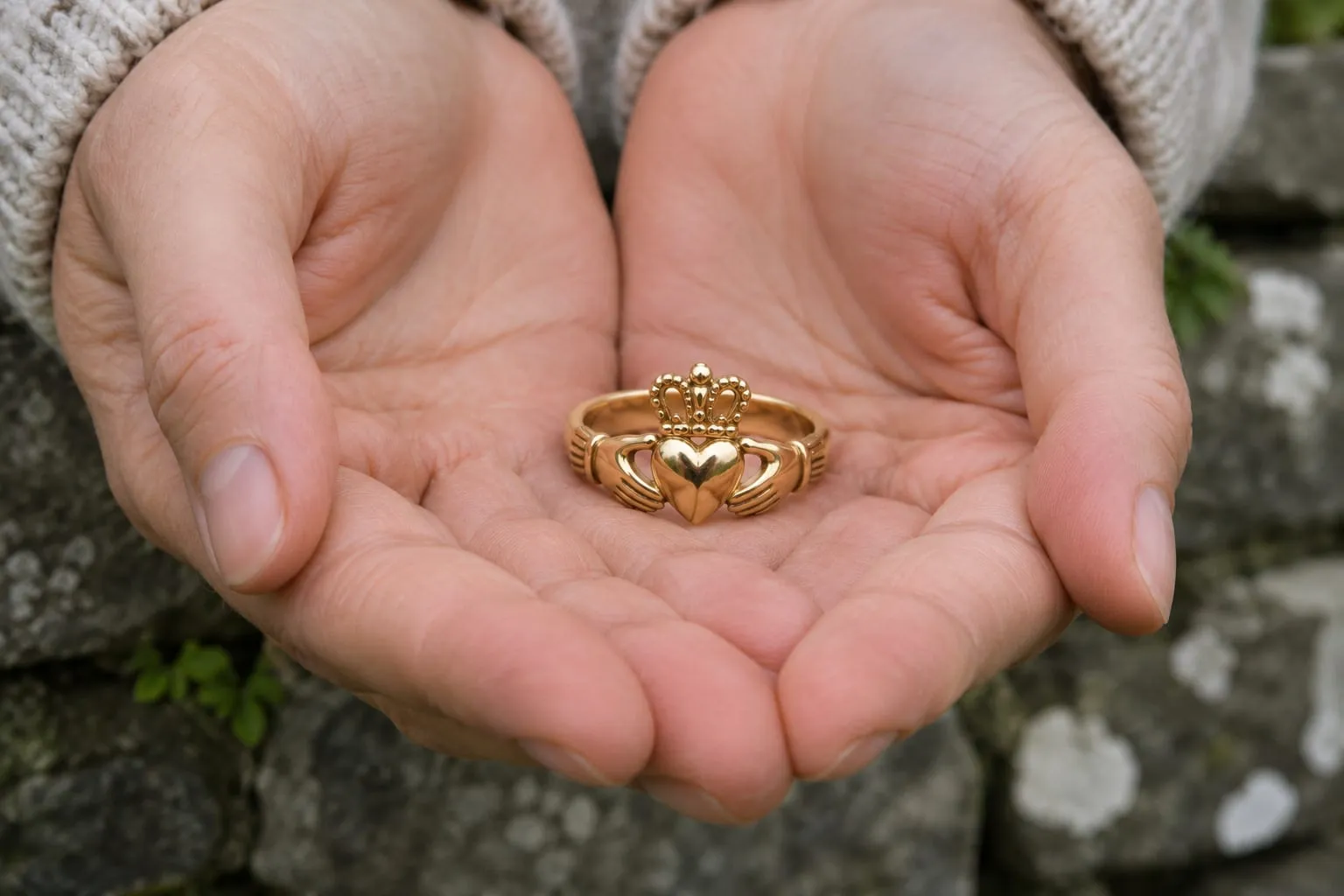
The Claddagh ring meaning is carried by its three symbols: the hands stand for friendship, the heart for love and the crown for loyalty. The ring is named after the Claddagh, a fishing village just outside Galway city, and the oldest surviving one, made around 1700 by the Galway goldsmith Richard Joyce, is now in Galway City Museum.
How you wear it is said to show whether your heart is taken, and the version most Irish sources repeat has four positions across two hands. That code is easy to find and hard to date. This guide sets out the meaning, the four positions as the Irish Emigration Museum gives them, and which parts of the famous origin story the historical record supports.
What is on this page9 sections
Key Takeaways
- The hands, heart and crown stand for friendship, love and loyalty, in the words of a plaque at Thomas Dillon’s Claddagh Gold in Galway quoted by Tourism Ireland.
- The clasped hands come from older fede rings, which National Geographic says were used in ancient Rome as wedding rings and became popular in Europe in the 12th century.
- The oldest known Claddagh ring dates from about 1700 and carries Richard Joyce’s mark; The Irish Times reports it sold at Sotheby’s in February 2020 for £8,125, and it is now in Galway City Museum.
- Historian Eoin O’Neill told National Geographic there is no concrete proof of Joyce’s capture and enslavement, the story most often told about the ring’s origin.
- The four-position code for wearing it is given by the Irish Emigration Museum, but none of the historical accounts we read dates it, and Tourism Ireland says you can wear it any way you want.
What the Claddagh Symbols Mean
A Claddagh ring shows two hands holding a heart, with a crown on top. Each part has a meaning, and the sources agree on all three.
| Symbol | Meaning | Who says so |
|---|---|---|
| Two hands | Friendship | Thomas Dillon’s plaque, via Tourism Ireland; RTÉ Brainstorm, 2026 |
| Heart | Love | Thomas Dillon’s plaque, via Tourism Ireland; RTÉ Brainstorm, 2026 |
| Crown | Loyalty | Thomas Dillon’s plaque, via Tourism Ireland; RTÉ Brainstorm, 2026 |
The Hands: Friendship
The hands are the oldest part of the design. National Geographic explains that rings with clasped hands, called fede rings from the Italian word for trust, were commonly used in ancient Rome as a wedding ring or symbol of faithful love. The Irish Times notes that the Claddagh design modifies those fede rings. Hands holding hands meant a promise long before anyone in Galway set a heart between them.
The Heart: Love
The heart is the part people read first. National Geographic says a heart was added to fede rings in the 16th century, so the hands and heart together were already known in Europe before the Claddagh version appeared. It is the direction of this heart that the wearing customs below are about.
The Crown: Loyalty
The crown is the Galway addition. National Geographic credits Richard Joyce with adding it in the 1690s, and reports historian Eoin O’Neill’s suggestion that it may have been a tribute to the king who helped secure Joyce’s release. That is offered as a possibility, not a fact. RTÉ Brainstorm notes a later variant, the Fenian Claddagh, which leaves the crown out because of its association with British royalty and colonialism in Ireland.
The Rhyme on the Plaque
Tourism Ireland quotes the words on a plaque at Thomas Dillon’s Claddagh Gold in Galway: “The Hands are for Friendship / The Heart is for Love, / And Loyalty is Shown / With the Crown up above.” It is the most quoted summary of the Claddagh ring meaning, and it comes from a jeweler that still makes the ring.
How to Wear a Claddagh Ring
The code most Irish sources repeat uses two things: which hand the ring is on, and whether the point of the heart faces toward your fingertip or toward your wrist.
The Four Positions
Echo Live, a Cork newspaper, published this version in February 2026, citing the Irish Emigration Museum, known as EPIC, and most Claddagh wearers.
| Hand | Heart points | What it is said to mean (EPIC, via Echo Live, 2026) |
|---|---|---|
| Right hand | Outward, toward the fingertip | Open to love, or not in a relationship |
| Right hand | Inward, toward the wrist | In a relationship |
| Left hand | Outward, toward the fingertip | Engaged |
| Left hand | Inward, toward the wrist | Married |
RTÉ Brainstorm gives the same reading for direction: a heart pointing to the fingernail means single, and the other way means the wearer is in love or attached.
The Simpler Version
Tourism Ireland’s guide uses only the direction of the heart. Pointing outward shows that your heart is open; turned inward, it signals that your heart is joined with another. It does not split the meaning by hand, and it adds that you can wear it any way you want.
Is There a Correct Way?
Not one that history fixes. National Geographic’s account of the ring’s history does not mention any wearing rules, and neither does The Irish Times’ report on the oldest ring. The record they describe is about who owned and passed on the rings, not how they were turned on the finger. The four-position code is a living custom, widely shared and useful if the people around you read it the same way. We did not find a dated source for when it began, which is different from saying it is new.
The Wedding Ring Finger
On the left hand, the ring goes on the fourth finger, the traditional wedding ring finger in the United States. Our guide to what hand a wedding ring goes on covers the left and right hand customs by country and faith, and our guide to ring finger meaning explains why the fourth finger is the only one with a documented tradition.
Where the Claddagh Ring Comes From
The origin story is the most retold part of the Claddagh ring meaning, and the sources disagree on its details.
The Village and the Name
National Geographic describes the Claddagh as a small fishing village opposite Galway city, and Tourism Ireland places it just outside the city. The ring takes its name from the village, not from a maker or a family.
The Richard Joyce Story
The most common account is that Richard Joyce, from Galway, was captured at sea by pirates in the late 17th century, enslaved in Algiers, trained there as a goldsmith, and returned home to make the first Claddagh ring. The broad outline is shared; the dates are not.
| Detail | National Geographic (2024) | The Irish Times (2020) | Echo Live, citing EPIC (2026) |
|---|---|---|---|
| When he was taken | 1675, as a teenager | Not dated | Late 1600s |
| Where | Algiers | Algiers | Captured by Algerian corsairs |
| Training | Not detailed | Apprenticed to a Turkish goldsmith, about 1676 to 1690 | Learned goldsmithing there |
| How he was freed | The king secured his release | William III ordered his release, 1690 | Agreement brokered by King William III, 1689 |
| Length of captivity | Not stated | About 14 years implied by the dates | 14 years |
The table shows a story that is consistent in shape and loose in detail, which is typical of accounts that trace back to one early source.
What the Evidence Supports
Historian Eoin O’Neill told National Geographic that there is no concrete proof of Joyce’s odyssey, and that James Hardiman’s history of Galway, published in 1820, provides the closest contemporaneous record. O’Neill also notes that Joyce’s mark on the oldest ring supports his role as the designer. RTÉ Brainstorm, writing in 2026, says the story cannot be proved with full certainty, but that Galway City Museum considers events of the same period to suggest it has veracity. The fair summary is that Joyce made Claddagh rings, and that the captivity story is plausible and unproven.
The Eagle Legend
Tourism Ireland records an older legend in which a widow named Margaret Joyce was given the first ring by an eagle that dropped it into her lap as a reward for her charity. RTÉ Brainstorm describes the same tale as medieval folklore. It is a legend, and no source presents it as anything else.
The Oldest Known Claddagh Ring
What It Is
The Irish Times reported in April 2020 that the oldest known Claddagh ring is thought to date from about 1700 and was made by Richard Joyce. National Geographic adds that Joyce’s stamp is visible inside the band. The ring is engraved with the initials MRC and LcM, the L quite faded, according to The Irish Times.
How It Reached Galway
The ring had belonged to the late Garech Browne of Luggala, County Wicklow. It sold at Sotheby’s in February 2020 for £8,125, far above its estimate of up to £2,500, and was bought by Garret Weldon, whose father Jimmy had originally sold it to Browne, according to The Irish Times. National Geographic reports that the ring was sold to Galway City Museum in 2021, which is where it is shown today.
What the Initials Suggest
The Irish Times notes that Claddagh rings were often passed through the female line and sometimes given as tokens of friendship, so the two sets of initials may belong to a mother and daughter rather than a married couple. That is the clearest documented use of the ring we found: an heirloom handed down, not a code turned on the finger.
Who Gives a Claddagh Ring, and When
Mother to Daughter
National Geographic says the ring was traditionally passed from mother to daughter, who would give it to her husband-to-be. That makes the Claddagh both an heirloom and a betrothal ring at once, and it is why so many families treat it as something inherited rather than bought.
As a Wedding Ring
Echo Live, citing EPIC, says Joyce married his fiancée on his return and that the ring served as their wedding bands. Tourism Ireland says many people still wear it as an engagement or wedding ring today. A Claddagh band can be worn alone as a wedding ring, or beside an engagement ring; our guide on how to wear an engagement ring and wedding band covers the order on one finger.
As a Promise or Friendship Ring
The hands mean friendship, and The Irish Times notes that Claddagh rings were sometimes given as tokens of friendship. On the right hand with the heart turned out, it can also work as a promise ring that says nothing yet about engagement. For where a promise ring usually goes, see what finger a promise ring goes on.
Emigration and the Diaspora
National Geographic writes that famine, poverty and war spread the Irish diaspora across the world, and that the Claddagh persists as both an icon of affection and of Irish ancestry. It also notes that some emigrants pawned their jewelry to pay for passage, so a ring that survived the crossing could be the one thing a family kept.
Choosing a Claddagh Ring to Wear Every Day
A Claddagh ring is worn like any other band, and the practical questions are the same: metal, size and whether the design survives daily wear.
Metal
None of the sources on this page ties the meaning to a metal: the oldest ring is gold, and the symbols mean the same in any metal. If you will wear it every day as a wedding ring, our guide to 14K vs 18K gold explains the trade-off between the two common karats, and our page on hypoallergenic wedding bands covers what to choose if your skin reacts to some metals.
Size
The crowned heart sits on top of the finger and is wider than the band, so the size matters for comfort as much as for fit. Measure first with our printable ring sizer, and measure the finger on the hand you will actually wear it on, since the four-position code may move it from one hand to the other over the years.
Matching His and Hers
If you want a custom pair that carries the hands, heart and crown in a different design, our guide to custom wedding rings compares what jewelers will change.
Frequently Asked Questions
How Should a Claddagh Ring Be Worn?
The most common code, given by the Irish Emigration Museum, uses the hand and the heart’s direction. On the right hand, heart out means single and heart in means in a relationship. On the left, heart out means engaged and heart in means married. Tourism Ireland adds that you can wear it any way you like.
Who Gives Someone a Claddagh Ring?
Traditionally, a mother. National Geographic says the ring was passed from mother to daughter, who would then give it to her husband-to-be. Today it is given by partners as an engagement, wedding or promise ring, by friends as a sign of friendship, and by family as an heirloom. Nothing in the sources limits who may give one.
Can Non-Irish People Wear Claddagh Rings?
Yes. Tourism Ireland describes people wearing the Claddagh as an engagement or wedding ring, as a statement piece, or as a sign of Irish heritage, and says you can wear it any way you want. None of the Irish sources we read treats it as reserved for people of Irish descent.
What Is the Traditional Irish Love Symbol?
The Claddagh is the best known. National Geographic calls it an emblem of love, loyalty and friendship, and the crowned heart held in two hands has been made in Galway since at least around 1700, when Richard Joyce made the oldest surviving example. Its heart is the part that stands for love.
What Does a Claddagh Ring Mean on a Woman?
The meaning is the same for anyone: friendship, love and loyalty. The hand and the direction of the heart signal relationship status under the common code. Historically the ring passed through the female line, according to The Irish Times, so for many women it is also an heirloom from a mother or grandmother.
What Does a Claddagh Ring Mean on a Man?
The same as on anyone else, and the same four positions apply. Some wearers choose the Fenian version, which leaves out the crown because, as RTÉ Brainstorm explains, the crown was linked to British royalty and colonialism in Ireland. For a man wearing it as a wedding ring, the left hand ring finger is the usual place.
Sources
- National Geographic (Justin Meneguzzi), Irish Claddagh rings have an unexpected history: it involves pirates, 11/01/2024.
- The Irish Times (Elizabeth Birdthistle), Eternal love: Oldest-known Claddagh ring comes home to Galway, 25/04/2020.
- RTÉ Brainstorm (Marion McGarry), The Claddagh ring: Richard Joyce, goldsmith history and folklore, 14/02/2026.
- Echo Live (Eva Osborne), What does a Claddagh ring symbolise? And how should you be wearing it?, 14/02/2026.
- Tourism Ireland, The Claddagh ring, updated 22/10/2024.