

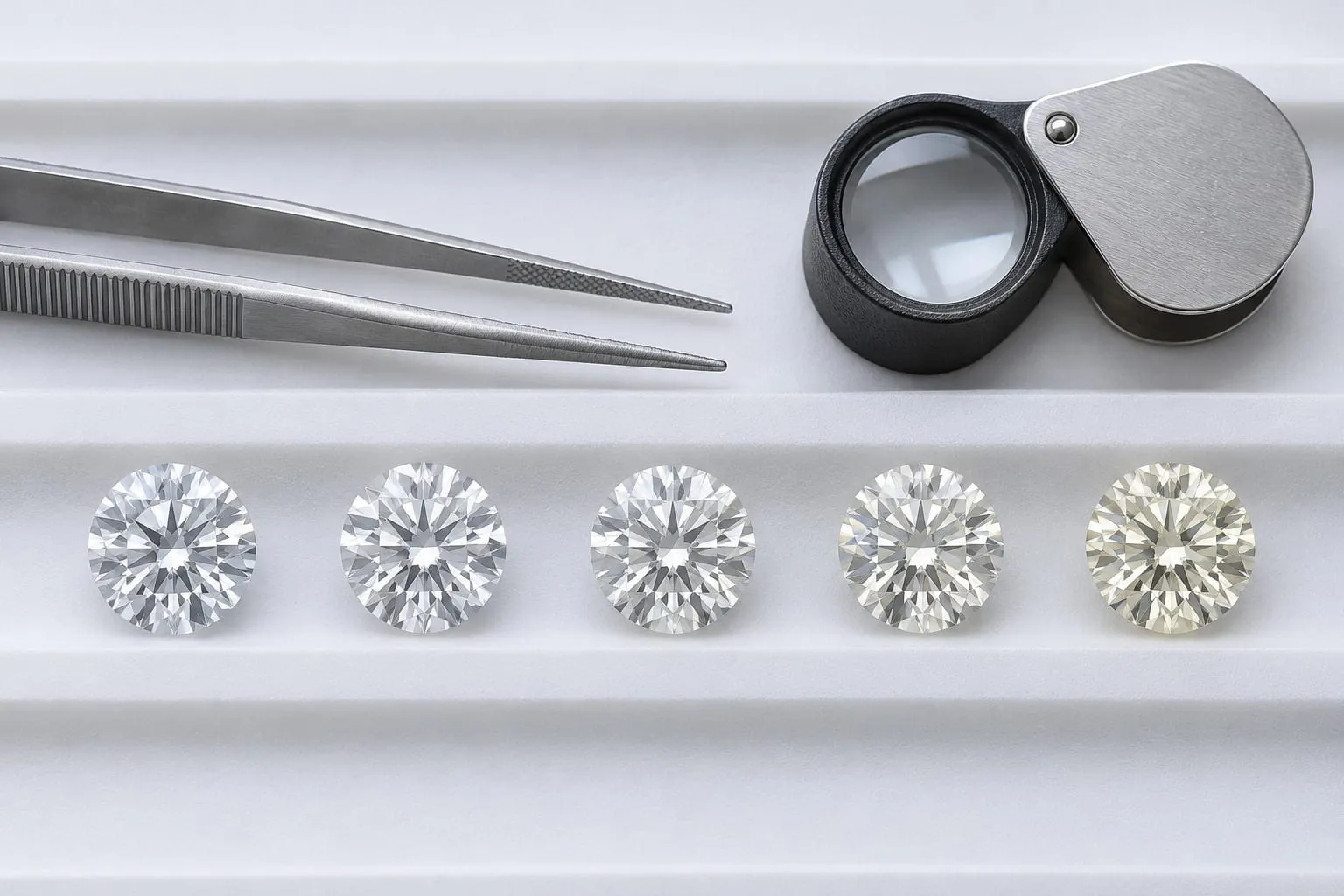
A diamond color and clarity chart puts two of GIA’s grading scales side by side: color, graded on a D-to-Z scale from colorless to light yellow or brown, and clarity, graded on 11 steps from Flawless to Included. GIA splits the 23 color grades into five groups and the 11 clarity grades into six categories. This guide sets out both charts, explains how to read them together, and shows what moving up the grades cost on one real ring on 6 November 2026, where the answer was not what the charts would lead you to expect.
What is on this page9 sections
Key Takeaways
- GIA’s color scale runs from D, for colorless, to Z, for light yellow, light brown or light gray, and GIA subdivides its 23 color grades into five groups: colorless (D-F), near colorless (G-J), faint (K-M), very light (N-R) and light (S-Z).
- GIA’s clarity system has 11 grades in six categories: Flawless, Internally Flawless, two Very Very Slightly Included, two Very Slightly Included, two Slightly Included and three Included.
- GIA grades clarity under 10x magnification, and says many blemishes and inclusions “are not visible to the naked eye.”
- On one Rare Carat ring on 6 November 2026, a 1 carat lab-grown round at D color and VVS1 clarity cost $580, while an F VS1 and a G VS2 each cost $365, less than the $375 H VS1 we price our ring comparisons with.
- GIA announced in 2025 that it would stop using its D-to-Z color and clarity nomenclature for laboratory-grown diamonds and describe them in broader terms instead.
The Diamond Color Chart
GIA’s Five Color Groups
GIA introduced its D-to-Z scale in 1953 and, in its own words, “begins with the letter D as the top (colorless) grade” to avoid confusion with older systems. Each letter covers a narrow, defined range of color, judged against masterstones under controlled lighting.
| Group (GIA) | Grades | Letters in the group |
|---|---|---|
| Colorless | D, E, F | 3 |
| Near colorless | G, H, I, J | 4 |
| Faint | K, L, M | 3 |
| Very light | N to R | 5 |
| Light | S to Z | 8 |
The group names and letter ranges come from GIA’s 2015 color chart article. GIA’s main color page puts it plainly: the normal range “goes from D for colorless to Z for light yellow, light brown, or light gray.” The H color we use to price our newer ring comparisons sits in the near colorless group.
Why Color Changes the Price
GIA’s encyclopedia says that in the normal color range, “the closer a diamond gets to colorless, the higher its per-carat price.” Its color page adds that “color variations from the most obvious to subdued can drastically alter diamond quality and price,” even though the differences between neighboring grades are subtle. That is the gap a buyer can use: two adjacent grades can be hard to tell apart face-up but priced differently.
What the Color Grade Does Not Tell You
The grade describes the loose stone, judged against masterstones under controlled lighting. It does not describe the ring: once the diamond is set, you see it beside metal, and the metal is part of the look. Our guide to white gold vs yellow gold covers how the two metals differ.
The Diamond Clarity Chart
GIA’s 11 Grades
GIA calls its clarity system “1 Universal System. 11 Grades.” The definitions below are GIA’s, quoted from its clarity page.
| Category | Grades | GIA’s definition |
|---|---|---|
| Flawless | FL | “No inclusions and no blemishes visible” |
| Internally Flawless | IF | “No inclusions visible but does have blemishes” |
| Very Very Slightly Included | VVS1, VVS2 | “Inclusions so slight they are difficult for a skilled grader” to see |
| Very Slightly Included | VS1, VS2 | “Inclusions are observed with effort but can be characterized as minor” |
| Slightly Included | SI1, SI2 | “Inclusions are noticeable” |
| Included | I1, I2, I3 | “Inclusions are obvious which may affect transparency, brilliance and durability” |
How Clarity Is Graded
GIA says “every diamond is evaluated under 10x magnification,” and that the grade is based on “the number, size, relief, nature, and location of characteristics.” Inclusions are features inside the stone; blemishes are on its surface. The number 1 and 2 within each category mark the cleaner and the less clean half, so VS1 is a step above VS2.
What You Can See With Your Own Eyes
GIA’s clarity page says that “many blemishes and inclusions are not visible to the naked eye,” and that the grade reflects overall appearance under magnification. The grades are not a promise about what you will see across a table. Shape matters too: GIA’s 2025 shape guide says brilliant cuts “can conceal small flaws through their many facets,” while step cuts like the emerald, with larger open facets, “may reveal them.” Our guide to VS1 vs VS2 goes into the middle of the clarity scale in detail.
Reading Color and Clarity Together
The Combined Chart
Most buyers pick one grade from each chart. The table below sets the most common engagement ring combinations against GIA’s groups.
| Combination | Color group | Clarity category | Where it sits |
|---|---|---|---|
| D VVS1 | Colorless | Very Very Slightly Included | Near the top of both scales |
| E VVS2 | Colorless | Very Very Slightly Included | One step down on each |
| F VS1 | Colorless | Very Slightly Included | Colorless, minor inclusions under 10x |
| G VS2 | Near colorless | Very Slightly Included | Top of near colorless |
| H VS1 | Near colorless | Very Slightly Included | The grade we price our ring comparisons with |
| H SI1 | Near colorless | Slightly Included | Inclusions noticeable under 10x |
| J SI2 | Near colorless | Slightly Included | Bottom of near colorless |
Which Matters More?
Neither chart is ranked above the other by GIA. The practical answer depends on the stone. A large table facet, as on an emerald cut, shows inclusions and color more easily: GIA’s shape guide advises choosing emerald cuts at “VS 2 clarity and G color or above.” A round brilliant, with many small facets, hides both better. If you are buying an emerald, Asscher or radiant, spend on clarity and color. If you are buying a round or an oval, there is more room to step down.
Cut Comes Before Both
GIA grades cut only on round brilliants, on a scale from Excellent to Poor. Color and clarity are the two Cs on this page, but on a round, check the cut grade on the report before comparing the other two. Our guide to engagement ring shapes explains how cut differs from shape.
What the Grades Cost on One Real Ring
Same Setting, Different Stones
Charts tell you the order of the grades. They do not tell you the price of each step on the day you buy. On 6 November 2026 we priced the same Rare Carat setting, the Olivia Knife Edge 6 Prong Solitaire in 14K white gold at $895, with five different 1 carat lab-grown rounds. The diamond line changed as follows.
| Diamond (lab-grown, round) | Color group | Clarity category | Diamond price |
|---|---|---|---|
| 1.00 ct D VVS1 | Colorless | VVS | 580 dollars |
| 1.00 ct E VVS2 | Colorless | VVS | 420 dollars |
| 1.01 ct H VS1 | Near colorless | VS | 375 dollars |
| 1.00 ct F VS1 | Colorless | VS | 365 dollars |
| 1.02 ct G VS2 | Near colorless | VS | 365 dollars |
What the Table Shows
The top grade cost the most, as the chart would predict: D VVS1 was 580 dollars. Below that, the order broke down. An F VS1, colorless, cost 10 dollars less than the H VS1 we use in our comparisons, and a G VS2 cost the same as the F. These are individual lab-grown stones from one jeweler on one day, not a market price, and lab-grown prices move often. The lesson is simple: do not assume a lower grade is cheaper. Price the actual stones.
Why Lab-Grown Prices Behave This Way
GIA’s 2024 Gems and Gemology update on laboratory-grown diamonds says lab-grown stones have begun to replace parts of the natural market as their prices fell. In 2025 GIA announced it would describe lab-grown diamonds with descriptive terms rather than its natural-diamond color and clarity nomenclature, noting that more than 95% of the lab-grown stones it sees fall in a narrow range. When most stones sit in a narrow range, small grade differences matter less to the price than which stone a jeweler happens to stock. For natural diamonds, GIA’s general rule is that the closer to colorless, the higher the per-carat price. Our guide to lab-grown diamond prices by carat has more figures.
Lab-Grown Diamonds and the Charts
GIA’s Change
From 1 October 2025, GIA said it would assess D-to-Z lab-grown diamonds as “Premium” or “Standard” based on an overall assessment of clarity, color and cut, inscribe the girdle “Laboratory-Grown,” and give no assessment to stones below Standard. GIA says reports already issued remain valid. If a lab-grown stone you are offered carries a letter and clarity grade, check which laboratory issued it. Our comparison of IGI vs GIA covers the two labs you will see most.
What It Means When You Shop
Retailers, including Rare Carat on the pages above, still list lab-grown stones with D-to-Z letters and clarity grades. That is useful for comparing stones on one site. It is not the same thing as a GIA grade for a natural diamond, so compare like with like: natural against natural, lab-grown against lab-grown, from the same grading lab where you can.
How to Use the Chart When You Buy
A Simple Order of Decisions
- Pick the shape. It sets how much color and clarity you need. Step cuts need more; brilliant cuts need less.
- Pick a color group. Colorless (D-F) or near colorless (G-J) covers most engagement rings.
- Pick a clarity category. VS is a common middle ground; GIA defines its inclusions as “observed with effort” under 10x.
- Price neighboring grades. As our table shows, one step down can cost the same or even less.
- Read the report. Check which lab graded the stone and confirm the grades on the certificate.
Where to Go Next
If you are choosing a setting at the same time, our page of lab-grown engagement rings compares complete rings, and our guide to diamond ring prices by carat shows how size changes the bill.
Frequently Asked Questions
What Is the Best Color of a Diamond?
On GIA’s scale, D is the best color grade: it is at the top of the colorless group (D-F). Best does not always mean best value, though. Near colorless grades (G-J) cost less and GIA says the differences between neighboring grades are subtle, so many buyers choose a G or H.
Which Diamond Color Is Better, D or G?
D is the higher grade: it sits at the top of GIA’s colorless group, while G is the first grade in the near colorless group. On one Rare Carat ring we priced on 6 November 2026, a 1 carat lab-grown D VVS1 cost $580 and a G VS2 cost $365, so the step from G to D was not cheap.
What Is the Cheapest Color Diamond?
Lower color grades usually cost less: GIA says that the closer a diamond gets to colorless, the higher its per-carat price. That makes the faint (K-M) and lower groups the cheapest in the normal range. Our own lab-grown prices show the rule can break between neighboring grades, so always price real stones.
What Clarity Grade Diamond Should I Get?
It depends on the shape and on your budget. For step cuts like the emerald, GIA advises VS2 clarity or above. For round brilliants, which GIA says conceal small flaws better, there is more room to step down the scale. Whatever you choose, read the grading report rather than relying on a retailer’s label.
What Are the 4Cs of a Diamond?
The 4Cs are color, clarity, cut and carat weight, the four factors GIA uses to describe a diamond’s quality. GIA introduced its D-to-Z color scale in 1953. This guide covers color and clarity; cut decides how much light the stone returns, and carat is its weight.
Sources
- GIA 4Cs, Diamond Color Chart: The Official GIA Color Scale, 2015.
- GIA 4Cs, What is Diamond Color & What it Means, undated, accessed 06/11/2026.
- GIA 4Cs, Diamond Clarity, undated, accessed 06/11/2026.
- GIA, Diamond Quality Factors, Gem Encyclopedia, undated, accessed 06/11/2026.
- GIA 4Cs, Guide to Diamond Shapes for Engagement Rings, 2025.
- GIA, Gems and Gemology, Eaton-Magana, Hardman and Odake, Laboratory-Grown Diamonds: An Update on Identification and Products Evaluated at GIA, 2024.
- GIA, GIA to Use New Descriptive Terminology for Laboratory-Grown Diamonds, 2025.
- GIA, GIA Launches Updated Laboratory-Grown Diamond Services October 1, 2025.
- Rare Carat, Olivia Knife Edge 6 Prong Solitaire complete-ring pages with a 1.00 ct D VVS1, 1.00 ct E VVS2, 1.01 ct H VS1, 1.00 ct F VS1 and 1.02 ct G VS2 round lab diamond, accessed 06/11/2026.