

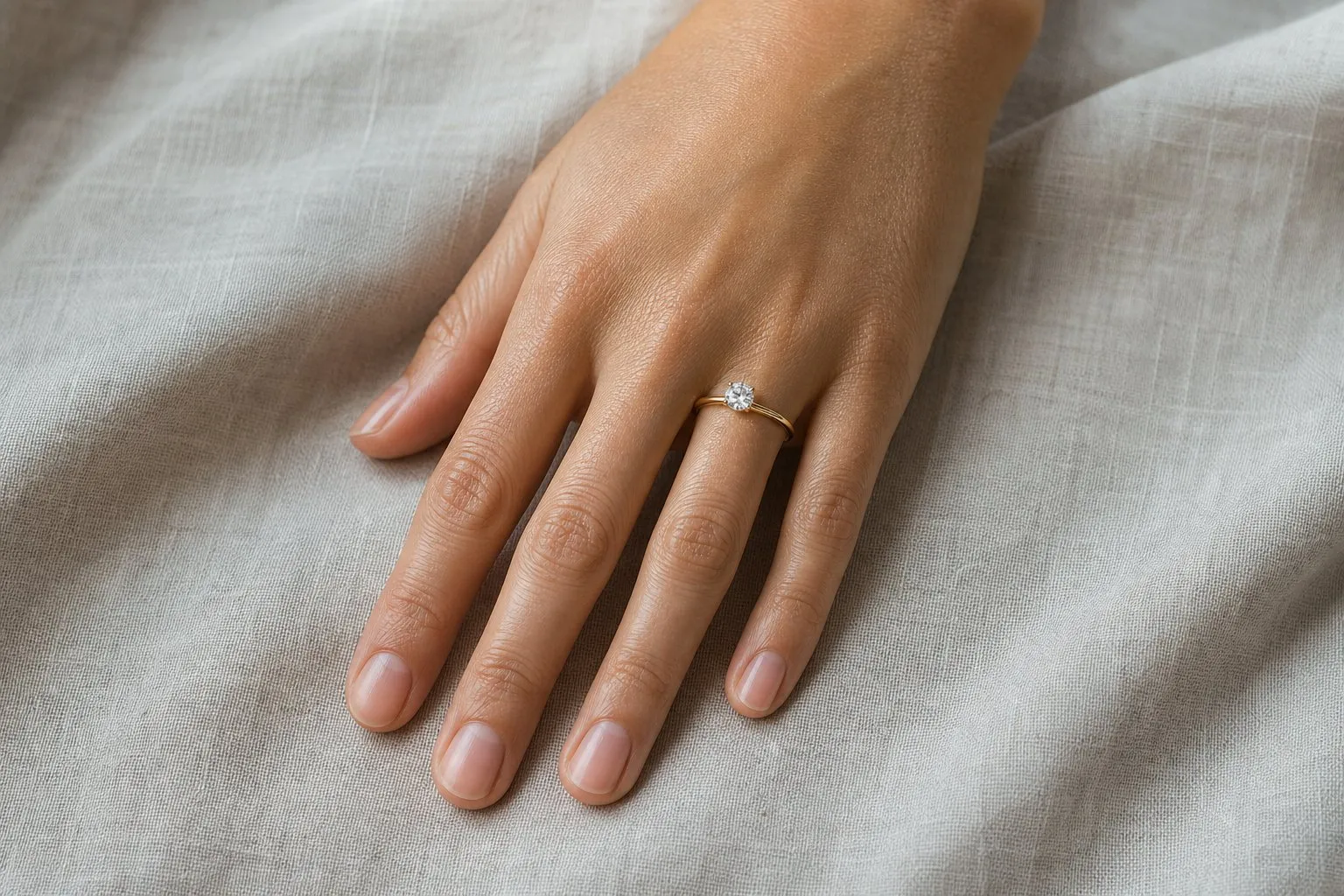
If you are wondering what finger does the engagement ring go on, the answer in the United States and most English-speaking countries is the fourth finger of the left hand, counting the thumb as the first: the finger between your middle finger and your little finger. It is the same finger for everyone.
That is the easy part, and where most guides stop. Several countries and faiths use the right hand, the vein to the heart is a belief with a datable history rather than anatomy, and from the wedding day a second band shares that finger.
What is on this page9 sections
Key Takeaways
- In the US the engagement ring goes on the fourth finger of the left hand, the finger a wedding band later shares.
- The 1662 Book of Common Prayer puts the wedding ring on the fourth finger of the woman’s left hand.
- Aulus Gellius, in the 2nd century AD, reported a nerve to the heart, not a vein, and second-hand from Apion.
- A 2026 Archives of Plastic Surgery paper says blood returns from all fingers, and dates vena amoris to 1686.
- Orthodox Christians traditionally use the right hand (Orthodox Church in America), as does Germany (Fischer Trauringe).
What Finger Does the Engagement Ring Go On?
The engagement ring goes on the fourth finger of the left hand in the United States, counting the thumb as the first finger. That is the whole answer; everything below is what follows from it. Nothing about it is binding, either: Brilliant Earth, writing in 2026, states that there are no strict rules about which finger or hand a ring goes on.
The Fourth Finger of the Left Hand
The engagement ring finger is the fourth, counting the thumb as the first. It sits between your middle finger and your little finger, and in the US it is on your left hand.
Two old texts name it in their own words: the Book of Common Prayer calls it the fourth finger, and Aulus Gellius the finger next to the little finger. The placement does not change with gender, so the engagement ring finger for men is the same one. If you are shopping for one, see men’s engagement rings compared.
Left Hand or Right Hand
Left in the United States, right in several countries and faiths, and neither is more correct. Which hand an engagement ring goes on is mostly a question of where a family’s custom comes from, and the table below sets out the traditions our sources name.
The Finger You Use to Propose
The ring goes onto the finger it will be worn on, which in the US means the fourth finger of the left hand. No authority governs this. Many people never place the ring at all: they hold it out, or open the box, and let the other person slide it on.
Where the Left-Hand Custom Comes From
Two named texts, roughly 1,500 years apart, carry the left-hand habit into English-speaking weddings, and neither is about engagement rings. The engagement ring inherited its finger from the wedding ring, which got it from a liturgy.
Aulus Gellius and Apion’s Nerve
Gellius, a Roman writer of the 2nd century AD, is the oldest named source we have for the finger. In Attic Nights he writes that he had heard the ancient Greeks wore a ring on the finger of the left hand next to the little finger, and that Roman men commonly wore theirs that way.
He does not explain it on his own authority. He passes on Apion, who wrote in his Egyptian History that on cutting into and opening human bodies, a very fine nerve was found to proceed from that finger alone to the human heart. A nerve, then, not a vein, at second hand, and Gellius never uses the phrase vena amoris.
The 1662 Book of Common Prayer
The Church of England’s marriage service in the 1662 Book of Common Prayer has the priest hand the ring to the man, who puts it “upon the fourth finger of the Woman’s left hand” and says “With this ring I thee wed.”
That rubric covers the wedding ring and says nothing about an engagement ring. What it fixed was the finger, and the English-speaking world inherited the service with it. The sibling guide to what hand a wedding ring goes on covers that side.
Betrothal Rings Before Either
The engagement ring has an older line of its own. Pliny the Elder records a Roman custom under which an iron ring, without any stone in it, was sent as a present to a woman when she was betrothed. He does not say which finger it went on, and that is the extent of what we can claim about Rome.
The clearest early split between the two rings comes from Pope Nicholas I, answering the Bulgars in 866. He describes the betrothed man joining the bride to himself with vows through the finger marked with the ring of faith, and says both are then brought to the wedding, soon after or at an appropriate time. A ring at the promise, a ceremony later: an engagement ring and a wedding ring compared takes it from there.
The Vein to the Heart Is a Belief, Not Anatomy
No vein runs from the ring finger to the heart in any way that sets it apart from the others. The story that one does is a belief with a traceable history, and it is the claim competing pages repeat without naming an author.
What the Medical Literature Says
A 2026 article in Archives of Plastic Surgery, by Hong, Innocenti and Hallock, addresses it head on. The authors write that “blood returns to the heart from all fingers, not just the sinister ring finger, that functions primarily only as a stabilizer.” The drainage is not special to the fourth finger, and what the finger mainly does, in their word, is stabilize.
Where the Phrase Came From, and When
The Latin phrase vena amoris is traced in print to 1686, not to antiquity. The same 2026 paper reports that the ecclesiastical lawyer Swinburne published a work in that year carrying the earliest known occurrence of the Latin phrase applied to this vein.
Put the dates side by side and the popular version comes apart. Gellius has a nerve and no phrase; the phrase arrives more than 1,400 years later, in English ecclesiastical writing, and only afterward gets read back onto the Romans. It survives because it is the better story, and nobody selling rings has a reason to correct it.
Which Hand, by Country and Tradition
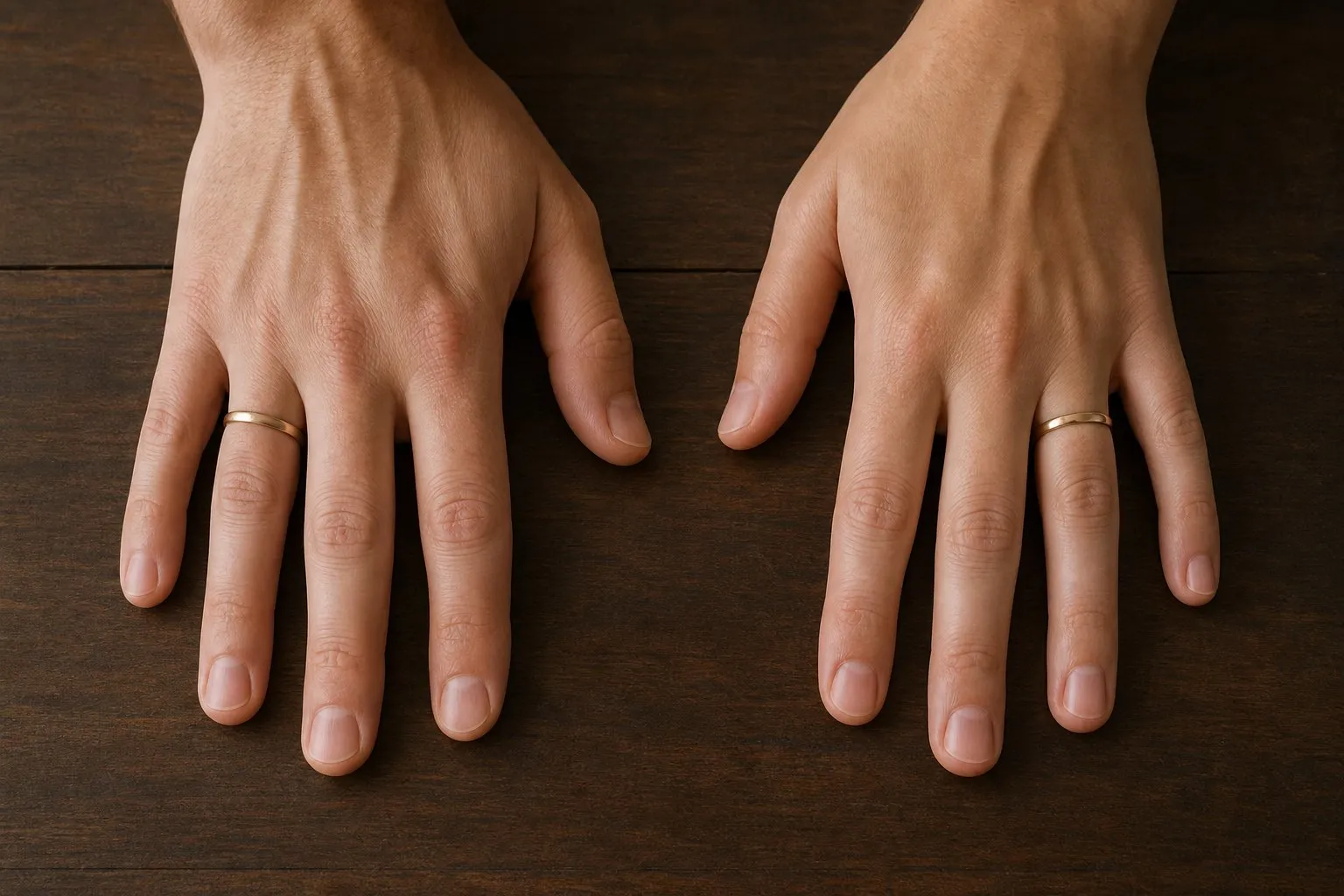
The left hand is standard in the US and most English-speaking countries, and the right hand is the tradition in several others and in some faiths. Each row keeps its own source: two are institutions writing about their own practice, two a general reference flagged as needing citations.
| Country or tradition | Hand while engaged | What the source is | Source |
|---|---|---|---|
| United States, UK, Ireland, Canada, Australia, New Zealand | Left ring finger | A 1662 liturgical text plus a general reference | Book of Common Prayer (1662); Wikipedia, Ring finger (2026) |
| Orthodox Christians (Greece, Russia, Serbia, Ukraine, Bulgaria) | Right ring finger is the tradition | The denomination’s own published answer | Orthodox Church in America (undated) |
| Germany and Austria | Wedding ring traditionally on the right | A German wedding ring maker writing about its own market | Fischer Trauringe (2025) |
| Turkey, Lebanon, Syria, Romania, Brazil | Right while engaged, moved to the left on the wedding day | General reference, section flagged as needing citations | Wikipedia, Ring finger (2026) |
| Jewish ceremony | Right index finger during the ceremony, often moved afterward | A Jewish education publisher | My Jewish Learning (2019) |
| Muslim and Indian weddings | A ring is not traditional; where worn, custom is local | General reference, section flagged as needing citations | Wikipedia, Ring finger (2026) |
Where the Right Hand Is Standard
The Orthodox Church in America states that Orthodox Christians traditionally wear their wedding rings on their right hands, not their left, that many American Orthodox still do while others choose the left, and that there is no Orthodox custom of switching the hand after the honeymoon. Fischer Trauringe, a German wedding ring maker, wrote in 2025 that in Germany the wedding ring is traditionally worn on the right ring finger.
Where the Ring Moves on the Wedding Day
In Turkey, Lebanon, Syria, Romania and Brazil the ring is worn on the right hand until the wedding day and then moved to the left, according to Wikipedia’s general reference on the ring finger, a section flagged as needing citations. A Jewish ceremony uses a different finger altogether: My Jewish Learning, in 2019, describes the groom placing the ring on the bride’s right index finger, and notes that many people move it afterward.
Where a Ring Is Not Part of the Custom
In some traditions the question has no ceremonial answer, because a ring is not part of the rite. The same general reference says a wedding ring is not a traditional part of the religious Muslim wedding, and that rings are not traditional in an Indian wedding, where men generally wear them on the right hand and women on the left.
What Happens to It on the Wedding Day
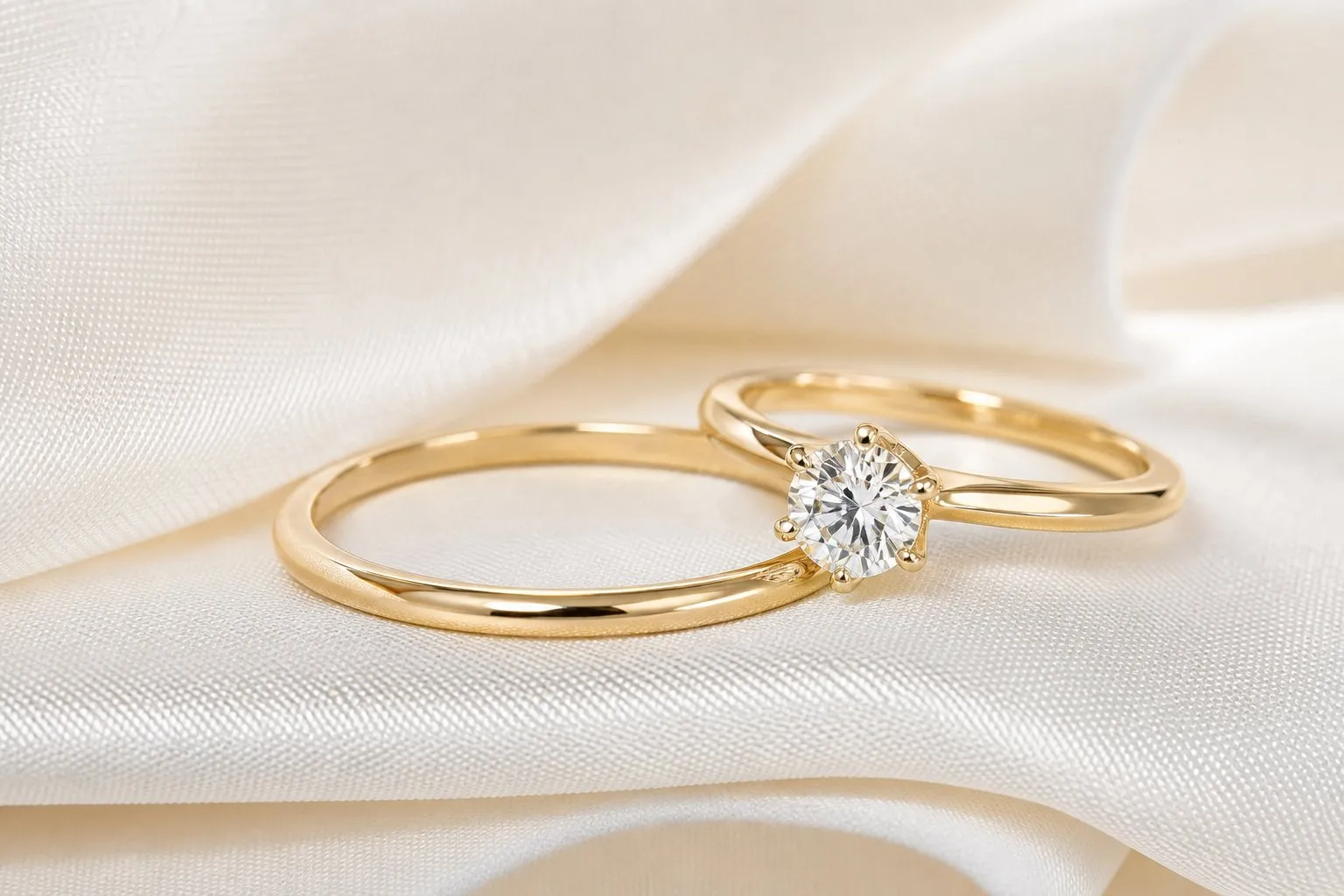
From the wedding day on, the engagement ring shares one finger with a band, and two questions follow that this page hands to the guides that answer them in full.
On the Day Itself
Etiquette in 1900 had the engagement ring come off for the ceremony, and Annie Randall White’s Twentieth Century Etiquette has it going back on afterward “to stand guard over its precious fellow.” That is one American etiquette writer in 1900, not a rule, and today it is a choice: our guide to whether you wear your engagement ring on your wedding day sets out what couples actually do and what the old instruction really said.
Every Day After
Two stacking orders are published and the GIA 4Cs guide, in 2025, describes both, plus a third route of the engagement ring on the right hand and the wedding band on the left. Which order, whether to solder the two rings together, and what two rings on one finger do to fit are all covered in how to wear an engagement ring and wedding band. Before any of it, find your ring size.
Where Should You Wear Yours?
Match your situation to the row that describes it.
| Your situation | Where the ring goes | Why |
|---|---|---|
| You live in the US and want the usual custom | Fourth finger, left hand | The standard in the US and most English-speaking countries |
| Your family is Orthodox, German or Austrian | Right ring finger, or left to match the US custom | Both are in use; the Orthodox Church in America notes many American Orthodox keep the right hand |
| You are marrying and want both rings on one finger | Band and engagement ring stacked, in either order | GIA publishes both orders and Brilliant Earth says there is no strict rule |
| The two rings rub, spin or will not line up | Ask a jeweler about soldering after the wedding | Brilliant Earth names spinning, misalignment and dissimilar metals as the reasons to solder |
| Your job or a swollen finger makes a ring impractical | Either hand, or off the hand during the task | Fit changes with activity, hydration and temperature, and no custom outranks safety |
Frequently Asked Questions
Does the Engagement Ring Go on the Left or Right Hand?
Left, in the United States and most English-speaking countries. The right hand is the tradition among Orthodox Christians, according to the Orthodox Church in America, and in Germany for the wedding ring, according to Fischer Trauringe in 2025. Families who came from a right-hand country often keep the habit here.
What Finger Does a Wedding Ring Go On?
The fourth finger of the left hand in the US, the very finger the engagement ring already occupies, which is why the two end up stacked together. Several countries and faiths use the right instead. Our separate guide to what hand a wedding ring goes on covers men, women and the country picture.
What Finger Do You Put the Ring On When You Propose?
Whichever finger the ring will live on afterward, so in the US that is the fourth on the left hand. No jeweler body or etiquette authority rules on the moment itself. If the size is a guess, passing the ring over beats forcing it on, and a resize later is routine work.
What Finger Does a Girl Wear an Engagement Ring On?
The fourth on her left hand in the US, exactly as for anyone else, because the custom does not vary by gender or by age. Counting the thumb as the first finger gets you to the right one. Some wearers shift the ring to the other hand for sport or work, which breaks nothing.
What Is the 3 Month Rule for an Engagement Ring?
There is no 3 month rule. No jeweler association or consumer body publishes one, and the three-months-of-salary idea has no named author. The only sourced figure is The Knot Worldwide’s 2026 Real Weddings Study, which puts the average US spend at $4,600 for couples married in 2025. More in what an engagement ring actually costs.
Sources
- Church of England, The Book of Common Prayer (1662): The Form of Solemnization of Matrimony, 1662.
- Aulus Gellius, Attic Nights, Book X.10 (Loeb translation by J. C. Rolfe, on LacusCurtius), Attic Nights, Book X, 1927.
- Hong, Innocenti and Hallock, Archives of Plastic Surgery, Congestion … Sinister … Vena Amoris … and the LOVE of Microsurgery, 2026.
- Pliny the Elder, translated by John Bostock and H. T. Riley (Perseus Digital Library), The Natural History, Book XXXIII, Chap. 4: The Origin of Gold Rings, undated.
- Pope Nicholas I, translated by W. L. North (Internet History Sourcebooks, Fordham University), The Responses of Pope Nicholas I to the Questions of the Bulgars A.D. 866 (Letter 99), 866.
- Orthodox Church in America, Wedding Bands (Questions & Answers), undated, accessed 11 September 2026.
- Fischer Trauringe (German wedding ring maker), Wedding ring left or right: Meaning and tradition at a glance, 2025.
- Wikipedia (general reference, section flagged as needing citations), Ring finger, 2026.
- My Jewish Learning, All About Jewish Wedding Rings, 2019.
- Annie Randall White (Internet Archive), Twentieth Century Etiquette, 1900.
- GIA 4Cs, How to Wear Your Engagement Ring and Wedding Band, 2025.
- Brilliant Earth, Engagement Ring & Wedding Band Rules: 18 Traditions Worth Breaking, 2026.
- Brilliant Earth, Soldered Rings: Pros, Cons, & Alternatives, 2026.
- Brilliant Earth, Comfort Fit Ring vs. Standard Fit Ring: What’s the Difference?, 2026.
- GIA 4Cs, Ring Size Guide: Tips and Ring Size Chart, 2018.
- The Knot Worldwide, The Knot Worldwide Unveils 2026 Real Weddings Study, 2026.