

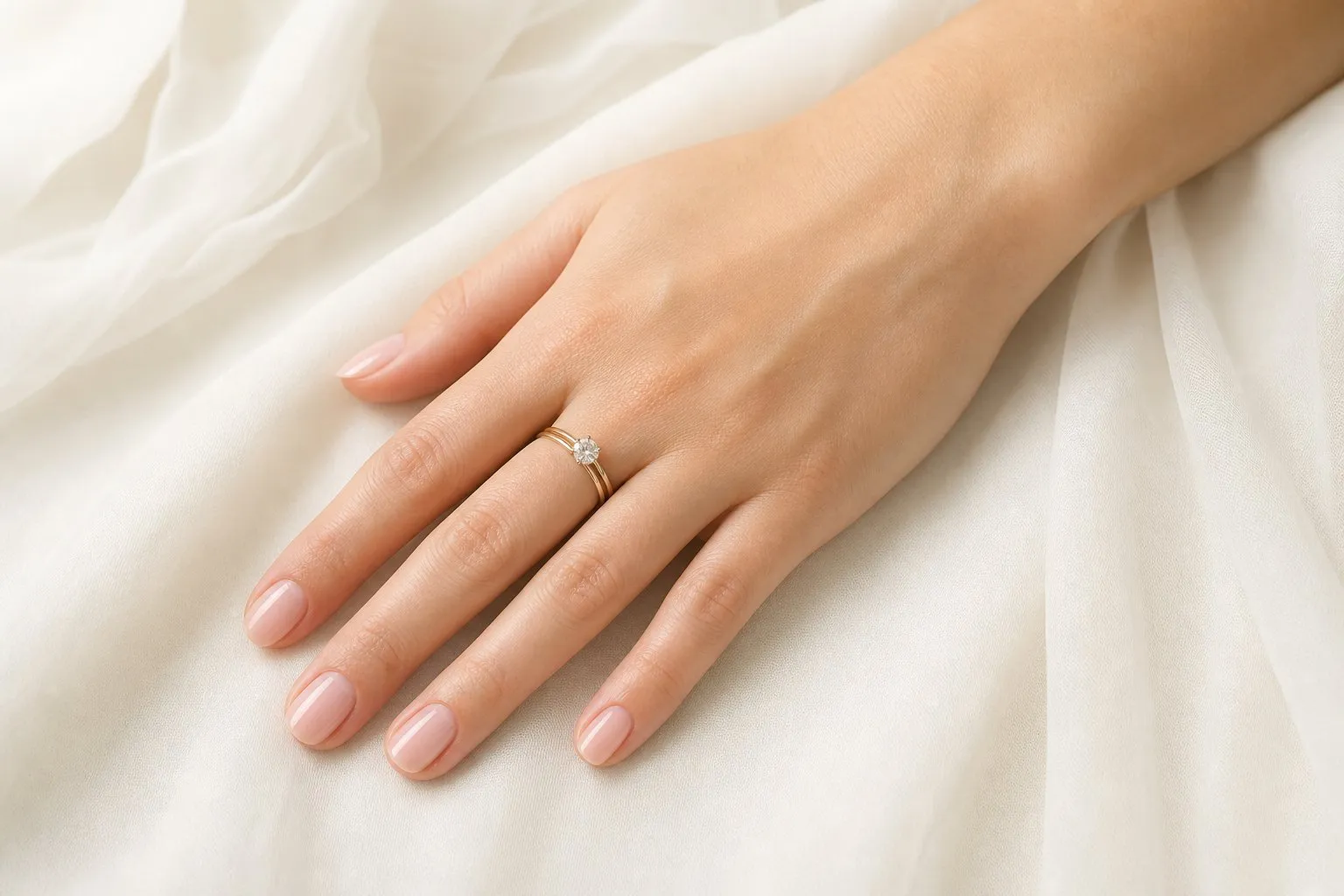
Do you wear your engagement ring on your wedding day? Yes, you can, and nothing obliges you to either way. Couples handle it in four ways: wear both rings, move the engagement ring to the right hand for the ceremony, hand it to someone to hold, or leave it at home until afterward. The rest of this guide covers each option, the walk down the aisle, the bad luck question and which ring goes on first once you are married.
What is on this page10 sections
Key Takeaways
- Nothing requires you to remove the ring, and we could not find a current authority that asks for it.
- Four routes: wear both rings, move the engagement ring to your right hand, take it off and put it back after, or leave it off.
- Annie Randall White’s Twentieth Century Etiquette, 1900, had the bridegroom remove it at the altar, with a plain band serving as the ceremony ring.
- Goodstone says there is no superstition requiring you to take the ring off, and that most brides move it to the right hand before the aisle.
- If the ring leaves your hand, decide beforehand who holds it, because a ring set down in a busy room is easy to lose track of.
The Four Things Couples Actually Do
These are options, not customs. We could not find a source that prescribes one over another, so pick on practical grounds.
| Option | What it involves | The catch | Basis |
|---|---|---|---|
| Wear both all day | The engagement ring stays on and the band goes on beside it during the ceremony | The band has to slide onto a finger that already has a ring on it | An option; no source prescribes it |
| Engagement ring on the right hand for the ceremony | It moves to the other hand for the vows and can move back afterward | It may sit differently on the other hand | GIA 4Cs, 2025, and Goodstone, 2026, describe this |
| Off before the ceremony, back on after | Removed earlier in the day or at the altar, returned above the new band | It has to come off, and somebody has to hold it | Prescribed by one American etiquette writer in 1900 |
| Left off the whole day | The ring stays at home or in a safe and goes back on afterward | One fewer thing on your hand, one more thing to remember | An option; no source prescribes it |
Wear Both, All Day
The simplest route leaves the engagement ring where it is, so your partner slides the band on over or beside it during the ceremony. The one thing to sort out is that the band has to pass a ring that is already on the finger, which is easier when the engagement ring sits low and the band is not a tight fit. Afterward you can swap the order in a quiet moment, and the everyday arrangement belongs to our guide to wearing both rings day to day.
Move It to the Right Hand for the Ceremony
GIA’s 2025 guide suggests you “consider wearing your engagement ring on your right hand and your wedding band on your left,” which it offers as one way of wearing two rings rather than as a wedding-day instruction. Goodstone’s 2026 article reports that most brides move the ring to the right hand before the aisle, which keeps the left ring finger clear for the band. The ring never leaves your hand, and it goes back to the left hand after the vows. For the hand question itself, see what hand a wedding ring goes on.
Hand It to Someone to Hold
This route needs the most planning, which is why a later section exists. The ring comes off earlier in the day, or is handed over just before the ceremony, and goes back on afterward. The cost is that you are relying on another person with an expensive object during a busy day.
Leave It Off Until Afterward
Some people leave the ring at home or in a safe and put it back on once the day is over. The honest appeal is one fewer thing to keep track of. Goodstone advises that if you are not wearing the ring, you “lock it somewhere safe rather than relying on another person.” If the ring spends the day somewhere other than your finger, insuring a ring is a separate subject.
During the Ceremony: Which Hand, and Who Holds It
The ceremony is the one stretch of the day where the ring genuinely matters, because it is the moment a second ring has to go onto your left hand. Everything else about the day is looser.
Down the Aisle on the Right Hand
If you want the left ring finger free, the right hand is where most people park the ring. Goodstone’s 2026 article says “most brides move their engagement ring to the right hand before walking down the aisle,” and that it returns to the left hand, above the band, after the vows. The article does not treat it as a rule, and the sources we read do not say that the ring must be off the left hand to walk down the aisle.
Practical points matter more than etiquette here. Move it in the morning, not in the vestibule, and check that it sits comfortably on the right ring finger for several hours. If you will be holding a bouquet or shaking many hands, a ring that spins on the wrong finger is more distracting than one that never moved. Your hands are also photographed more than any other part of you at a wedding, so the choice shows up in the album either way.
Who Keeps It While It Is Off
Goodstone says your maid of honor or a close family member can hold the ring until the ceremony ends, and that if you are not wearing it, you should lock it somewhere safe rather than rely on another person. We could not find a source publishing a rule about who should hold it, so a bridesmaid, a parent, the officiant or a zipped pocket are options rather than etiquette.
Whoever it is, tell them what they are carrying and where it goes when the ceremony is over. Put the ring in a small box or a ring dish, not a loose pocket, and agree a moment to hand it back, such as straight after the vows or before photographs. Do not leave this to the reception, when everyone is moving around and bags and jackets change hands.
Is It Bad Luck to Wear It?
This question shows up as a related search for the topic, so it deserves a straight answer. We could not find a named authority that says wearing the ring on the day brings bad luck, and Goodstone’s 2026 article answers that many brides wear the ring through the entire day without any issues and describes no superstition requiring removal.
What does exist is an old etiquette instruction, and it is about practice rather than luck. We cover it below.
Catholic and Other Ceremonies
The related search “Catholic” suggests people wonder whether a church ceremony changes the answer. We could not open a published rite or church rubric that says anything about the engagement ring, so we will not say what the Catholic rite requires. What the sources we read do say is practical: Goodstone advises talking to your officiant beforehand if your ceremony has specific requirements, and notes that Jewish weddings place the ring on the bride’s right-hand index finger during the ceremony. Both points are about the wedding ring that is exchanged, not a ban on wearing the engagement ring.
If you are marrying in a church or any ceremony with its own customs, ask the officiant at the rehearsal or earlier. It takes one question, and the answer comes from the person running the ceremony rather than from a retailer blog.
What Etiquette Actually Says, and How Old It Is
The etiquette language other pages reach for has one traceable origin, and it is older than most readers expect.
The 1900 Instruction
Annie Randall White’s Twentieth Century Etiquette, published in 1900, is the oldest dated instruction we found, and two details in it get lost when it is repeated. The bride was not the one doing the removing: “The engagement ring is removed at the altar by the bridegroom, who passes the wedding-ring (a plain gold band, with the date and the initials engraved inside) to the clergyman, to be used by him in the ceremony.” The ceremony ring was the plain band. That is what one American etiquette writer prescribed in 1900, and nothing binds you to it.
Why There Is No Modern Rule
We looked for a modern authority, a church rubric or a trade body publishing anything specific about the engagement ring on the wedding day, and found retailer blogs and forum threads. The retailers concede the ground themselves: Brilliant Earth wrote in 2026 that “there are no strict rules about which finger or hand the wedding ring should be worn on.” Treat the advice on this topic as a menu of options, and choose the one that suits your hands, your dress or suit and your ceremony.
After the Wedding: Which Ring Goes First
Once the day is over, the question changes from whether to wear the ring to how to wear two. GIA’s 2025 guide describes the traditional arrangement this way: “the wedding ring is placed on the finger first, with the engagement ring worn on top,” which it says symbolizes the wedding band, representing your vows, being closest to the heart. It adds that some brides prefer to wear the engagement ring first, followed by the wedding band, a method it calls less common that reflects the order in which the rings were received.
So the ring that is slid on during the ceremony ends up lowest on the finger if you follow the traditional order, and the engagement ring returns above it. If you choose the other order, the engagement ring stays closest to your hand and the band sits above it. Both are in published guidance, and neither is wrong.
Two practical points follow. First, the two rings will rub against each other all day, so a high-set stone can catch on a flat band, and some couples prefer a matched bridal set designed to sit together. Second, the full day-to-day detail, including stack order and how the rings wear over time, is in our guide to wearing an engagement ring and wedding band together. If the two rings are still a blur in your head, how an engagement ring differs from a wedding ring lays out the roles, and the engagement ring finger guide covers the hand.
The One Thing Worth Planning in Advance
Only one part of this question carries a real consequence, and it applies to the routes where the ring leaves your hand. It has to come off when you want it to, and then it has to be somewhere safe.
A ring that slides off easily at home may not behave that way on a warm day spent on your feet, when fingers can swell. Try removing and replacing it that morning rather than at the altar, and if it will not move, read getting a ring off a finger that has swollen before the day, not during it. The same rehearsal tells you whether the ring fits the other hand if you plan to switch.
Then decide where it goes. A named person, a small box and a set moment to hand it back cover most of the risk. Everything else on this topic is taste.
Which Option Fits Your Day?
None of the four is better in the abstract, so the useful question is which one suits the day you are actually having. Read the left column, then settle the last column before the week of the wedding.
| If this is true | What fits | Sort this out beforehand |
|---|---|---|
| You want the simplest version | Wear both all day | Which side of the band the engagement ring will sit on |
| You want your left ring finger clear for the vows | Move it to the right hand | Whether it fits and sits well on the right ring finger |
| The ceremony involves the ring being handed over | Off before, back on after | Who holds it, and where they keep it |
| It is a hot day, a long day, or you are on your feet | Anything that does not rely on removing it at the altar | Try taking it off that morning, not at the altar |
| You would rather not think about it at all | Leave it off the day entirely | Where it is kept while you are out |
For more on rings and the traditions around them, the guides hub lists everything in the same series.
Frequently Asked Questions
Do I take my engagement ring off when I get married?
You do not have to. Nothing we found requires removal, and Goodstone describes no superstition behind it. Many people wear both rings, and others move the engagement ring to the right hand for the ceremony and back afterward. The only dated instruction to remove it comes from an etiquette book published in 1900.
Are you supposed to stop wearing your engagement ring when you get married?
No source we found says you should stop. Most people keep wearing it after the wedding, either above or below the band. GIA describes the traditional arrangement as the wedding ring on first with the engagement ring on top, and also notes that some prefer the reverse. Which you choose is a style decision.
Is it bad luck to wear your engagement ring on your wedding day?
We could not find a named authority that says so. Goodstone’s 2026 article states that many brides wear the ring throughout the entire day without any issues and notes no superstition requiring removal. If your family or faith has its own custom, ask your officiant, since that answer is theirs to give.
Do you wear your engagement ring first or the wedding band?
GIA’s 2025 guide describes the traditional order as the wedding band on first, with the engagement ring on top, so the band sits closest to the heart. It also says some brides wear the engagement ring first, followed by the band. Both are published options, so pick the one that sits comfortably.
Do you wear your engagement ring down the aisle?
You can. Goodstone says most brides move it to the right hand before walking down the aisle so the left ring finger stays free, and it goes back above the band after the vows. Wearing it on the left hand is also fine, since the sources we read treat the aisle as personal preference, not a rule.
Can your engagement ring double as your wedding ring?
Yes. Nothing in the sources we read requires a second ring, so using one ring for both roles is a real choice, and the ceremony simply uses the ring you already wear. Buying the two as a matched pair designed to sit together is the opposite route, which is what bridal sets are.
Sources
- Annie Randall White (Internet Archive), Twentieth Century Etiquette, 1900.
- GIA 4Cs, How to Wear Your Engagement Ring and Wedding Band, 2025.
- Goodstone, Do You Wear Your Engagement Ring on Your Wedding Day? Etiquette and Options Explained, 2026.
- Brilliant Earth, Engagement Ring & Wedding Band Rules: 18 Traditions Worth Breaking, 2026.