

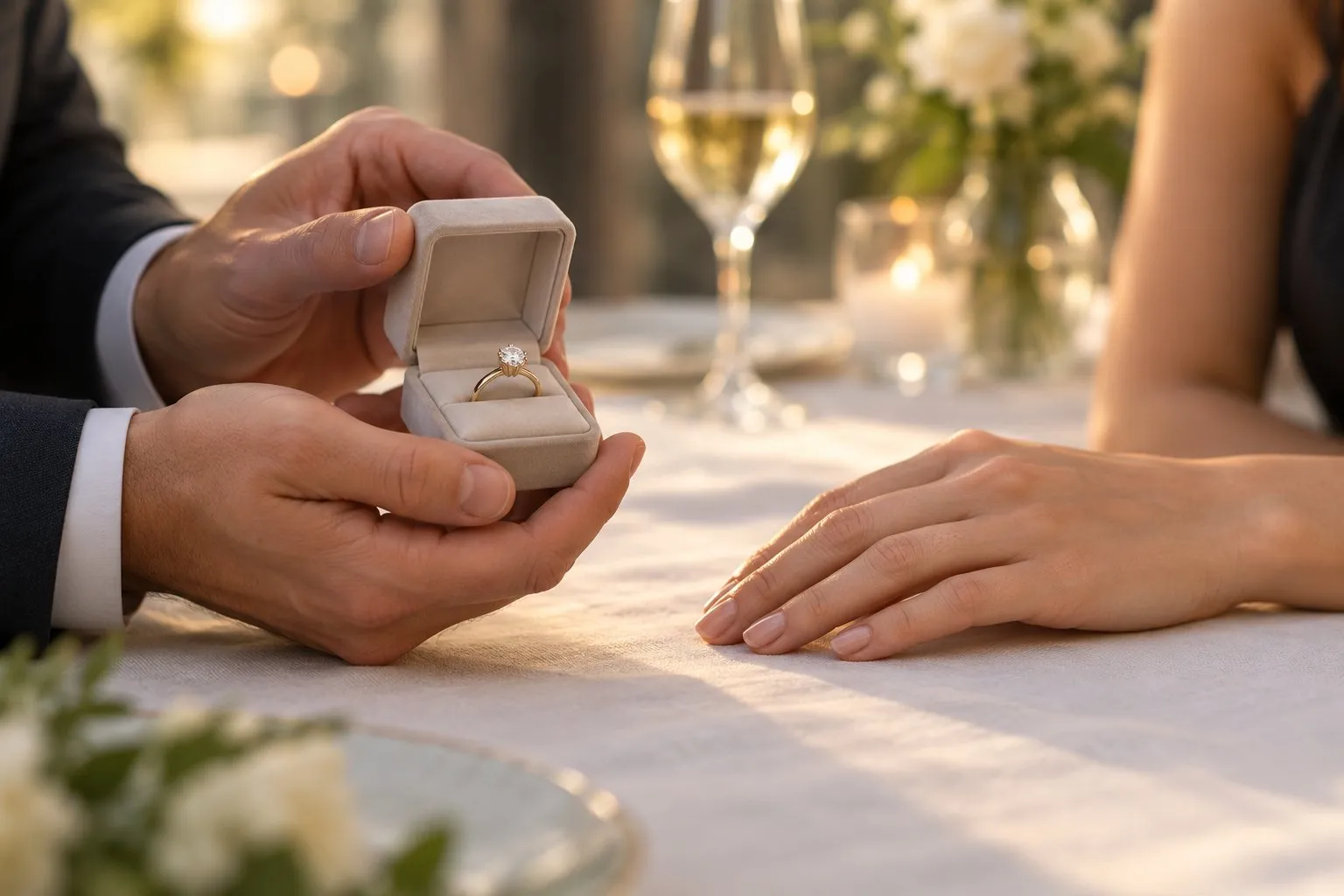
Engagement ring etiquette is a set of customs, not a binding rulebook: no body enforces it, and the sources that publish it describe tradition and say couples now do what suits them. The Emily Post Institute, reprinting a 1960 edition of Etiquette in 2025, described the ring itself as nothing more than evidence of a proposal, and that is a useful spirit to carry through the rest of this page. Below, who pays, who chooses, how to shop, how to wear it, and what happens if the engagement ends, with each claim tied to the source that makes it.
What is on this page10 sections
Key Takeaways
- Nothing written obliges anyone to pay for, choose or wear the ring in a particular way, so what follows is tradition, labeled as such.
- Brilliant Earth, a retailer, wrote in 2026 that the historical expectation is that men buy the engagement ring, and that couples now split the cost or set a budget together.
- The Emily Post Institute’s 2025 excerpt of its 1960 edition says the ring “is simply evidence that he proposed marriage and that she answered, ‘Yes!’”
- The three-months’-salary guideline traces to De Beers advertising, per Brilliant Earth in 2026, so it is a marketing figure rather than etiquette.
- If an engagement ends, who keeps the ring depends on the state, per FindLaw in 2026, and a family law attorney is the right person to ask.
What Etiquette Says, and What Couples Do Now
The table sets the traditional answer beside current practice for each question. Where a source is named, it is the one we opened for this page. Where none is named, we could not find a published authority and the row is plain custom.
| Question | What tradition says | What many couples do now |
|---|---|---|
| Who pays for the engagement ring | The proposer, historically a man1 | Split the cost or agree a budget together1 |
| Who chooses it | Kept secret until the proposal1 | Shop together so it suits the wearer’s taste1 |
| Who buys the groom’s ring | The bride buys it, per a 1960 etiquette book2 | Spouses buy each other’s rings, but not as a fixed rule1 |
| How much to spend | One month’s salary was the original advertising line1 | Choose a budget that fits your finances1 |
| Which hand | Left ring finger1 | Any hand or finger the wearer likes1 |
| If the engagement ends | Varies by state3 | Ask an attorney in your state |
3 sources cited in this table
Who Pays for the Engagement Ring
The answer has a traditional version and a modern one, and neither is wrong. Because it is the question people ask most, it deserves a plain answer before the details: whoever proposes has traditionally paid, and today the couple decides.
The Traditional Answer
Brilliant Earth’s 2026 guide to engagement ring and wedding band rules states that “the historical expectation is that men purchase the engagement ring, often without financial input from their partner.” That is a statement about history, and the same guide treats it as one of the traditions worth rethinking rather than a requirement. If you are keeping to tradition because it feels right to you both, that is a perfectly good reason. It is not an obligation.
Splitting the Cost
The same Brilliant Earth guide says couples may now split the cost equally or agree on a budget together. Practically, splitting tends to suit couples who already share their finances, who are buying a custom or higher-priced ring, or who simply find it odd to treat a purchase they will both live with as one person’s gift. Nothing about splitting changes how the ring is received or worn. If you go this route, settle the number before you shop, because a budget agreed in advance removes most of the awkwardness at the counter. For what that number might be, our guide on how much to spend on an engagement ring covers the budget question on its own.
Who Buys the Other Person’s Ring
Etiquette has more to say about wedding rings than people expect. The Emily Post Institute’s newsletter reprinted an excerpt from the 1960 edition of Etiquette in 2025, and it says: “If he is to have a wedding ring she buys that, of course!” Brilliant Earth, writing in 2026, says “traditionally, spouses purchase each other’s wedding rings, but this is not a fixed rule.” So the old custom of each partner buying the other’s band is the one most often cited, and it is also one that couples routinely adjust. Whether you buy yours separately, together, or as a matched pair is up to you, and our pages on wedding bands for men cover the options if the groom’s band is still open.
Who Chooses the Ring
Tradition says the ring is a surprise. Practice says many people would like a say. Both camps have a point, and the right call depends on how well you know your partner’s taste.
The Surprise
Brilliant Earth’s 2026 guide notes that traditionally the engagement ring is kept secret until the moment of the proposal. The appeal is obvious: the ring becomes part of the moment. The risk is just as obvious, because a surprise puts the whole job of reading someone’s taste on you. If you go this way, a few quiet checks help. Notice what metal they already wear, whether they favor simple or ornate pieces, and what they have said about rings they have seen on others. A trusted friend or family member can often confirm what you cannot ask directly, and a good return or resizing policy is a safety net, which is why the shopping section below puts policies on the list.
Choosing Together
Brilliant Earth also notes that many couples now shop together so the ring reflects the wearer’s taste. The Emily Post Institute’s excerpt makes a related point about the ring’s role: it is “simply evidence” of the proposal, and, in the same excerpt’s words, “the engagement ring is not essential to the validity of the betrothal.” Reading that, a ring picked together loses nothing as an object of meaning. A common middle path is to choose the setting and stone together and still keep the proposal itself a surprise. If you go that way, the ring on the day can be a placeholder, a simple band, or the real thing, depending on how long the made-to-order process takes.
Finding Out the Size Without Asking
Size is the practical obstacle to a surprise, and it is the one part of this question that has a clean fix. Options that do not require asking: borrow a ring they already wear on the same finger and measure it, or trace the inside onto paper. Our ring sizer tool walks through measuring a ring you already have. Whatever you do, plan for the possibility of a resize, because fit is hard to judge from a guess. Check the seller’s resizing terms before you buy, not after.
Engagement Ring Shopping Etiquette
Shopping etiquette is mostly common courtesy applied to a high-value purchase. No source we found publishes formal rules for it, so this section sticks to practical points and says where it is giving advice rather than citing one.
What to Bring and Wear
For an appointment in a store, comfortable, ordinary clothes are fine. Jewelers see people in everything from work clothes to suits, and nobody in the trade expects a dress code. What helps more than an outfit is a few things in your pocket: a rough budget, a few photos of styles you or your partner like, and the ring size if you know it. Wearing a ring you already own on the same finger gives the jeweler a quick sizing reference. It also helps to keep the metal you normally wear in mind, so you can say yes or no to white gold, yellow gold or platinum on the spot.
Budget and the Three-Month Rule
Say your budget out loud early. A good jeweler will work within it, and it saves everyone time. As for the three-months’-salary rule, Brilliant Earth’s 2026 buying guide says it dates back to a 1930s De Beers advertising campaign that recommended one month’s salary, and that by the 1980s the guideline had grown into a two-to-three-month rule. Brilliant Earth’s 2026 rules guide calls it increasingly seen as outdated and suggests a budget that fits your finances. So the figure is advertising history, not etiquette, and you can set it aside.
Appointments, Returns and Resizing
A few courtesies are practical rather than formal. Book an appointment if the store offers one, and tell them if you are buying for a proposal with a date, so lead times can be checked. Ask before you pay about returns, exchanges, resizing and engraving, in writing if you can. Policies differ from store to store and we do not publish them here, so read the seller’s own terms. If the ring is expensive, ask whether it is covered in transit and from the day you take it home; our guide to engagement ring insurance covers that side.
Wearing It
Wearing etiquette is where the old customs are most visible and the rules least firm. The ring goes on one hand, the band joins it later, and the day itself involves a small logistical choice.
Which Hand
Brilliant Earth’s 2026 guide says the traditional placement of the engagement ring is on the left hand’s ring finger, and attributes that to an old belief about a vein leading to the heart. The same guide says couples can choose any hand or finger. Our guide on what finger the engagement ring goes on covers the finger question and the regional differences in more depth, so we leave it there.
The Order with the Wedding Band
When the wedding band arrives, the usual question is how to stack the two. A common convention puts the band closest to the hand and the engagement ring above it, but it is a convention and the reverse order is also in print. Our guide on how to wear an engagement ring and wedding band sets out who publishes which order, and what soldering the pair commits you to. If you buy a matched set, the order is usually settled for you by how the pieces are designed to nest.
On the Wedding Day
The remaining question is whether the engagement ring stays on for the ceremony. There are four options couples take, and nothing in the etiquette sources we found requires any one of them. The simplest is to leave it on and let the band go on beside it. Our guide on whether you wear your engagement ring on your wedding day compares all four and flags the one practical catch, which is that a ring you plan to remove has to come off easily on the day.
If the Engagement Ends
This is the part of ring etiquette that stops being etiquette and becomes law, and it varies. What follows is general information, not legal advice. For a specific situation, speak to a family law attorney in your state.
FindLaw, in an article last updated July 14, 2026, says many courts treat an engagement ring as a conditional gift given in anticipation of marriage. In that view, if the wedding does not happen, the giver has the right to the ring back. FindLaw describes three broad approaches. Some states follow a fault-based rule, under which the person who called off the wedding cannot keep the ring; it names Alabama, Alaska, Kentucky, New Hampshire and Massachusetts. Others follow a no-fault rule, under which the ring returns to the giver whoever ended the engagement; it names Iowa, Kansas, New Jersey, New Mexico, New York and Wisconsin. FindLaw says Montana treats the ring as an unconditional gift that the receiver keeps, and that California can differ depending on whether both sides agreed to end the engagement.
Beyond the law, there is the question of courtesy, which no source can settle for you. Returning the ring promptly and quietly, or settling it by agreement, are the courteous routes. A short written note about what you have agreed is worth having if the ring is valuable. Whatever you decide, check the current rule for your own state before you act, because the sources above describe a position that can change.
Which Etiquette Choice Fits You
Use the table as a quick way to decide, not as a rule.
| Your situation | A sensible way to handle it | Why |
|---|---|---|
| You want the ring to be a complete surprise | Learn the size discreetly, check the resizing policy, and keep the receipt | The surprise works only if the fit can be fixed afterward |
| You would rather your partner has a say | Choose the setting and stone together, keep the proposal itself a surprise | You get a ring they like and still keep the moment |
| Your finances are shared | Agree on a number and split the cost | Brilliant Earth, 2026, notes that couples now do this |
| You want to follow tradition closely | The proposer pays, the ring is a surprise, left ring finger | It matches what Brilliant Earth, 2026, calls the historical expectation |
| You are unsure about the budget | Pick a figure that fits your finances and ignore the salary rule | The rule traces to De Beers advertising1 |
| The engagement ends | Check your state’s rule and talk to an attorney | FindLaw, 2026, says the rule varies by state |
1 source cited in this table
Frequently Asked Questions
What do you wear to go engagement ring shopping?
Comfortable everyday clothes are fine, since jewelers see every style and no source we found sets a dress code. More useful than an outfit is what you bring: a budget, photos of styles you like, a known ring size, and any ring you already wear on the same finger for a quick sizing check.
What is the 3 month rule for rings?
It is the idea that an engagement ring should cost about three months of salary. Brilliant Earth says it dates to a 1930s De Beers advertising campaign that began with one month’s salary and grew to two or three months by the 1980s. It is a marketing figure, not etiquette, so choose a budget that fits your finances.
What order do you wear rings on a wedding finger?
A common convention puts the wedding band on first, closest to the hand, with the engagement ring above it so the band sits nearer the heart. The reverse order is also published, and neither is a rule. Soldered or matched sets can settle it for you. Our wearing guide sets out both orders and who publishes them.
Why do you not wear your engagement ring on your wedding day?
Many people do wear it, and nothing requires them not to. Those who remove it usually do so for practical reasons, such as moving it to the other hand for the vows or keeping the ring finger free for the band. It then goes back on after the ceremony, usually above the new band.
Sources
- Emily Post Institute, “Etiquette Throwback 1960: Emily Post, Etiquette, Engagement Ring and Gift Etiquette,” 2025. https://emilypost.substack.com/p/etiquette-throwback-1960-emily-post-e72
- Brilliant Earth, “Engagement Ring & Wedding Band Rules: 18 Traditions Worth Breaking,” updated August 6, 2026. https://www.brilliantearth.com/guides/engagement-ring-and-wedding-band-rules/
- Brilliant Earth, “What Is the 3-Month Salary Rule?,” updated August 5, 2026. https://www.brilliantearth.com/engagement-rings/buying-guide/engagement-ring-salary-rule/
- FindLaw, “What Happens to the Engagement Ring in a Broken Engagement?,” updated July 14, 2026. https://www.findlaw.com/family/marriage/what-happens-to-the-engagement-ring-in-a-broken-engagement.html